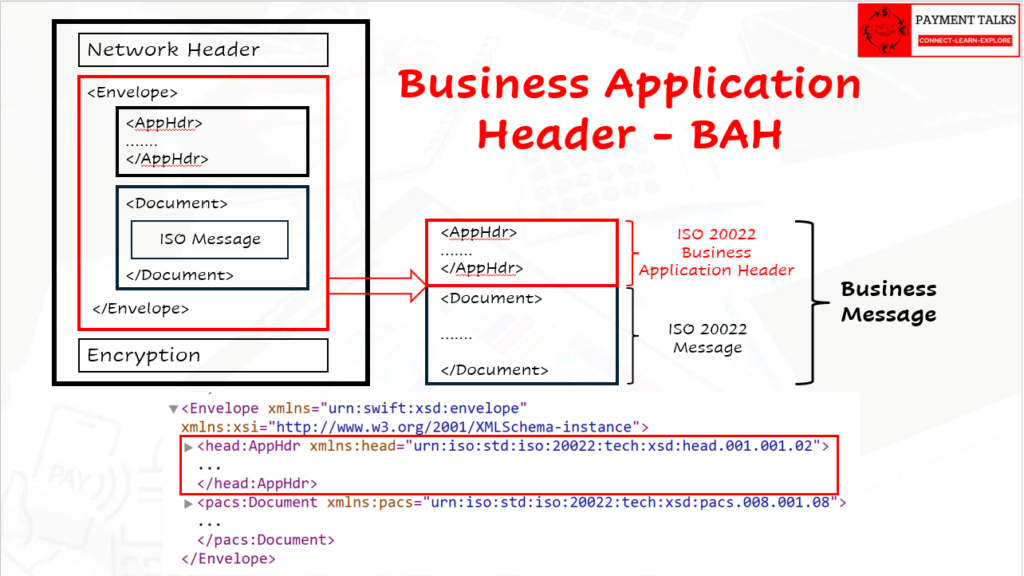
The Business Application Header (BAH) is a foundational concept in ISO 20022 messaging.
It plays a crucial role in routing, identifying, securing, and contextualizing business messages—no matter which network transports them.
What is the Business Application Header (BAH)?
- The BAH is itself defined as an ISO 20022 message — message definition identifier starting with head.001.xxx.nn (e.g. head.001.001.03), root element <AppHdr>.
- When you combine a BAH (the header) with a regular ISO 20022 business message (e.g. pacs.008, pain.001, camt.053, etc.), the result is called a Business Message — i.e. the complete ISO 20022 message exchange unit.
- The BAH is not part of the business data model itself (i.e. it does not carry payment amounts, debtor/creditor, remittance info, etc.). Instead, it carries metadata about the message: who sent it, who should receive it, when it was created, what type of message it is, and other control information.
- The goal: provide a consistent, harmonized, predictable way to send metadata with any ISO 20022 business message — regardless of the underlying network or transport protocol. That way, routing, filtering, processing, duplicate detection, auditing, and automation become simpler.
In short: BAH = “header metadata” for ISO 20022 messages; ISO business payload = “the actual business data”.
What Is the Group Header?
The Group Header (GrpHdr) is a standard structural block used in many ISO 20022 messages — especially those that contain a set of transactions grouped together.
GrpHdr is business-level metadata
It includes:
- Who initiated the message
- When it was created
- The message identifier (MsgId)
- Control sums and no of transactions
- Overall service level
- Settlement Information
- Additional business parameters
Important:
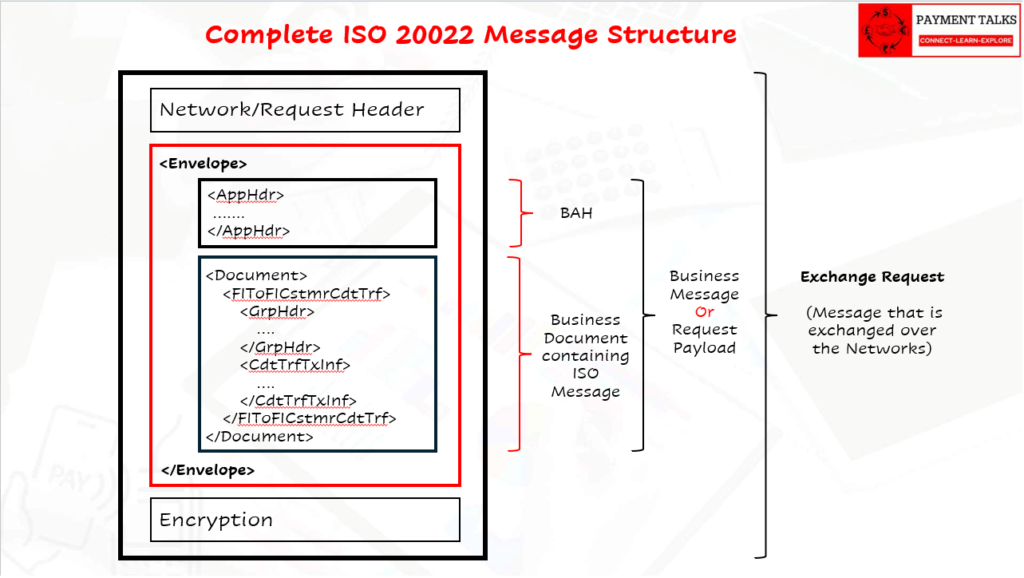
The Group Header is part of the business content, unlike the BAH (Business Application Header) which is transport-level metadata.
It is only present in messages that contain a group of transactions.
Examples: PACS08, PACS09, PAIN01, CAMT52, CAMT53, etc.
Complete Generalised ISO 20022 Message Structure
Group Header vs BAH — Full Comparison Table
| Aspect | Group Header (GrpHdr) | Business Application Header (BAH / AppHdr) |
| Layer | Inside ISO message (<Document>) | Outside ISO message as <Envelope> header |
| Purpose | Business metadata for the batch of transactions | Technical/business-message metadata for routing, identification, duplication control |
| Who uses it? | Payment engines, batch processors, CSMs, banks | Networks (SWIFT), gateways, message routers, interbank systems |
| Mandatory? | Only in messages that define it (pacs/pain/camt batches) | Optional per ISO, mandatory only in some schemes (e.g., CBPR+) |
| Scope | Applies only to the content of that specific message instance | Applies to the entire business message, regardless of type |
| Contains sender/receiver? | Available in most cases but optional. | Yes (Fr/To) |
| Duplicates allowed? | Yes, business fields may overlap with BAH | Yes, BAH does not prevent duplication inside the Document |
What Does the BAH Contain (Key Elements & Their Purpose)
Here are the main elements of the BAH, what they mean, and why they matter. (Note: depending on the implementation or community profile, some elements may be optional or unused.)
Note: BAH standard only mandates Fr, To, BizMsgIdr, MsgDefIdr, CreDt. Everything else is conditional or optional depending on the service.
| Tag | Meaning | Usage / Purpose | Remarks |
| AppHdr | Root element of Business Application Header | Wraps all BAH information | Part of ISO 20022 header layer (not part of business document) |
| CharSet | Character Set | Declares the character set, in addition to Latin, that is contained in the Business Document | This element is intended for use once extended character sets are implemented, whereby the string represented in this element can enable any necessary network validations, such as a closed user group for that character set. |
| Fr | From (Sender Identification) | Declares who is sending the message. Can be Party or Agent | Always mandatory. In CBPR+, it identifies Agent/FI. |
| To | To (Receiver Identification) | Identifies the destination . Can be Party or Agent | Always mandatory. In CBPR+, it identifies Agent/FI. |
| BizMsgIdr | Business Message Identifier | End-to-end unique message identifier assigned by sender | Must be unique for 90 days. In CBPR+, the content of this element should match the Group header -> Message Identification of Business Document. |
| MsgDefIdr | Message Definition Identifier | Name of the underlying ISO business message | Example: pacs.008.001.08, pacs.009.001.08, camt.053.001.08, etc. The content of this element should match the Business Document |
| BizSvc | Business Service | Identifies the service like CBPR+ or SEPA scheme. The data represented in this elements is referred to as a Usage Identifier. When updated usage guidelines are released, Business Service is incremented. | These values may be used together with the Message Definition Identifier to determine routing rules to specific applications without having to open the business document. Example: 1) pacs.009.001.08 + swift.cbprplus.cov.01 = Financial Institution (Cover) Credit Transfer 2) pacs.009.001.08 + swift.cbprplus.01 = Serial Financial Institution Credit Transfer |
| MktPrctc | Market Practice | “Specifies the market practice to which the message conforms. The market practices are a set of rules agreed between parties that restricts the usage of the messages in order to achieve better STP (Straight Through Processing) rates” | “A market practice specification may also extend the underlying message specification by using extensions or supplementary data of this underlying message” |
| CreDt | Creation DateTime | Timestamp of when header was created | UTC ISO 8601 format |
| BizPrcgDt | Business Processing Date | “Processing date and time indicated by the sender for the receiver of the business message. This date may be different from the date and time provided in the CreationDate” | Usage: Market practice or bilateral agreement should specify how this element should be used |
| CpyDplct | Copy/Duplicate indicator | Indicates if the message is original, copy, or duplicate. Mainly used for CAMT messages. | Values: CODU, COPY, DUPL |
| PssblDplct | Possible Duplicate | Indicates suspicion of duplication | Boolean (true/false) |
| Prty | Message Priority | Normal vs. Urgent | SWIFTNet may override |
| Sgntr | Digital Signature | Provides message-level signing | Rare; used in some markets |
| Rltd | Related Reference | Used in responses or follow-up messages. Can be used when replying to a query; can also be used when canceling or amending. | Links original and follow-up headers. Example, in a pacs.004 Payment Return the Related Business Application Header from the original message can be included |
Why BAH Matters — What Problems It Solves
Consistency across networks and systems
Because BAH is a standard header definition, any ISO 20022 system adopting it can rely on the same metadata layout — regardless of underlying transport (SWIFTNet, AS4, proprietary RTGS, API, etc.). This reduces fragmentation.
Simplified routing & automation
Rather than parsing the full business payload, routing engines or gateways can inspect BAH quickly (sender, receiver, message type, business service) and decide where to send the message. This speeds up screening, filtering, routing, prioritisation etc.
Robust message tracking, deduplication & auditing
With a unique BizMsgIdr, plus timestamps and possible duplicate indicators, recipients can efficiently detect duplicates, reconstruct message history, audit flows, and avoid double processing — even if messages traverse multiple hops or gateways.
Flexibility: works with or without transport-level headers
Because BAH is agnostic to network protocols, it doesn’t assume anything about transport. Whether you send via SWIFT FINplus, AS4, REST API over HTTPS, MQ or other means — BAH sits in the business layer, not the transport layer.
Harmonisation across message types & domains
Different ISO 20022 business messages (payments, securities, trade, etc.) can all reuse the same BAH structure. That avoids reinventing “header metadata” for each domain and reduces duplication in schema definitions.
What BAH Does — and What It Does Not Do (Caveats & Common Misunderstandings)
- BAH does not replace message-internal headers (like GrpHdr, CtrlSum, transaction lists, business-specific fields). It only provides metadata about the message at the transport/business message level.
- BAH is optional in ISO 20022 — not mandatory for every message per the standard. It’s a feature / extension defined by the community.
- Use and enforcement depend on the community (or rail / scheme). For instance, in some implementations the BAH is mandatory (e.g. CBPR+), in others it may be ignored or bypassed, or replaced by transport-level headers or scheme-specific wrappers.
- There is no single “binding definition” across all ISO 20022 messages. Because the ISO 20022 schema generation process creates separate XML namespaces per message definition, there’s no standard single “message + header” envelope defined in the base standard. That means implementers must decide how to combine BAH + business message in their environment. Consequently, different communities handle BAH differently
— some embed it, some use external wrapping envelopes, some rely on network headers instead.
How BAH Is Used in Real-World Systems & Payment Rails
Here’s how BAH fits into different real-world ISO 20022 ecosystems and message flows:
CBPR+ (SWIFT MX / FINplus)
- For cross-border ISO 20022 payments (pacs, pain, camt) over SWIFT, the BAH is considered mandatory.
- In practice: the business message sent over SWIFT includes <AppHdr> (BAH) + <Document> (business payload). Network-level headers (SWIFT FINplus envelope) wrap that.
- This layering allows SWIFT gateways and intermediary banks to quickly route, validate, and forward messages based on BAH metadata, without parsing the full payload.
RTGS, Large-Value Systems, Domestic Payments (if ISO-based)
- Many modern RTGS systems — especially those migrating to ISO 20022 — may adopt BAH to maintain consistency, enable automation and enable interoperability across banks/infrastructures.
- Because BAH is transport-agnostic, such systems can use it whether they operate over SWIFT, proprietary messaging, APIs or internal gateways.
Customer-Bank Flows, SEPA-like Schemes, Legacy Systems
- In some “customer-to-bank” or “bank-to-customer” flows, or in schemes designed before BAH existed (or which do not adopt it), the header may not be used. Instead, only the business message payload (with its own internal headers such as GrpHdr) is exchanged, possibly inside a file or batch envelope (file header, batch header), or protocol header (e.g. HTTP, SFTP).
- In these cases, metadata such as sender/receiver or message ID might be inside the business message body (e.g. in GrpHdr), or carried in the transport header — which is one reason BAH was invented (to standardize across both use cases).
Why BAH Doesn’t Prevent Duplication of Data — and Why That Matters
One of the FAQ points emphasizes: (Link to FAQ: https://www.iso20022.org/catalogue-messages/additional-content-messages/business-application-header-bah)
“The use of the BAH does not preclude the duplication of its elements in the ISO 20022 message definitions.”
What this means:
- Even if you use BAH, some ISO business messages may still repeat metadata (message ID, creation time, sender/receiver info, etc.) inside their own structure (e.g. inside GrpHdr of a pacs or pain message).
- That duplication is allowed and sometimes necessary because:
- Some systems or counterparties may ignore BAH and rely only on message-internal data.
- Some flows (customer-to-bank, batch processing, legacy systems) were defined before BAH existed — they expect metadata inside the business message.
- For backward compatibility and flexibility across diverse rails and schemes.
So BAH adds a layer of standard metadata, but does not eliminate in-message metadata. Implementations and downstream processors must be able to handle possible duplication and define precedence/rules (e.g. trust BAH over internal fields, or vice versa).
Security, Integrity & Signature Support
- BAH supports inclusion of a digital signature (<Sgntr> element) — enabling message-level signing, not just transport-level.
- This is important for non-repudiation, message integrity, audit trails — especially in interbank, cross-border, or high-value flows.
- Because BAH sits outside the business payload but travels with it, signature covers the entire “business message” (header + payload), strengthening end-to-end integrity.
When to Use BAH — Practical Guidance & Trade-Offs
Use BAH when:
- You operate in a multi-bank or multi-rail environment (cross-border, RTGS, correspondent banking)
- You want consistent routing, automation, deduplication, auditability across networks
- You need message-level metadata standardised and independent of transport
- You foresee future upgrades or migration (versioning)
Be cautious/aware when:
- Some counterparties or networks don’t support BAH — then you’ll need fallback handling (message-internal metadata or transport header)
- You need to decide how to bind BAH + business message — custom envelope, namespace import, or embedded header
- Your business message also contains internal metadata (GrpHdr, control sums, etc.), so you must define which metadata (header vs. internal) is authoritative
Conclusion: BAH in Today’s ISO 20022 Landscape
- Allows standardised routing, validation and automation
- Simplifies interoperability across networks (SWIFT, RTGS, API, proprietary rails)
- Improves message traceability, deduplication, auditing
- Let’s implementers evolve business message definitions without repeating metadata logic
At the same time, because BAH is optional and because ISO 20022 was designed with flexibility, diverse implementations will coexist: some using BAH, some using internal metadata, some using transport headers, sometimes mixtures of all.