
Why Payment Identifiers in ISO 20022 Matter
I have sat in war rooms where a payment return sat stuck for two days, and the money was never the problem. The problem was that nobody in the room agreed on which ID actually identified the transaction. Payment Identifiers in ISO 20022 exist to prevent exactly that argument, and when a team does not know them field by field, that argument is exactly where the delay comes from.
Every payment that moves through the financial system carries a story. A corporate initiates a payment. It travels through a Debtor Bank, sometimes an Intermediary or Correspondent Bank, sometimes a Clearing System, and finally reaches a Creditor Bank on the other side. Multiple parties handle the same transaction along that route, and each one generates its own records, its own logs, its own reconciliation entries. If you want the full cast of parties involved in that journey, I cover it separately in All Agents and Parties in an ISO Payment Message.
So how do all these parties know they are talking about the same payment? The answer is a structured set of reference fields inside every ISO 20022 message, each one owned by a specific party, each one governed by a clear rule about when it can change and when it must not. Get the ownership or the change rule wrong, and you get exactly the kind of stuck return I opened with.
This guide walks through every Payment Identifier in ISO 20022: who creates it, which messages carry it, whether it survives the payment chain, and what actually happens to it when a payment gets returned or rejected. That last part is where most teams get caught out, and I have added a dedicated section on it later in this guide.
What Are the Three Levels of Payment Identifiers?
Before going field by field, categorize first. That is the first thing I do on a whiteboard before touching a single tag name. Every identifier in ISO 20022 operates at one of three levels:
- Message-level: identifies the ISO 20022 message itself, the envelope carrying everything inside it.
- Batch Instruction-level: identifies a group of transactions, or a single payment instruction, within that message.
- Transaction-level: identifies one individual credit transfer, from origin to final destination.
Once you know the level, one question does most of the remaining work: does this ID get created fresh at every hop, or does it stay exactly as assigned from start to finish? That single distinction is the mental model I use every time I walk a team through this:
- Point-to-Point identifiers: created fresh at each hop. They identify the current sender’s instruction to the next party only, and they are not designed to travel end-to-end.
- End-to-End identifiers: created once and must not change, no matter how many banks or systems the payment passes through.
- Scope-limited identifiers: only meaningful at a specific point in the chain, such as inside a PAIN.001 file or inside a clearing system.
If you want the broader building blocks this sits inside, I break those down separately in Fundamentals of ISO 20022 and Understanding the Building Blocks of ISO 20022.
The 7 Payment Identifiers in ISO 20022: A Quick Reference Table
With that mental model in place, here is the full family as defined in the ISO 20022 Official Registry, before we go deep into each one individually. This table alone resolves most of the confusion I see in production:
| Identifier | XML Tag | Assigned By | Changes During Payment? | Appears In |
| Message ID | MsgId | Sender of each message | Yes, new at every hop | PAIN.001, PACS.008, PACS.009 |
| Payment Information ID | PmtInfId | Corporate / Initiating Party | Not propagated beyond Debtor Agent | PAIN.001 only |
| Instruction ID | InstrId | Sender of each message | Yes, changes at every hop | PAIN.001, PACS.008, PACS.009 |
| End-to-End ID | EndToEndId | Corporate / Debtor | Never changes | PAIN.001, PACS.008, PACS.009 |
| Transaction ID | TxId | First Instructing Bank (Debtor Agent) | No, unchanged after assignment | PACS.008, PACS.009 |
| UETR | UETR | Debtor Agent (or Corporate via GPI) | Never changes | PAIN.001, PACS.008, PACS.009 |
| Clearing System Reference | ClrSysRef | Clearing Infrastructure | No, generated once at clearing | PACS.008, PACS.009 |
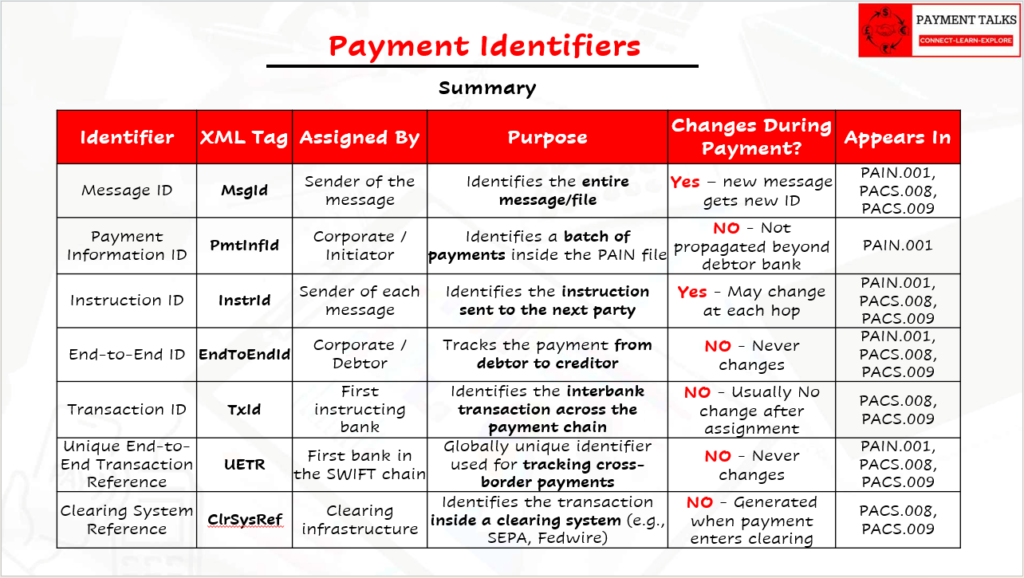
[VISUAL 1: Table graphic summarising the 7 ISO 20022 payment identifiers, their XML tags, and who assigns each one.]
Each Payment Identifier Explained, Field by Field
Message Identification (MsgId)
What it is: the unique reference assigned to the ISO 20022 message as a whole, the identifier for the envelope carrying all the content inside it.
Who creates it: the sender of each message, whether that sender is a corporate, a bank, or a payment system, assigns their own MsgId to every message they create.
Where it appears: in the Group Header (GrpHdr) of every ISO payment message: PAIN.001 (CustomerCreditTransferInitiation), PACS.008 (FIToFICustomerCreditTransfer), and PACS.009 (FinancialInstitutionCreditTransfer). The Group Header sits alongside the Business Application Header structure I cover separately in ISO 20022 Business Application Header (BAH), and the two get confused often enough that it is worth reading both.
What it covers: the entire message, which may contain multiple payment batch instructions and multiple individual transactions.
Key rule: the MsgId is a point-to-point reference. Because each bank creates a new message when forwarding a payment to the next party, the MsgId changes at every hop. It is not designed to travel end-to-end, and that is exactly why so many recon builds get into trouble with it. More on that in the misconceptions section below.
Example: When ABC Manufacturing Ltd sends a PAIN.001 to Barclays Bank containing payment instructions for 10 suppliers, one MsgId covers that entire file. When Barclays forwards the first payment onward to Citi as a PACS.008, it creates a brand new MsgId for that message.
Payment Information Identification (PmtInfId)
What it is: a batch-level reference identifying a group of payment instructions within a PAIN.001 file that share the same payment characteristics, such as the same Debtor, the same payment date, or the same payment method.
Who creates it: the Corporate or Initiating Party, assigned at the point of payment initiation. For the full field-by-field breakdown of a PAIN.001 file, see PAIN.001 Fields Explained: A Complete Guide and What Is PAIN.001?.
Where it appears: in the Payment Information block (PmtInf) of PAIN.001 only. It does not appear in PACS.008 or PACS.009.
What it covers: a subset of transactions within the PAIN.001, the batch or payment group. A single PAIN.001 can contain multiple PmtInf blocks, each with its own PmtInfId.
Key rule: the PmtInfId is not propagated beyond the Debtor Agent. Once the payment leaves the Debtor Bank and enters the interbank chain, this identifier has no further relevance. In CBPR+ cross-border flows, batches are not permitted, so per CBPR+ Usage Guidelines, the same value is typically used across MsgId, PmtInfId, and InstrId for a single-transaction PAIN.001.
Field trap: that same-value pattern is correct under CBPR+. I have seen teams take it and apply it as if it were a universal ISO 20022 rule, reusing one value across MsgId, PmtInfId, and InstrId on domestic rails that support batching. It does not hold. The moment a rail supports batches, forcing a single shared value across those three fields breaks the batch structure in production, and you find out in the worst way: during a live run.
Example: ABC Manufacturing sends a PAIN.001 to Barclays Bank with two payment groups, one batch of EUR payments and one batch of USD payments. Each group carries its own PmtInfId. When Barclays processes and forwards the individual payments as PACS.008 messages, neither PmtInfId appears again.
Instruction Identification (InstrId)
What it is: the reference identifying the specific instruction a sender is sending to the next party in the chain. It operates at the transaction level, one InstrId per transaction, per hop.
Who creates it: the sender of each message. The corporate assigns one in PAIN.001, and each bank assigns a new one in every PACS.008 it sends.
Where it appears: in the transaction-level blocks of PAIN.001, PACS.008, and PACS.009.
What it covers: a single transaction, in a single bilateral exchange between two parties.
Key rule: the InstrId is a point-to-point reference, changing at every hop. It identifies the instruction from the current sender to the immediate next party only. The Clearing System does not assign an InstrId.
Example: ABC Manufacturing sends a PAIN.001 to Barclays with InstrId = I1 for a payment to a US supplier. Barclays forwards it to Citi as a PACS.008 with InstrId = I2, Barclays’ own instruction to Citi. Citi then sends it to the Creditor Bank with InstrId = I3. The value changes at every step, because each bank’s instruction to the next party is a distinct instruction.
End-to-End Identification (EndToEndId)
What it is: the corporate’s tracking reference for the payment, a single value assigned at the point of initiation that must travel unchanged from the Debtor all the way to the final Creditor.
Who creates it: the Corporate or Debtor, assigned in the PAIN.001 at the point of initiation.
Where it appears: in the transaction-level blocks of PAIN.001, PACS.008, and PACS.009. It is the only identifier that appears in all three message types and remains constant across all of them.
What it covers: one individual transaction, tracked across the full payment journey from Debtor to Creditor, through every bank, correspondent, and clearing system.
Key rule: no bank, intermediary, or clearing system is permitted to alter the EndToEndId. It passes through every hop exactly as the corporate assigned it. Of the transaction-level identifiers in PAIN.001, it is the only one created by the corporate rather than a financial institution, and that ownership is exactly why it gets confused with TxId. More on that next.
Example: ABC Manufacturing sends a payment to Tanaka Electronics with EndToEndId = PAY-2025-INV-4471. The payment travels through Barclays, Citi, and MUFG Tokyo. When MUFG credits Tanaka’s account and sends a CAMT.054 notification, EndToEndId = PAY-2025-INV-4471 appears in that notification unchanged, and Tanaka’s ERP automatically matches the credit against invoice INV-4471.
Transaction Identification (TxId)
What it is: the interbank reference for the payment transaction, tracking the transaction as it moves across the financial institution chain.
Who creates it: the first instructing bank, the Debtor Agent. This is the distinction that trips people up the most: the TxId is not assigned by the corporate. It enters the picture only once the payment moves into the interbank space.
Where it appears: in the transaction-level blocks of PACS.008 and PACS.009 only. It does not appear in PAIN.001.
What it covers: one individual transaction, across the interbank payment chain, from the Debtor Agent onward.
Key rule, and the one that costs the most time in production: once the Debtor Agent assigns the TxId, it is passed unchanged through every subsequent bank in the chain. Unlike MsgId and InstrId, it does not change at each hop. But it is also not the same field as EndToEndId. I have watched integration teams populate the corporate’s EndToEndId value straight into TxId, assuming the two are interchangeable because both stay constant. They are not the same field, they are not owned by the same party, and treating them as one causes exactly the kind of recon confusion I opened this guide with.
Example: Barclays (Debtor Agent) sends a PACS.008 to Citi with TxId = T1. Citi forwards it to MUFG Tokyo, also with TxId = T1. MUFG delivers the payment to the Creditor Bank, still with TxId = T1. The value Barclays assigned travels unchanged through the entire interbank chain, but it stays a distinct field from the EndToEndId travelling alongside it.
Unique End-to-End Transaction Reference (UETR)
What it is: a globally unique identifier, formatted as a UUID (Universally Unique Identifier), used to track cross-border payments across the SWIFT network. Introduced with SWIFT gpi (Global Payments Innovation), it is now mandatory for all CBPR+ cross-border transactions.
Who creates it: typically the Debtor Agent, the first bank in the SWIFT chain. With SWIFT GPI for Corporates, an advanced corporate system can assign the UETR directly in the PAIN.001. If the Corporate assigns a UETR, the Debtor Agent must honour it and forward it unchanged. If the Corporate does not assign one, the Debtor Agent creates it and communicates it back to the Corporate.
Where it appears: in the transaction-level blocks of PAIN.001, PACS.008, and PACS.009.
What it covers: one transaction, tracked globally across the full SWIFT correspondent banking chain, and even through clearing systems in mixed-flow scenarios.
Key rule: the UETR never changes once assigned, through every correspondent bank, every intermediary, and every clearing system the payment passes through. It is immutable by design. The UUID format guarantees global uniqueness without any central coordination.
Example: Barclays (Debtor Agent) assigns UETR = 550e8400-e29b-41d4-a716-446655440000 to a payment from ABC Manufacturing to Tanaka Electronics. This exact value appears in every PACS.008 across the chain, Barclays to Citi, Citi to MUFG. When Tanaka’s bank settles via local clearing, the UETR still travels unchanged. Any party in the chain, or on the SWIFT gpi Tracker, can locate this payment using that single UUID.
Clearing System Reference (ClrSysRef)
What it is: the reference assigned by the clearing infrastructure itself when the payment enters the clearing system. It identifies the transaction within the scope of that specific clearing system, such as SEPA, Fedwire, or TARGET2.
Who creates it: the Clearing Infrastructure, not a bank, not a corporate. This identifier is owned entirely by the clearing system.
Where it appears: in the transaction-level blocks of PACS.008 and PACS.009 only. It is absent in PAIN.001 and in pure cross-border flows where no clearing system is involved.
What it covers: one transaction, within the scope of a specific clearing and settlement system.
Key rule: the ClrSysRef is generated once, at the point the payment enters the clearing system, and does not change thereafter. The clearing system communicates this reference to all participating banks: the sending bank receives it via acknowledgements or reporting messages, and the receiving bank receives it in the PACS.008 delivered by the clearing infrastructure.
Example: Barclays submits a payment into the SEPA clearing system. SEPA assigns ClrSysRef = C1 to the transaction. Barclays receives C1 in the acknowledgement back from SEPA. The Creditor Bank receives the PACS.008 from SEPA carrying ClrSysRef = C1. Both banks record C1 internally, and when the nostro CAMT.053 statement arrives, Barclays uses C1 to match the settled entry against its internal payment record. If nostro accounting is unfamiliar territory, I cover it in full in Nostro, Mirror Nostro, Vostro, and Loro Accounts: A Comprehensive Guide.
How Do These Identifiers Behave Across Real Payment Flows?
The best way to understand payment identifiers is to trace them through actual payment scenarios. Here are three flows, domestic, cross-border, and mixed, showing exactly which identifiers are present and what happens to each one at every step.
Flow 1: Domestic Scheme (Spain to Netherlands)
Scenario: A Corporate in Spain initiates a payment to a Creditor in the Netherlands. The payment moves: Corporate to Debtor Bank to Clearing System to Creditor Bank.
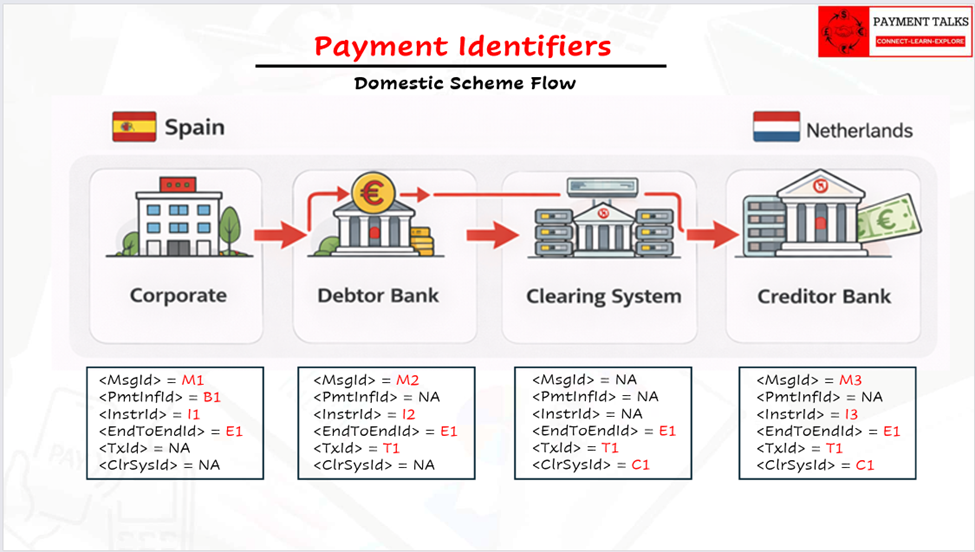
[VISUAL 2: Domestic payment flow diagram, Spain to Netherlands. ]
| Party | Message | MsgId | PmtInfId | InstrId | EndToEndId | TxId | ClrSysRef |
| Corporate | PAIN.001 | M1 | B1 | I1 | E1 | NA | NA |
| Debtor Bank | PACS.008 | M2 | NA | I2 | E1 | T1 | NA |
| Clearing System | — | NA | NA | NA | E1 | T1 | C1 |
| Creditor Bank | PACS.008 (from clearing) | M3 | NA | I3 | E1 | T1 | C1 |
Key observations:
- MsgId is created fresh at every hop. The Clearing System does not create a new MsgId, because it is infrastructure, not a bank.
- PmtInfId is batch-relevant at the corporate level only, it does not flow beyond the Debtor Bank.
- InstrId changes at each bank hop. The Clearing System does not assign an InstrId.
- EndToEndId (E1) remains unchanged from Corporate through to Creditor Bank.
- TxId (T1) is assigned by the Debtor Bank and stays unchanged, including through the Clearing System.
- ClrSysRef (C1) is generated when the payment enters the Clearing System and is carried through to the Creditor Bank in the outgoing PACS.008.
- UETR is not shown here, since this is an exclusively domestic flow, and UETR is primarily a cross-border tracking identifier.
Flow 2: Cross-Border CBPR+ (Spain to United States)
Scenario: A Corporate in Spain initiates a payment to a Creditor in the United States. The payment moves: Corporate to Debtor Bank to Intermediary Bank to Creditor Bank. No domestic clearing system is involved, this is pure SWIFT correspondent banking.
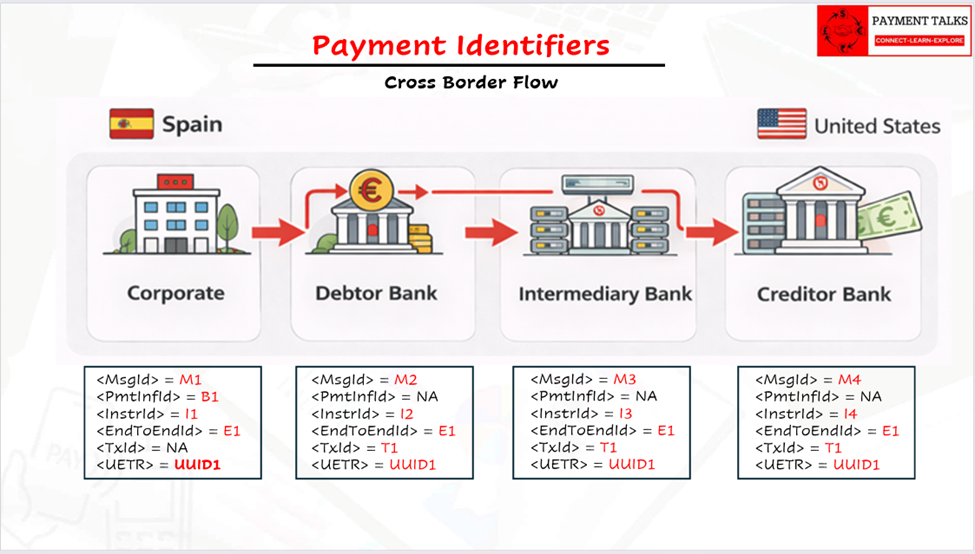
[VISUAL 3: Cross-border CBPR+ payment flow diagram, Spain to United States.]
| Party | Message | MsgId | PmtInfId | InstrId | EndToEndId | TxId | UETR |
| Corporate | PAIN.001 | M1 | B1 | I1 | E1 | NA | UUID1 |
| Debtor Bank | PACS.008 | M2 | NA | I2 | E1 | T1 | UUID1 |
| Intermediary Bank | PACS.008 | M3 | NA | I3 | E1 | T1 | UUID1 |
| Creditor Bank | PACS.008 | M4 | NA | I4 | E1 | T1 | UUID1 |
Key observations:
- MsgId is new at every hop (M1 to M2 to M3 to M4).
- PmtInfId exists in the PAIN.001 at the corporate level but is not propagated into the interbank chain.
- InstrId changes at every hop (I1 to I2 to I3 to I4), each bank’s instruction to the next party.
- EndToEndId (E1) is unchanged across all four parties.
- TxId is assigned by the Debtor Bank as T1 and passes through every subsequent bank unchanged.
- UETR (UUID1) is assigned by the Corporate in this scenario, with GPI for Corporates, or by the Debtor Bank, and it travels unchanged through all four parties.
- No ClrSysRef, since there is no clearing system in this pure cross-border flow.
Flow 3: Mixed Flow (Cross-Border + Domestic Clearing)
Scenario: A Corporate initiates a cross-border payment. The Debtor Bank sends it to a Correspondent Bank in the Creditor’s market. That Correspondent then settles to the Creditor Bank via the local clearing system in that market. If correspondent banking relationships are new to you, I cover the mechanics separately in Understanding Correspondent Banking: A Comprehensive Guide.
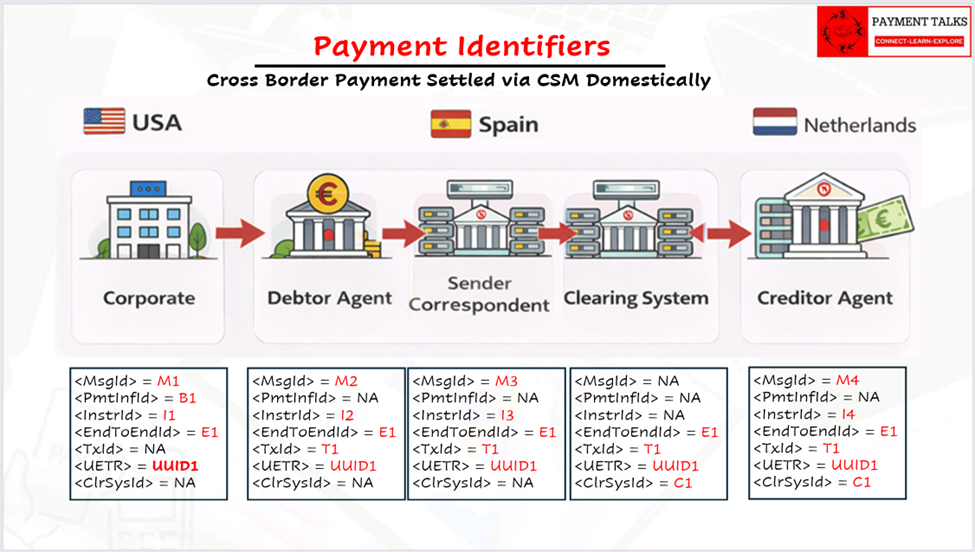
[VISUAL 4: Mixed cross-border and domestic clearing payment flow diagram.]
| Party | Message | MsgId | PmtInfId | InstrId | EndToEndId | TxId | UETR | ClrSysRef |
| Corporate | PAIN.001 | M1 | B1 | I1 | E1 | NA | UUID1 | NA |
| Debtor Bank | PACS.008 | M2 | NA | I2 | E1 | T1 | UUID1 | NA |
| Correspondent (Sender) | PACS.008 | M3 | NA | I3 | E1 | T1 | UUID1 | NA |
| Clearing System | — | NA | NA | NA | E1 | T1 | UUID1 | C1 |
| Creditor Bank | PACS.008 | M4 | NA | I4 | E1 | T1 | UUID1 | C1 |
Key observations:
- MsgId and InstrId change at every bank hop, as always.
- EndToEndId, TxId, and UETR all remain constant from their point of assignment through to the Creditor Bank, even across the clearing system.
- ClrSysRef is generated when the payment enters local clearing and is carried through to the Creditor Bank.
- This flow illustrates the core design principle: end-to-end identifiers survive infrastructure boundaries. They pass through clearing systems, correspondent banks, and payment scheme gateways without change.
Common Misconceptions About Payment Identifiers (And Why They Cause Delays)
“The Transaction ID changes at every hop, like the Instruction ID.”
This is incorrect. The TxId is assigned by the first instructing bank, the Debtor Agent, and remains unchanged through the entire interbank chain. Only the MsgId and InstrId are point-to-point references that change at each hop.
“EndToEndId and TxId are basically the same thing, so it is fine to populate one into the other.”
This is the mix-up that costs teams the most time. EndToEndId is the corporate’s field, assigned in PAIN.001, and it is the only identifier present in PAIN.001, PACS.008, and PACS.009 alike. TxId is a bank-owned field that does not even exist in PAIN.001. When an integration team copies EndToEndId into TxId, or the reverse, they are not just making a naming error, they are conflating a corporate reference with an interbank reference that has a completely different owner and a completely different scope. Add to that the fact that most recon builds are anchored to MsgId, which changes at every hop, and you get returns and rejects that take days to trace instead of minutes, because the R-message references a field the recon system was never built to index against. I walk through exactly what this looks like in a PACS.004 return further down.
“The UETR is always assigned by the Debtor Agent.”
Usually, yes. But with SWIFT GPI for Corporates, an advanced corporate system can assign the UETR in the PAIN.001. When this happens, the Debtor Agent must honour and forward that same UETR. If the Corporate does not assign one, the Debtor Agent creates it.
“The EndToEndId and the UETR serve the same purpose.”
They do not. The EndToEndId is a business reference created by the Corporate to reconcile the payment against an invoice or order, it serves the corporate treasury or ERP system. The UETR is a tracking reference created within the banking network to trace a cross-border payment across SWIFT. Different ownership, different scope, different audience.
“The PmtInfId travels through the payment chain.”
It does not. The PmtInfId is scoped to the PAIN.001 file and the relationship between the Corporate and the Debtor Bank. It has no existence beyond the Debtor Agent.
“The Clearing System Reference is only relevant for settlement.”
The ClrSysRef is also critical for payment operations and reconciliation. Both the sending bank and the receiving bank in a clearing-settled payment receive and use the ClrSysRef: the sending bank via acknowledgement or reporting messages, the receiving bank in the PACS.008 it receives from the clearing infrastructure.
“If the CBPR+ rule of reusing one value across MsgId, PmtInfId, and InstrId works there, it must be a general ISO 20022 rule.”
It is not, and this is a trap I have watched catch experienced teams. That reuse pattern is correct specifically because CBPR+ prohibits batching, so there is only ever one transaction per message and the three fields can safely collapse to one value. Extend that same pattern to a domestic rail that supports batch PAIN.001 files, and you break the batch structure the moment a second transaction enters the same PmtInf block. What works under CBPR+ is a consequence of CBPR+’s no-batch rule, not a universal ISO 20022 pattern.
What Happens to Payment Identifiers on a Return or Reject? (PACS.004 and R-Messages)
This is the part most guides skip, and it is exactly where the war-room story I opened with plays out. A payment gets returned or rejected, an R-message goes out, and the team building it has to reference the original payment correctly. Get the wrong original identifier into the wrong field, and the return sits stuck while two banks argue about which payment it actually belongs to.
A PACS.004 (Payment Return) does not reuse the original identifiers directly. It carries “Original” versions of them, in an Underlying Transaction Information block, so the receiving party can trace the return back to the exact payment being reversed. Keeping this to the mapping that matters, not a full schema walkthrough:
| Original Identifier | Points Back To | Why It Matters in a Return |
| OrgnlMsgId | The MsgId of the message being returned | Confirms which message envelope carried the original payment |
| OrgnlEndToEndId | The corporate’s EndToEndId from the original payment | Lets the corporate’s ERP match the return against the original invoice |
| OrgnlUETR | The UETR from the original payment | Keeps the return traceable on the same SWIFT gpi Tracker record as the original |
| OrgnlTxId | The TxId from the original interbank leg | Lets the Debtor Agent match the return to its own internal transaction record |
The trap is the one I raised earlier: if your recon system is built to index primarily on MsgId, and MsgId changes at every single hop, it has nothing stable to match a return against. That is why OrgnlEndToEndId and OrgnlUETR matter so much more than OrgnlMsgId in practice. They are the fields that actually stayed constant on the original payment, so they are the fields your recon and your ops team should be matching returns against first.
Summary: Key Takeaways
- ISO 20022 uses a structured family of seven payment identifiers, each with a defined owner, scope, and behaviour across the payment chain.
- MsgId and InstrId are point-to-point references. They change at every hop and serve bilateral tracing, not end-to-end tracking.
- PmtInfId is a batch identifier, scoped to PAIN.001, and it does not propagate beyond the Debtor Agent. In CBPR+ cross-border flows, batches are not permitted, which is the only reason the same-value pattern works there.
- EndToEndId is the corporate’s unchanging reference, travelling from Debtor to Creditor untouched through every bank and every system.
- TxId is the interbank transaction reference, assigned by the Debtor Agent and passed unchanged through the rest of the chain. It does not appear in PAIN.001, and it is not the same field as EndToEndId no matter how often the two get merged in practice.
- UETR is the globally unique cross-border tracking reference, assigned by the Debtor Agent or by the Corporate under SWIFT GPI for Corporates. It never changes once assigned, even in mixed domestic-cross-border flows.
- ClrSysRef is owned by the clearing infrastructure, generated at the point of clearing entry and communicated to all participating banks. It does not exist in pure cross-border flows with no clearing system.
- On a return or reject, the “Original” identifiers in PACS.004 carry the trace back to the source payment, and the ones that hold up under pressure are OrgnlEndToEndId and OrgnlUETR, not OrgnlMsgId.
Frequently Asked Questions About Payment Identifiers in ISO 20022
Q1: What is the main difference between EndToEndId and TxId in ISO 20022?
A1: EndToEndId is created by the Corporate in PAIN.001 and never changes, appearing in PAIN.001, PACS.008, and PACS.009 alike. TxId is created by the Debtor Agent, only exists in PACS.008 and PACS.009, and while it also does not change, it is a separate field owned by a different party. Populating one into the other is a common integration mistake.
Q2: Does the Transaction ID (TxId) change at every hop?
A2: No. The TxId is assigned once by the first instructing bank, the Debtor Agent, and passes unchanged through every subsequent bank in the interbank chain. Only MsgId and InstrId change at every hop.
Q3: Can a Corporate assign the UETR instead of the bank?
A3: Yes, under SWIFT GPI for Corporates. If the Corporate assigns the UETR in the PAIN.001, the Debtor Agent must honour and forward that exact value. If the Corporate does not assign one, the Debtor Agent creates it.
Q4: Why do recon systems built around the Message ID (MsgId) run into trouble?
A4: Because MsgId changes at every single hop, it was never designed as a stable, end-to-end matching key. A recon process anchored to MsgId loses the thread the moment a payment crosses a second bank, which is why returns and rejects referencing the original payment take far longer to trace than they should.
Q5: Is it safe to reuse the same value across MsgId, PmtInfId, and InstrId outside CBPR+?
A5: No. That practice is correct under CBPR+ specifically because CBPR+ prohibits batching, so each message carries exactly one transaction. On a domestic rail that supports batch PAIN.001 files, forcing the same value across those three fields breaks the batch structure as soon as a second transaction enters the same batch.
Q6: What happens to payment identifiers when a payment is returned or rejected?
A6: The PACS.004 return message carries “Original” versions of the key identifiers, such as OrgnlEndToEndId, OrgnlUETR, OrgnlTxId, and OrgnlMsgId, in its Underlying Transaction Information block. Of these, OrgnlEndToEndId and OrgnlUETR are the most reliable for tracing, because they are the fields that actually stayed constant on the original payment.
Q7: What is the Clearing System Reference (ClrSysRef) used for?
A7: ClrSysRef is generated once by the clearing infrastructure, such as SEPA, Fedwire, or TARGET2, when a payment enters that clearing system. It is used for both settlement and reconciliation, and both the sending and receiving banks receive and rely on it.
▶ Watch the Full Walkthrough on YouTube
Prefer video? The full walkthrough is on the PaymentTalks YouTube channel.