
The Cross-Border Payment Problem That Has Not Moved in Fifty Years
A company in the United Arab Emirates wins a contract with a buyer in China. The company ships the goods. Now it needs to get paid: $4 million USD equivalent, moving from a Chinese bank to a UAE bank.
Here is what actually happens. A SWIFT message leaves China. It passes through one or more correspondent banks, usually routed through a US dollar clearing bank. Each correspondent takes a fee. The FX conversion happens somewhere inside that chain, often at a rate the UAE company never explicitly agreed to. The funds land, sometimes in a day, sometimes in three, minus fees the UAE company only discovers after the fact.
This is not a niche problem. Cross-border trade between Asia, the Middle East, and beyond moves trillions of dollars a year through exactly this friction. The plumbing was built in the 1970s. It has not fundamentally changed since.
mBridge is the most serious attempt by central banks to change that. Not by bolting another layer onto the existing system, but by replacing the settlement layer itself with a shared, multi-central-bank digital currency platform.
I have sat on the inside of one of these pilots. Between August and November 2025 I was the functional point of contact for one of four Saudi banks running a live mBridge test inside SAMA’s sandbox, settling in eSAR (Saudi Arabia’s wholesale CBDC) straight to HSBC Hong Kong. This article covers what mBridge is, how it works, who runs it now that the Bank for International Settlements has stepped back, what has actually settled on it, how it compares to SWIFT, and what it means for a payments professional at any stage, from a fresher learning the landscape to a solution architect planning the next decade of infrastructure.
What Is mBridge, Exactly?
mBridge, short for Multiple Central Bank Digital Currency Bridge, is a shared distributed ledger that lets commercial banks settle cross-border payments and FX trades directly with each other, in real time, using wholesale Central Bank Digital Currencies (CBDCs): digital sovereign money issued straight onto the platform by participating central banks.
Every part of that definition earns its place. Let me break it down.
Shared distributed ledger, not a messaging network. mBridge is not SWIFT. It is not a payment switch like Fedwire. It is a blockchain: a shared ledger run by multiple participating nodes, where the participants are central banks and the commercial banks they supervise. Every transaction sits on this ledger, visible to every participant, settled with finality the moment it executes.
Real-time, peer-to-peer. Payments on mBridge settle directly between the sending commercial bank and the receiving one. No correspondent bank sits in the middle. Settlement is immediate and final: not end-of-day, not next-day, not “pending correspondent processing.” It happens in seconds.
Wholesale CBDCs, not instructions. The assets moving on mBridge are not messages telling a bank to move money elsewhere. They are tokenised central bank money, issued directly onto the mBridge ledger by each participating central bank. When the Hong Kong Monetary Authority issues HKD CBDC and the Central Bank of the UAE issues AED CBDC, and the two get swapped in a trade settlement, both the payment and the FX conversion happen atomically: at the same instant, with zero counterparty risk.
Who built it, and who runs it now. mBridge was conceived and developed by the BIS Innovation Hub, the innovation arm of the Bank for International Settlements, working with the founding central banks below. That is the history. It is not the present. On October 31, 2024, BIS General Manager Agustín Carstens announced that the BIS was stepping away from the project entirely, framing it as a “graduation”: the platform had matured to the point where the BIS’s ongoing involvement was no longer needed. Governance of mBridge now sits entirely with the participating central banks themselves, through a project Steering Committee.
Why Was mBridge Built? The Origins Story
To understand why mBridge matters, you need to understand what it replaces, and why that infrastructure falls so short.
The Correspondent Banking Problem at the Wholesale Level
When a bank in China needs to pay a bank in the UAE, the two rarely have a direct account relationship. They lean on correspondent banks, usually US institutions with global reach, to sit in the middle.
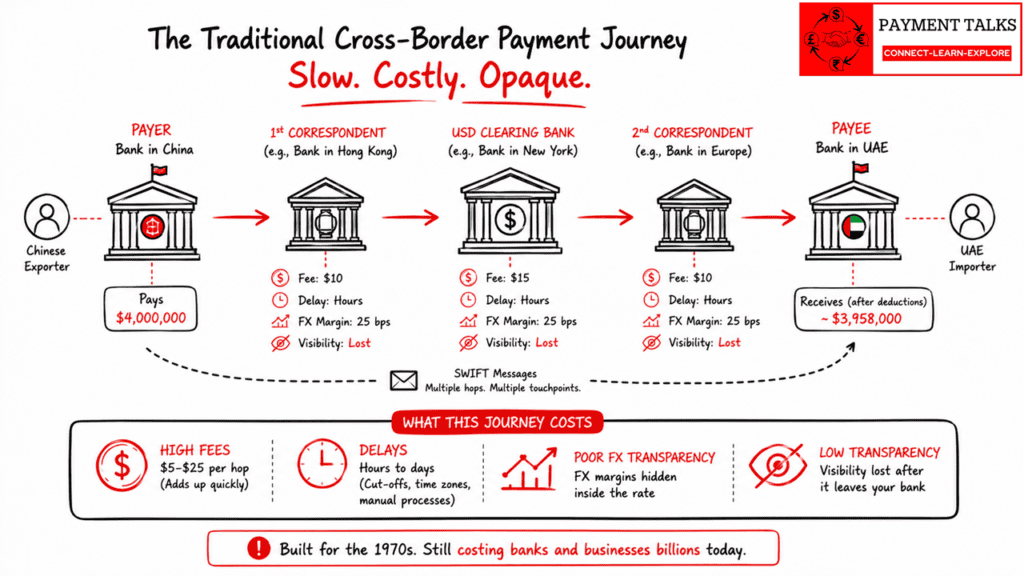
[VISUAL 1: Diagram of the correspondent banking flow, showing the fee, delay, and transparency loss at each hop between a Chinese bank and a UAE bank]
Each hop adds:
- A fee, typically $5 to $25 per correspondent hop
- A delay, from cut-off times, processing windows, and time zone gaps
- An FX margin, baked into the conversion rate rather than disclosed separately
- A loss of transparency, since the originating bank loses visibility the moment the payment leaves its correspondent
For a single $4 million trade settlement, this is irritating but manageable. Scaled across global trade finance, where banks hold trillions of dollars in pre-funded nostro accounts (accounts a bank maintains at a foreign correspondent to facilitate payments), the cost is enormous.
The Nostro Account Problem
The correspondent model forces banks to pre-fund currency positions. If a bank in Hong Kong wants to process USD payments for its clients, it has to hold a balance in a USD nostro account at a US correspondent: money sitting idle, earning close to nothing, just so it’s available when a client payment comes in.
The BIS estimates the global banking system holds around $10 trillion in pre-funded nostro and vostro balances at any given time. That is capital doing nothing. Not lending, not earning a return, not productive. Just waiting to be used.
mBridge, by enabling atomic real-time settlement in central bank money, sharply reduces or removes the need for pre-funded nostro positions in the corridors it covers. A bank can, in principle, source liquidity just-in-time from the platform instead of holding weeks of idle balances.
For a deeper walkthrough of how these relationships actually function, see our guides on correspondent banking and nostro, mirror nostro, vostro and loro accounts.
The Geopolitical Dimension
There’s a dimension to mBridge beyond pure efficiency, and payments professionals need to see it clearly.
Global correspondent banking runs on US dollar clearing. SWIFT, while technically a Belgian cooperative, carries the vast majority of international financial messages. The US has shown it will use that infrastructure as a foreign policy tool, most visibly in 2022, when Russia was cut off from SWIFT after the invasion of Ukraine, severing Russian banks from the global dollar payment system.
For central banks across Asia, the Middle East, and beyond, that creates a real strategic exposure. Infrastructure that does not route through US correspondents or SWIFT reduces that exposure. mBridge, by enabling direct central-bank-to-central-bank settlement in each party’s own currency, gives them an alternative pathway.
The BIS was careful, while it was still involved, to frame mBridge as a technical efficiency project, not a geopolitical one. That framing gets harder to hold now that BIS has exited and the People’s Bank of China sits at the center of the Steering Committee alongside growing interest from Global South economies. I’ll come back to this tension in the governance and challenges sections below, because it’s one of the most-asked questions I get about this platform.
Who Runs mBridge Today? Participants and the Steering Committee
mBridge launched as a collaboration between four founding central banks and the BIS Innovation Hub. Since then the platform has expanded, and its governance has changed hands entirely.
Founding Central Bank Participants
Hong Kong Monetary Authority (HKMA). Hong Kong’s de facto central bank. Issues HKD CBDC on mBridge. Hong Kong’s role as a financial gateway between China and global capital markets makes it a critical participant, and the HKMA has been one of the most technically advanced CBDC authorities globally.
People’s Bank of China (PBoC). Through its Digital Currency Institute, issues e-CNY (digital yuan) on mBridge. China’s participation is the single biggest factor in mBridge’s geopolitical weight. The PBoC runs the largest retail CBDC in the world, e-CNY, with billions in transactions live, and its wholesale CBDC capability feeds straight into mBridge.
Central Bank of the UAE (CBUAE). Issues AED CBDC on mBridge. The UAE’s position as a major trade and financial hub, especially for Asia-Middle East flows, makes it a high-value corridor participant, and the CBUAE has been among the most forward-leaning Gulf central banks on CBDC.
Bank of Thailand (BOT). Issues THB CBDC on mBridge. Thailand is a significant trade partner for both China and the UAE, with heavy cross-border flows in both directions.
Saudi Central Bank (SAMA). Joined as a full participant in June 2024. Issues eSAR, the Kingdom’s wholesale CBDC, on mBridge. Saudi Arabia is the largest economy in the Arab world and a major oil exporter to Asia, and payment flows between Saudi Arabia and China sit among the highest-value corridors in the Gulf-Asia trade lane.
The Steering Committee Takes Over: 2024 to 2026
On October 31, 2024, the BIS formally exited Project mBridge. BIS General Manager Agustín Carstens called it a graduation rather than a withdrawal, arguing the platform had reached the maturity to run itself. Governance passed in full to a project Steering Committee made up of the participating central banks, operating under a legal rulebook and governance framework the Committee had already been building alongside the BIS in the run-up to MVP stage.
The Committee has kept adding members since. In June 2026, the Bank of Mongolia signed on as a full participant and joined the Steering Committee, giving it the same governance rights as the founding five.
As of the most recent public counts, mBridge also carries more than 30 observer central banks and institutions
Observer status lets a jurisdiction access the platform and run pilots without full Steering Committee membership. The design principle behind all this expansion: mBridge is built to be multi-jurisdictional by architecture, not a fixed bilateral arrangement. New central banks can onboard without anyone rebuilding the platform underneath them.
Inside a Live Pilot: What a SAMA Sandbox Test Actually Looks Like
Here’s what most explainers on mBridge miss: what participation actually requires from a commercial bank, on the ground.
Between August and November 2025, I was the functional point of contact for one of four Saudi banks running a live pilot inside SAMA’s mBridge sandbox. We executed a transaction using eSAR, settling directly from our bank to HSBC Hong Kong. No SWIFT message. No correspondent bank. No multi-day wait.
What surprised me was not the ledger mechanics. The mBridge side of it worked exactly as the technical documentation says it should. What surprised me was everything sitting around it: getting treasury comfortable holding a CBDC position instead of a nostro balance, getting compliance to sign off on an entirely new reconciliation trail that doesn’t produce a SWIFT MT/MX confirmation, and getting our own systems to treat an on-ledger settlement event as equivalent, for accounting and client-notification purposes, to a traditional payment confirmation. That gap between “the platform works” and “our bank is ready to run it in production” is the real barrier to mBridge scaling, and it’s a theme I’ll come back to under commercial bank readiness later in this piece.
How Does mBridge Actually Work? The Technology Behind the Platform
This is where mBridge separates itself from everything before it. It is not a patch on existing infrastructure. It is a ground-up redesign of cross-border settlement.
The mBridge Ledger (mBL): A Purpose-Built Blockchain
mBridge runs on its own purpose-built blockchain, the mBridge Ledger (mBL). This is not Ethereum. It is not Hyperledger Fabric or Corda. It was designed specifically for central bank requirements: high throughput, deterministic finality, privacy controls, and governance mechanisms suited to sovereign institutions.
The mBL is a permissioned distributed ledger, not an open public blockchain. Only authorised nodes validate transactions. Those nodes are operated by:
- The participating central banks, each running one or more validation nodes
- A technical coordination function, previously the BIS Innovation Hub, now managed by the Steering Committee’s own technical working group
- Licensed commercial banks, as observer or transacting nodes depending on their authorisation level
This permissioned structure gives central banks the control and oversight they require, while still delivering the core benefits of distributed ledger technology: shared visibility, tamper-evident records, and the ability to run smart contracts for atomic settlement.
The Consensus Mechanism Behind mBridge
The mBL uses Byzantine Fault Tolerant (BFT) consensus, built for environments where participants are known and regulated but the system still needs to tolerate a node failing or acting incorrectly.
BFT consensus gives deterministic finality. When a transaction confirms on the mBL, it is final. Not probabilistically final, the way Bitcoin gets more irreversible with each added block. Definitively and irreversibly final. That is a non-negotiable requirement for central bank settlement infrastructure.
How Is CBDC Issued on mBridge?
Each central bank issues its own CBDC onto the mBridge ledger. This process is worth understanding closely, because it’s what separates mBridge from a private stablecoin or a pure messaging network.
Step 1: the central bank creates CBDC tokens on the mBL. When the HKMA wants to make HKD liquidity available for mBridge transactions, it instructs the mBL to mint HKD CBDC tokens. Those tokens are direct claims on the HKMA: the digital equivalent of Hong Kong Dollar reserves.
Step 2: commercial banks fund their mBridge wallets. A commercial bank in Hong Kong that wants to transact on mBridge deposits HKD with the HKMA. The HKMA issues an equivalent amount of HKD CBDC to that bank’s wallet on the mBL.
Step 3: transaction execution. That bank can now transact in real time on the mBL, sending HKD CBDC to a UAE commercial bank in exchange for AED CBDC, with the FX swap and settlement happening simultaneously on the platform.
Step 4: redemption. When a commercial bank wants to convert its mBridge CBDC back to fiat, it redeems the tokens with the issuing central bank, which burns the tokens on the mBL and credits the bank’s reserve account in the traditional RTGS system.
This issuance-redemption cycle mirrors the mint-and-burn lifecycle you’ll recognise from how private stablecoins are created and destroyed, with one critical difference: the token here is issued by a central bank, not a private company. It is sovereign money from issuance to redemption, not a private claim on reserves held somewhere else. If you want the fuller picture of that distinction, our introduction to stablecoins walks through it from the private-sector side.
The Atomic Swap: mBridge’s Core Settlement Innovation
The most technically significant feature of mBridge is its atomic swap capability for cross-currency settlement.
An atomic swap is a transaction where two legs, paying Currency A and receiving Currency B, execute simultaneously and indivisibly. Either both legs succeed or neither does. There is no window where one party has paid and the other hasn’t received yet. Counterparty risk, the risk that the other side defaults mid-settlement, is eliminated at the protocol level.
To see why that matters, look at what happens today in a cross-border FX settlement:
- Bank A sends USD to Bank B (Leg 1). This settles.
- Hours or a day later, Bank B sends EUR to Bank A (Leg 2). This settles.
Between those two steps sits a window of risk. If Bank B defaults after receiving USD but before paying EUR, Bank A loses its USD. This is Herstatt risk, named after Bankhaus Herstatt, a German bank that collapsed in 1974 mid-way through FX settlement, leaving counterparties holding their side of a trade with nothing coming back. Herstatt risk is why the global banking system runs an entire FX settlement risk infrastructure just to manage it: CLS Bank settles roughly $6.5 trillion a day specifically for this reason.
mBridge atomic swap: both legs, HKD CBDC debited from Bank A’s wallet and AED CBDC credited to it, simultaneously with AED CBDC debited from Bank B’s wallet and HKD CBDC credited to it, execute in a single transaction on the mBL. If any part fails, nothing settles. Herstatt risk simply does not exist inside this model.
That is not a marginal improvement. It removes a category of risk that has required a whole global infrastructure to manage for fifty years.
A Real mBridge Transaction, Step by Step
I already told you about running this exact settlement pattern myself, from Saudi Arabia to Hong Kong. Here’s how the mechanics play out on paper, using a sample China-UAE corridor, so you can see every step of the flow.
The Scenario
- Debtor: Guangzhou Import Ltd, a Chinese manufacturing company importing electronic components.
- Creditor: Emirates Technology Corp, a UAE technology supplier.
- Amount: AED 5,000,000 (about USD 1.36 million).
- Debtor’s bank: Bank of China (BOC), an mBridge participant.
- Creditor’s bank: Emirates NBD, an mBridge participant.
Step-by-Step Flow
Step 1: Guangzhou Import Ltd initiates the payment. It instructs Bank of China to pay Emirates Technology Corp AED 5,000,000, with full creditor details, payment purpose, and remittance information: a standard corporate payment instruction on the surface.
Step 2: Bank of China prepares the mBridge transaction. It checks its AED CBDC balance on the mBL. If it holds enough, it proceeds. If not, it runs an FX swap on the platform to acquire AED CBDC using its CNY CBDC holdings. In practice, commercial banks keep pre-positioned CBDC balances in the currencies their clients transact in most often.
Step 3: the payment instruction goes to the mBL. Bank of China submits the transaction, specifying the AED CBDC amount, the destination wallet (Emirates NBD’s mBL wallet), and the payment reference data.
Step 4: central bank validation, if the protocol requires it. Depending on transaction size and type, the mBL may route the transaction through a validation step confirming compliance with applicable regulation from the PBoC and/or CBUAE, giving central banks the supervisory oversight they need over large transactions.
Step 5: settlement executes on the mBL. Bank of China’s AED CBDC wallet is debited AED 5,000,000. Emirates NBD’s AED CBDC wallet is credited the same amount. The transaction is recorded permanently on the ledger. Settlement is final.
Step 6: Emirates NBD credits Emirates Technology Corp. It receives the AED CBDC on the mBL, then credits the client’s AED account in its core banking system through a local instruction.
Step 7: reporting and reconciliation. Both banks generate payment confirmations, with the mBL transaction hash as the settlement reference, and can hand their corporate clients confirmation of settled payment based on that on-ledger data.
Total elapsed time for Steps 3 through 6: under 10 seconds. No US correspondent. No SWIFT correspondent chain. No FX margin hidden inside a multi-hop conversion. No one-to-three day wait.
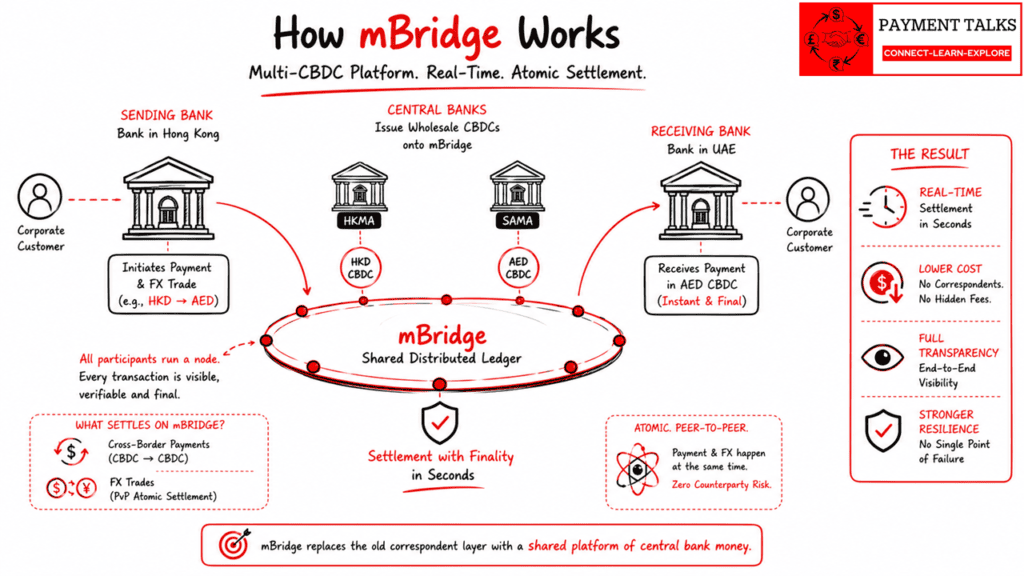
[VISUAL 2: Step-by-step diagram of the mBridge transaction flow from Bank of China to Emirates NBD]
mBridge’s Track Record: From Pilot to Billions in Live Volume
mBridge is not a white paper. It has moved through defined development stages with real transaction volume, and that track record is what separates it from dozens of blockchain payment projects that never left the pilot phase.
Phase 1: Proof of Concept (2021)
The initial proof of concept showed the core premise was technically feasible: multiple central banks could issue digital currencies onto a shared platform and run cross-currency transactions. No live currency. No real value at risk. A technical demonstration only.
Key finding: the mBL could hit the throughput and finality characteristics needed for interbank settlement.
Phase 2: Pilot (2022)
The pilot brought in real value for the first time. Over six weeks, 20 commercial banks from Hong Kong, China, the UAE, and Thailand took part, running real-value transactions.
Published results: over 160 transactions executed; over HKD 22 million in total value settled across HKD, CNY, AED, and THB; transaction types spanning cross-border payments, FX spot trades, and FX swaps.
This was the first time multiple central banks had successfully settled real cross-currency transactions on a shared CBDC platform: a landmark moment for payment infrastructure.
Phase 3: MVP (2024)
In June 2024, the BIS announced mBridge had reached Minimum Viable Product stage, its most significant milestone yet. MVP meant the platform was stable, functional, and governed enough for real commercial use at scale.
At MVP stage: the platform opened to new central bank and commercial bank participants; Saudi Arabia’s SAMA joined as a full central bank participant; the governance framework was formalised; commercial banks from the four original jurisdictions started operating on the platform in earnest.
The MVP announcement came with a pointed statement from the BIS: mBridge would not become a tool for sanctions circumvention, and governance would hold to international AML/CFT standards. That was a direct answer to the geopolitical sensitivity already surrounding the platform.
Life After BIS: 2025 and 2026
This is where most other explainers stop telling the story, and it’s the most important update to make here. On October 31, 2024, the BIS formally exited mBridge, handing full governance to the Steering Committee of participating central banks. Carstens framed it as graduation, not abandonment: the project had matured past the point of needing BIS involvement.
Since then, activity has scaled sharply. By November 2025, mBridge had processed more than 4,000 transactions worth a combined $55.49 billion, a jump of roughly 2,500 times the pilot’s total value in about three years.
The UAE Central Bank has also executed live cross-border digital dirham transfers to China over the platform outside the original pilot structure, reported at roughly 50 million AED (about USD 13.6 million).
In June 2026, the Bank of Mongolia joined as a full Steering Committee member, the newest sign that mBridge’s expansion did not slow down after BIS left. If anything, it sped up.
mBridge vs SWIFT: How Do They Actually Compare?
For payments professionals, this is the comparison that matters most. mBridge is not trying to beat SWIFT on every dimension, but on cross-border settlement specifically, the contrast is stark.
| Dimension | SWIFT (Correspondent Banking) | mBridge |
| What it carries | Payment instructions (messages), not money itself | Sovereign digital money (CBDC): the actual settlement asset |
| Settlement model | Indirect: instructions flow through correspondent accounts | Direct: CBDC transfers between commercial bank wallets |
| Settlement time | 1 to 3 business days (typical cross-border) | Seconds |
| Settlement finality | Delayed: final only once all correspondent legs complete | Immediate: deterministic on mBL confirmation |
| Operating hours | Business hours, cut-off times apply | 24/7/365 |
| FX conversion | Embedded in the correspondent chain (opaque margin) | Explicit atomic swap at an agreed rate (transparent) |
| Counterparty risk | Herstatt risk exists between settlement legs | Eliminated: atomic swap, both legs simultaneous |
| Nostro/Vostro prefunding | Required: trillions in idle capital globally | Dramatically reduced: just-in-time liquidity possible |
| Correspondent banks required | Yes, typically 2 to 5 per cross-border payment | None: direct bank-to-bank settlement |
| Cost per transaction | $25 to $75+ (correspondent fees plus FX margin) | Near zero (platform fees, no correspondent markup) |
| Transparency | Limited: originator loses visibility at each hop | Full: all participants see the transaction on the shared ledger |
| Network participants | 11,000+ financial institutions globally | 6 full central bank members (adding Mongolia, 2026) plus 30+ observer members, and their supervised commercial banks |
| Currencies supported | 140+ currencies | HKD, CNY, AED, THB, SAR, with Mongolia onboarding |
| Regulatory framework | SWIFT rulebook plus national regulation | mBridge Steering Committee rulebook plus national central bank oversight |
| Established since | 1973 | 2021 (pilot), 2024 (MVP), 2024 (central-bank-run) |
| Geographic reach | Global | Asia-Middle East corridors (expanding) |
SWIFT’s advantage is fifty-plus years of network effects, global reach, deep regulatory embedding, and the operational trust that 11,000-plus institutions place in it daily. A bank in the Netherlands paying a supplier in Brazil is not waiting on mBridge. That payment runs on SWIFT correspondent rails for the foreseeable future.
mBridge’s advantage sits in the specific corridors it covers: Asia-Middle East-Southeast Asia cross-currency trade settlement. In those corridors, for participating institutions, mBridge offers a settlement capability SWIFT’s correspondent model structurally cannot match, and it now does so without a neutral third party like the BIS sitting in the governance chair. Whether that matters to you depends on how you weigh settlement speed against having an independent multilateral referee. I’ll unpack that trade-off properly in the governance section below.
What Can mBridge Do That SWIFT Cannot? Programmability Explained
Beyond speed and cost, mBridge’s programmable ledger enables things that are structurally impossible on SWIFT’s messaging model.
Conditional Payments and Smart Contract Settlement
Because mBridge is a programmable ledger, payment execution can be conditional, tied to an external event confirmed on the ledger.
Example, trade finance: an importer in China and an exporter in the UAE agree a documentary trade. The exporter ships goods. The shipping company confirms delivery on the mBridge ledger, or via an oracle connected to it. The moment delivery is confirmed, payment pre-committed in an escrow smart contract on the mBL releases automatically to the exporter’s wallet.
No bank staff manually reviewing documents. No delay between document acceptance and payment release. No dispute over whether payment landed before or after delivery. The smart contract executes atomically: delivery confirmation and payment, simultaneous.
This is Delivery versus Payment (DvP) applied to commercial trade, removing the operational risk and manual processing that still characterises trade finance today. It’s the same principle atomic swaps bring to FX settlement, applied one layer up.
Liquidity Management Across Central Banks
mBridge’s shared ledger lets central banks see aggregate liquidity positions across the platform, something invisible under correspondent banking, where each bank’s position is known only to its own correspondent.
That visibility supports more sophisticated liquidity management: central banks can offer intraday credit facilities on the mBL, commercial banks can optimise CBDC holdings across currencies in real time, and the platform can run dynamic multilateral netting, where offsetting payments across multiple participants net out before settlement, sharply cutting the gross volume of CBDC that needs to move.
Cross-Border Securities Settlement
mBridge’s roadmap includes cross-border securities settlement: settling the purchase of a tokenised bond or equity against CBDC payment, simultaneously, on the same platform. That is DvP at the cross-border securities level, removing settlement risk the same way atomic swaps remove it in FX.
Project Jura, a related BIS project, proved this concept between France and Switzerland using tokenised financial instruments and wholesale CBDCs. As mBridge matures, folding in tokenised asset settlement is a natural next step, though it now depends on the Steering Committee’s own roadmap rather than a BIS-led one.
Who Governs mBridge Now That the BIS Has Stepped Back?
Governance is the most underappreciated part of mBridge, and it’s also the part that changed most since this platform first launched. A payment platform is only as trustworthy as its governance structure, so this section matters more than most.
From BIS Oversight to Central Bank Self-Governance
Until October 2024, the BIS provided mBridge’s neutral, multilateral governance backbone: convenor, technical standard-setter, and reference point for dispute questions. No single country controlled the platform. No single commercial interest controlled it. The BIS’s institutional neutrality, owned as it is by 63 central banks, gave mBridge a legitimacy a privately built platform could never match.
That changed on October 31, 2024, when BIS General Manager Agustín Carstens announced the organisation’s exit. Carstens called it a graduation, arguing the platform had reached a level of maturity where BIS involvement was no longer essential, and stated plainly that the decision was not politically driven.
Not everyone reads it that way. Some analysts see the exit as removing the one neutral arbiter that reassured Western observers the platform would not become a sanctions workaround, leaving China as the most influential technical voice on a system it did not build alone but now carries outsized weight within. Others take Carstens at his word: a mature, working platform simply does not need an external convenor anymore, and BIS involvement was always meant to be a bootstrap, not a permanent fixture. Both readings are worth holding at once, because the truth probably has elements of each, and how you weigh them will shape how comfortable your institution is engaging with the platform.
Since the exit, governance runs through the mBridge Steering Committee: the participating central banks themselves, operating under the legal rulebook and governance framework built out during the MVP phase.
Central Bank Governance Rights
Each participating central bank keeps full sovereignty over its own CBDC on the platform. The HKMA decides how HKD CBDC is issued, redeemed, and governed. The PBoC decides the same for CNY CBDC. No central bank is forced to accept or process a transaction it doesn’t approve.
Each central bank also runs its own validation nodes on the mBL, so no single central bank can unilaterally change the ledger. Protocol changes require consensus among the Steering Committee.
AML/CFT Compliance
This draws intense outside scrutiny, and rightly so. Any platform letting China, the UAE, Saudi Arabia, and others move money cross-border without routing through SWIFT is going to face questions about sanctions evasion.
The Steering Committee, following the standard the BIS set before it left, treats AML/CFT compliance as a foundational design requirement, not an afterthought. Each central bank enforces its own AML/CFT standards on the commercial banks operating in its jurisdiction. The shared ledger gives more transaction visibility than correspondent banking ever did; it’s architecturally more transparent, not less.
Commercial banks on mBridge have to be regulated and supervised by their national central bank. They have to onboard corporate clients with full KYC/AML due diligence. They have to comply with sanctions obligations that apply in their jurisdiction.
The platform does not route around sanctions. It routes around correspondent banks. Those are not the same thing, and conflating them is the most common mistake I hear from people encountering mBridge for the first time.
What Happens When Countries Disagree?
This is a legitimate governance concern. If a payment between a Chinese bank and a UAE bank touches a counterparty one jurisdiction considers sanctioned and the other doesn’t, what happens?
The mBridge design gives each central bank a supervisory window into transactions touching its jurisdiction. A central bank can reject or block a transaction that violates its own regulatory obligations. The protocol does not force any central bank to process a transaction it considers non-compliant.
The detailed dispute resolution and cross-jurisdictional conflict protocol, now run entirely by the Steering Committee rather than a BIS-mediated process, has not been fully disclosed publicly.
mBridge’s Real Challenges: What Critics Get Right
mBridge is one of the most promising cross-border infrastructure projects in decades. It also has real problems, and a payments professional who doesn’t understand them can’t fairly assess it.
Challenge 1: Limited Geographic Reach
mBridge currently covers HKD, CNY, AED, THB, and SAR corridors, with a sixth full central bank member, Mongolia, now onboarding.
For Asia-Middle East trade, that’s significant. For global payments, it’s a narrow slice. A payment from Germany to Brazil, the UK to Nigeria, or the US to India gets nothing from mBridge in its current form.
Expanding to new jurisdictions means each new central bank has to build CBDC infrastructure compatible with the mBL, build governance relationships with existing members, and clear its own domestic regulatory approval for CBDC issuance. That’s a multi-year process per jurisdiction, even with the Steering Committee streamlining onboarding since BIS left.
Challenge 2: Commercial Bank Readiness
Participating in mBridge isn’t just a central bank decision. The commercial banks actually processing trade payments need new technical capability: mBridge API integration, CBDC wallet management, real-time liquidity tooling, and staff trained to operate in a CBDC settlement environment.
I saw this up close running our own SAMA sandbox pilot. The mBridge technology itself was the easy part. Getting treasury, compliance, and reconciliation processes ready to actually operate the platform in production was the harder, slower work. For large commercial banks with strong technology teams (HSBC, Emirates NBD, Bank of China), that’s achievable. For smaller regional banks, the investment required can be a real barrier.
Challenge 3: Liquidity Management in Multiple CBDCs
A commercial bank on mBridge has to manage liquidity across multiple CBDCs at once. If a bank needs to process AED payments but its mBridge wallet is running low on AED CBDC, it needs a way to get more: either redeeming a CBDC with the issuing central bank (slow) or running an FX swap on the platform (needs a willing counterparty).
Intraday liquidity management across several CBDC positions is a genuinely new operational discipline. Banks have decades of refined skill managing nostro liquidity. The equivalent tools and practices for CBDC liquidity are still being built.
Challenge 4: Interoperability With Other CBDC Platforms
mBridge is not the only multi-CBDC project in motion. Project Agorá (seven central banks including the US Federal Reserve, Bank of England, and ECB) is exploring tokenised commercial bank deposits and wholesale CBDCs on a different model. Jasper-Ubin (Canada-Singapore) piloted a bilateral CBDC arrangement. Various bilateral CBDC experiments continue globally.
There’s also a louder narrative worth naming directly: some commentary frames mBridge as a building block toward a “BRICS Bridge,” a payment rail explicitly designed to reduce dependence on the US dollar. The BIS, while still involved, pushed back on that framing directly, and Carstens has stated mBridge was never intended as a BRICS-specific tool. Whether that holds as the platform’s own membership tilts further toward BRICS-adjacent economies is a fair question to keep asking, not one that gets settled by either side’s statements alone.
The underlying technical risk either way is a fragmented landscape of incompatible CBDC platforms, each covering different corridors, using different standards, requiring separate integration work from commercial banks. Interoperability standards are in progress, but how mBridge connects to other emerging CBDC infrastructure remains unresolved.
Challenge 5: Geopolitical Risk to the Platform Itself
The People’s Bank of China’s role as a founding participant creates political complexity, especially given US-China tensions, and that complexity did not disappear when the BIS left. If anything, some analysts argue the BIS’s exit removed the one factor giving Western banks cover to engage without appearing to endorse a China-centered payment rail. Some Western banks and central banks have stayed hesitant about joining mBridge specifically because of PBoC’s central role. How the platform is perceived in Washington, Brussels, and London matters to the commercial banks operating under those regulators.
Carstens has been consistent that mBridge’s exit and its technical multilateral nature are separate from any geopolitical reading. Whether that framing holds up as membership grows is still an open question, and one worth watching rather than assuming settled in either direction.
What Does mBridge Mean for Payments Professionals?
For Payments Freshers: Understanding the Landscape
mBridge is the most important live example of what wholesale CBDC infrastructure looks like in practice. Understanding it gives you a concrete reference point for every “future of cross-border payments” conversation you’ll sit in. When someone says “CBDC bridge,” “atomic settlement,” or “nostro reduction,” you now have a real, named project to anchor those terms to, including the fact that it’s no longer run by the institution that built it.
For Mid-Level Payments Professionals: The Practical Implications
If your bank operates in any mBridge currency corridor (HKD, CNY, AED, THB, SAR), whether your institution participates, and when, is a live strategic question, not a hypothetical one. The answer affects your correspondent banking relationships, your nostro management practices, and your client-facing cross-border capability.
If you work in payment operations, understand that mBridge settlement does not generate the SWIFT confirmation messages your reconciliation systems are built around. It generates on-ledger transaction records instead. The reconciliation and operations workflow is fundamentally different, and I can tell you from running our own pilot that this is the piece that takes the longest to get production-ready, not the ledger connectivity itself.
For Solution Architects: The Design Implications
If you’re architecting payment infrastructure for a bank in an mBridge-adjacent jurisdiction, work through three questions.
Question 1: should this bank participate in mBridge? Assess the bank’s exposure to the covered corridors. If a meaningful share of cross-border volume runs through HKD, CNY, AED, THB, or SAR, the economics (lower correspondent fees, faster settlement, nostro efficiency) usually justify the technical investment.
Question 2: how does mBridge integrate with the existing payment engine? The payment engine receives ISO 20022 payment instructions from corporate clients (see our full breakdown of what PAIN.001 actually is) and routes them for processing. For mBridge-eligible payments, the routing logic needs to identify eligible transactions by currency, counterparty bank participation status, and transaction type, then route them to the mBridge API layer instead of the SWIFT gateway.
The settlement confirmation coming back from mBridge is an on-ledger event, and it has to be translated into a PACS.002-equivalent status report for the upstream client notification. That translation layer, from mBridge ledger event to ISO 20022 status message, is the exact integration point that took the most design iteration in the pilot I ran. It’s not conceptually hard. It’s operationally unforgiving if you get the mapping wrong.
Question 3: how does CBDC liquidity management integrate with treasury systems? The treasury management system (TMS) needs to track CBDC wallet balances across currencies in real time, the same way it tracks nostro balances today. The difference: nostro balances come through account statements and SWIFT balance messages (CAMT.052, CAMT.053). mBridge CBDC balances sit on-ledger, queryable in real time through the API. TMS integration needs new data feeds and, in most cases, new liquidity optimisation models your treasury team hasn’t built yet.
The Bigger Picture: mBridge in Tomorrow’s Payment Architecture
mBridge doesn’t exist in isolation. It’s the most advanced instance of a broader shift toward tokenised settlement infrastructure, where the assets being settled aren’t account entries on a correspondent’s ledger but programmable tokens on a shared distributed platform.
The BIS’s Finternet vision, laid out by BIS General Manager Agustín Carstens, describes a future financial system of interconnected ledgers, each settling in tokenised central bank money, with atomic cross-ledger transactions enabling real-time, risk-free settlement of financial assets globally.
mBridge is the first real step toward that vision. It’s not the destination. It’s the proof that the destination is buildable, and now it’s being built by the central banks themselves rather than a BIS-led consortium.
For payments professionals, the implication is clear: the skills that matter in this next era aren’t just ISO 20022 message mapping and SWIFT connectivity. They include understanding tokenised settlement mechanics, CBDC architecture, smart contract design, and the governance frameworks that let sovereign institutions share infrastructure without a neutral referee in the room.
The architects who understand both worlds, the traditional one (SWIFT, ISO 20022, correspondent banking, RTGS) and the emerging one (CBDC, atomic settlement, programmable money, DLT), will be the ones designing the infrastructure handling the next fifty years of global trade. I’ve now worked both sides of that line, and the traditional-world fluency is what made the CBDC side legible to me, not the other way around.
Frequently Asked Questions About mBridge
Q: What does mBridge actually stand for?
A: Multiple Central Bank Digital Currency Bridge. It’s a shared platform letting central banks issue digital currency directly to commercial banks for real-time cross-border settlement.
Q: Is the Bank for International Settlements still involved in mBridge?
A: No. The BIS formally exited the project on October 31, 2024, handing full governance to a Steering Committee made up of the participating central banks.
Q: How much money has actually settled on mBridge?
A: By November 2025, reported figures put it at more than 4,000 transactions worth a combined $55.49 billion, up sharply from the 2022 pilot’s 160 transactions worth about $22 million. Confirm the latest figure before publishing, as it updates regularly.
Q: Which countries are part of mBridge?
A: The founding participants are Hong Kong, mainland China, Thailand, and the UAE, joined by Saudi Arabia in 2024 and Mongolia in 2026. More than 30 other central banks hold observer status.
Q: Is mBridge the same thing as a stablecoin?
A: No. A stablecoin is issued by a private company and typically backed by reserves it holds. CBDC on mBridge is issued directly by a central bank: sovereign money, not a private claim.
Q: Does mBridge let countries bypass SWIFT sanctions?
A: The platform routes around correspondent banks, not around sanctions. Commercial banks on mBridge still have to meet KYC/AML obligations and enforce sanctions rules set by their national regulator.
Q: What is Herstatt risk, and how does mBridge remove it?
A: Herstatt risk is the danger that one side of an FX trade pays out before confirming the other side has paid too, named after a 1974 bank collapse. mBridge’s atomic swaps settle both legs of a trade simultaneously, so that risk doesn’t exist on the platform.
Key Takeaways
- mBridge is a multi-central-bank digital currency settlement platform, originally built by the BIS Innovation Hub with the HKMA, PBoC, CBUAE, and Bank of Thailand, joined since by Saudi Arabia’s SAMA (2024) and the Bank of Mongolia (2026). It enables real-time, peer-to-peer cross-border payment and FX settlement using wholesale CBDCs.
- The BIS formally exited the project on October 31, 2024, handing governance entirely to a Steering Committee of participating central banks. That is the single biggest change since this platform launched.
- The platform removes the correspondent banking chain for covered corridors: the fees, delays, opacity, and pre-funded nostro requirements that make traditional cross-border settlement expensive and slow.
- Atomic swaps on the mBridge Ledger remove Herstatt risk at the protocol level. Both legs of an FX trade settle simultaneously, with zero window of counterparty default exposure.
- By November 2025, mBridge had processed more than 4,000 transactions worth roughly $55.49 billion, up from the pilot’s $22 million. Confirm this before publishing.
- Governance is now fully central-bank-run. Each central bank keeps sovereignty over its own CBDC. AML/CFT compliance is a design requirement, though critics argue losing the BIS as neutral arbiter is a real cost, not just a symbolic one.
- Real challenges remain: limited geographic reach, commercial bank readiness (which I’ve now seen up close), multi-CBDC liquidity complexity, interoperability with other CBDC platforms, and geopolitical perception.
- For solution architects: mBridge integration needs a routing layer in the payment engine, an ISO 20022-to-mBL translation layer, and new CBDC liquidity management integration with treasury systems, exactly the design work I did during our own SAMA pilot.
- mBridge isn’t the end state. It’s the first production proof that sovereign atomic settlement on shared distributed infrastructure works, and it’s now advancing without the institution that built it in the room.
Further Reading
For primary sources on mBridge, the BIS still publishes its historical technical reports and MVP progress updates at bis.org/mbridge, even though it’s no longer an active participant. For the adjacent landscape, see our guides on CBDCs Explained and our Stablecoin Masterclass, which give the foundational context that makes mBridge’s significance fully legible. For how private stablecoin rails interact with ISO 20022 messaging, see Stablecoins & ISO 20022. For the payment message mechanics behind the scenes, see What Is PAIN.001? and All Agents and Parties in an ISO Payment Message.