
Nostro and vostro accounts are the foundation of correspondent banking. They are the mechanism that allows any bank to process international payments in currencies and countries where it has no physical presence. Every cross-border payment your institution processes touches at least one of these accounts. If your bank acts as an intermediary in a multi-hop payment chain, it touches all four: nostro, vostro, mirror nostro, and loro.
If you are new to how banks form correspondent relationships and why they need them, start with Understanding Correspondent Banking. This article builds on that foundation and goes straight into the account mechanics.
What Are Nostro, Vostro, Mirror Nostro, and Loro Accounts?
These four account types describe the same physical banking relationship from four different vantage points. One actual account. Four names. The name changes depending on which bank is looking and from where.
Vostro Account
A vostro account (from the Latin vostro, meaning “yours”) is an account that a foreign correspondent bank holds with a domestic bank, in the domestic currency. From the domestic bank’s perspective: your account, held in our books.
Vostro accounts enable foreign banks to process transactions in a currency or jurisdiction without maintaining a physical presence there. When Bank A in India opens a USD account with Bank B in the United States, Bank B records that as a vostro account on its books.
Purpose of a Vostro Account
- Domestic payments for foreign banks: allows the foreign bank to process transactions in the domestic currency on behalf of its customers.
- Collection and remittance: enables the correspondent bank to receive and forward funds on behalf of the foreign bank’s customers.
- Trade settlements: supports import and export payments in the domestic currency.
- Liquidity management: gives the foreign bank a maintained reserve of domestic currency for ongoing transaction processing.
Key Characteristics of a Vostro Account
- Always denominated in the domestic bank’s local currency.
- Recorded as a liability on the domestic bank’s books: the funds belong to the foreign bank.
- Acts as an operational channel for the foreign bank to process transactions in the domestic market.
- Reflects the foreign bank’s reliance on the domestic bank for local jurisdiction access and services.
Nostro Account
A nostro account (from the Latin nostro, meaning “ours”) is the account a bank holds with a correspondent bank in a foreign country, in that foreign country’s currency. From the domestic bank’s perspective: our account, held in their books.
The same physical account carries two names depending on who is describing it. Bank A in India calls its USD account with Bank B a nostro account. Bank B in the United States calls that same account a vostro account.
Purpose of a Nostro Account
- Foreign trade payments: settling import and export payments between countries in the relevant foreign currency.
- Foreign currency liquidity: maintaining balances in foreign currencies for ongoing transactions or hedging.
- Cross-border remittances: transferring funds internationally without physically moving currency.
- Efficient settlement: processing international transactions through the correspondent’s infrastructure without opening a physical branch abroad.
Key Characteristics of a Nostro Account
- Always denominated in the currency of the foreign correspondent bank’s country.
- Recorded as an asset on the domestic bank’s books: funds deposited with a foreign institution.
- Used to settle international transactions through the correspondent’s local clearing infrastructure.
- Tracked and reconciled internally through a Mirror Nostro account maintained in the domestic bank’s own systems.
Mirror Nostro Account
A mirror nostro account is an internal ledger maintained by a bank to track and reconcile the transactions and balance of its nostro account held with a foreign correspondent. While the nostro exists in the foreign bank’s books, the mirror nostro lives in the domestic bank’s own systems as a real-time reflection of the nostro activity.
Think of it this way: you hold an account at a foreign bank (nostro). You cannot see inside their general ledger in real time. So you maintain your own shadow ledger (mirror nostro) that records every debit and credit as you process them. When the foreign bank sends you a statement via SWIFT MT950 or CAMT.053, you reconcile your mirror against their actual position.
Purpose of a Mirror Nostro Account
- Reconciliation: ensuring the domestic bank’s internal records align with the actual nostro account balance at the correspondent.
- Real-time monitoring: providing a continuously updated view of the foreign currency position as payments are processed.
- Error detection: surfacing discrepancies between the domestic and correspondent banks’ records before they become settlement problems.
- Operational efficiency: enabling liquidity management by tracking inflows and outflows as they occur.
- Audit trail: maintaining a complete transaction history for regulatory compliance and internal audit.
Operational Setup of a Mirror Nostro Account
- Account Structure: The mirror nostro is maintained in the domestic bank’s general ledger in the same currency as the nostro account. If the nostro is in GBP, the mirror nostro tracks GBP. It is an off-balance-sheet account used for tracking and reconciliation, not representing actual funds. Critical point: entries in the mirror nostro carry the opposite sign from the actual nostro. A credit to the nostro is recorded as a debit in the mirror nostro, and vice versa.
- Automation: Core banking systems automatically update mirror nostro accounts whenever a debit or credit is processed against the nostro. SWIFT messages are the primary update mechanism: CAMT.053 for account statements, MT900 for debit advice, MT910 for credit advice.
- Reconciliation Process: The domestic bank compares the mirror nostro balance against the actual position reported by the correspondent bank. Mismatches trigger investigation and correction through adjustments or direct correspondent communication.
| NOTE: Mirror Nostro in Home Currency. In some implementations, a bank also maintains a version of the mirror nostro in its home currency (for example, a US bank maintaining a USD-equivalent shadow of a GBP nostro). This tracks the home currency value of the foreign currency balance and is used for financial reporting and risk management. This is separate from the cross-border payments mirror nostro, which exists purely for transaction tracking and reconciliation. |
Key Characteristics of a Mirror Nostro Account
- Internal ledger only: exists in the domestic bank’s own systems, not in the correspondent bank’s books.
- Currency match: denominated in the same currency as the nostro account it mirrors.
- Real-time updates: reflects every transaction processed against the nostro account.
- Not a financial asset: unlike the nostro account, the mirror nostro does not represent actual funds held anywhere.
- Reconciliation tool: the primary internal control mechanism for accuracy in foreign account management.
Nostro Account vs Mirror Nostro Account
| Aspect | Nostro Account | Mirror Nostro Account |
| Definition | The foreign currency account held with a correspondent bank. | An internal ledger maintained to track and reconcile the nostro account. |
| Location | Maintained in the foreign correspondent bank’s books. | Maintained in the domestic bank’s internal systems. |
| Purpose | Used for actual foreign currency transactions. | Used for reconciliation, monitoring, and position tracking. |
| Financial Role | Asset for the domestic bank. | Not a financial asset: purely operational. |
Loro Account
A loro account (from the Latin loro, meaning “their”) is not an account that exists in any bank’s books. It is a reference term used by a third bank to describe another bank’s nostro or vostro relationship: their account, with them.
The loro concept matters in multi-bank payment chains where one bank needs to route a payment through a correspondent relationship it does not own. If Bank A holds a USD nostro at Bank B, and Bank C needs to route a USD payment through that relationship, Bank C calls Bank A’s account at Bank B a loro account.
Purpose of a Loro Account
- Identify third-party accounts: allow banks to reference another bank’s nostro or vostro when routing cross-border payments.
- Enable intermediary routing: allow a third bank to process payments through a correspondent relationship it does not hold directly.
- Simplify communication: provide clear language in payment instructions and SWIFT messages for multi-bank account relationships.
Key Characteristics of a Loro Account
- Not an actual account: a descriptive label for another bank’s nostro or vostro relationship.
- Referenced in payment instructions, SWIFT messages, and operational documentation.
- Enables multi-bank payment chains without requiring direct correspondent relationships between all parties.
- Currency neutral: applies regardless of the underlying account’s currency.
How Do These Four Accounts Compare?
The table below maps all four account types across the dimensions that matter in practice: where the account lives, who owns it, what it is used for, and how it sits in each bank’s books.
| Aspect | Vostro | Nostro | Mirror Nostro | Loro |
| Meaning | “Your account with us”: foreign bank’s account in the domestic bank’s books. | “Our account with you”: domestic bank’s account held with foreign correspondent. | Internal replication of the nostro account maintained by the domestic bank for reconciliation. | “Their account with them”: a third-party reference to another bank’s account relationship. |
| Purpose | Allow a foreign bank to transact in the domestic bank’s currency. | Enable domestic bank to manage foreign currency transactions through a correspondent. | Track, reconcile, and monitor nostro account activity for operational accuracy. | Describe another bank’s account relationship in multi-bank payment chains. |
| Existence | Exists in the domestic bank’s books. | Exists in the foreign correspondent bank’s books. | Exists in the domestic bank’s internal systems only. | Conceptual: not an actual account in any bank’s books. |
| Financial Role | Liability on domestic bank’s books. | Asset on domestic bank’s books. | Not a financial asset: purely operational. | Not a financial account: purely conceptual. |
| Currency | Domestic bank’s local currency. | Foreign correspondent bank’s currency. | Same currency as the nostro account it mirrors. | Can reference accounts in any currency. |
| SWIFT Messages | MT103, MT202 (customer and bank-to-bank transfers). | MT900 (debit advice), MT910 (credit advice). | MT950, CAMT.053 for statements; MT900, MT910 for debit/credit advice. | Referenced in SWIFT messages; not directly involved in account operations. |
| Example | UK bank holds GBP vostro for US bank to process GBP transactions. | US bank holds GBP nostro at UK bank to manage GBP settlements. | US bank maintains internal mirror nostro to shadow its GBP nostro at UK bank. | German bank calls US bank’s GBP nostro at UK bank the loro account when routing a GBP payment. |
| Reconciliation | Domestic bank reconciles against the foreign bank owning the vostro. | Domestic bank reconciles via SWIFT statements from the correspondent. | Used to detect and resolve open items between mirror and actual nostro. | No reconciliation needed: conceptual reference only. |
How Do Nostro and Vostro Accounts Work Together in a Real Payment?
In international banking, the nostro and vostro accounts are two sides of the same coin. One physical account. Described with different names depending on which bank is at the viewing point. The mirror nostro is the domestic bank’s internal reflection of that account. The loro is what a third bank calls it when routing through a correspondent relationship it does not own.
Here is a concrete example. Customer A at Bank A in India wants to send USD 1,000 to his son at Bank B in the United States. Bank A must settle USD in the US but has no presence there. Bank A opens a USD account with Bank B. The physical account number is ABCD1234 in Bank B’s books. To track and reconcile that account internally, Bank A creates a mirror account in its own systems: PQRS5678. Outside Bank A, that number means nothing. Inside Bank A, it tracks every movement in ABCD1234 in real time.
Bank A’s perspective:
ABCD1234 held at Bank B in USD: Bank A’s nostro account.
PQRS5678 maintained internally to shadow ABCD1234: the mirror nostro account.
Bank B’s perspective:
ABCD1234 held at Bank B on behalf of Bank A: Bank B’s vostro account. Bank B has no knowledge of PQRS5678.
Bank C’s perspective (Loro Account):
Bank C in India wants to send USD to the United States but has no USD correspondent. Bank C routes through Bank A’s existing relationship with Bank B.
From Bank C’s perspective, ABCD1234 is their account with them: a loro account. Bank C settles INR domestically with Bank A. Bank A then uses its nostro (ABCD1234) to process the USD payment on Bank C’s behalf.
For how Bank A, B, C, and D map to agent roles in an ISO 20022 payment message, see All Agents and Parties in an ISO Payment Message.
Nostro and Vostro Accounting Entries: Two Real Payment Scenarios
The accounting entries below show exactly how the nostro, vostro, and mirror nostro accounts move with each payment. For the underlying double-entry principles, see Double-Entry Accounting in Payments.
Scenario 1: Direct Nostro Payment (Bank A to Bank B)
Bank A (India) Customer A wants to send USD 1,000 to Customer B in the United States. Customer A holds an INR account with Bank A. Bank A uses its nostro account ABCD1234 (USD) at Bank B to settle. Exchange rate: 1 USD = 80 INR, so USD 1,000 = INR 80,000.
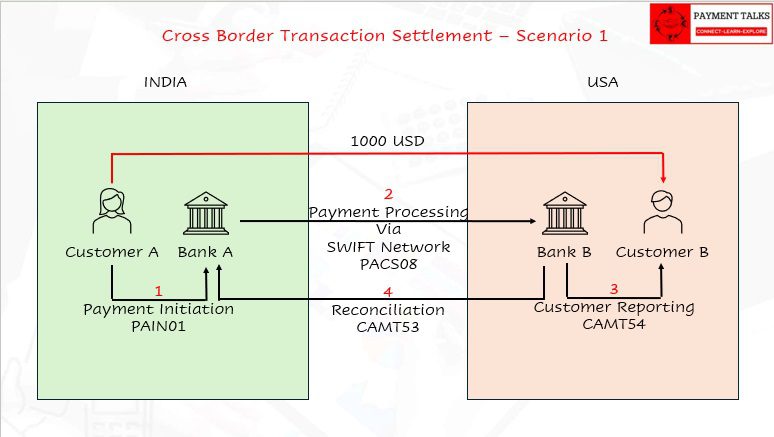
[VISUAL 1: Scenario 1 accounting diagram: Bank A debits Customer A INR 80,000 > FX Suspense > Mirror Nostro PQRS5678 (USD); Bank B debits Vostro ABCD1234 and credits Customer B USD 1,000]
Points to Note and Assumptions
- The FX Suspense Account is an internal Bank A account where currency conversion is processed. It is a multi-currency account.
- FX profit or loss is calculated by the Treasury Department at end of day. FX gains and losses are outside scope here: this article focuses on the nostro, vostro, and mirror nostro mechanics.
- The accounting model here is simplified for conceptual clarity.
Step 1: Bank A Processes the Payment
Bank A debits Customer A’s INR account and credits its FX Suspense Account:
Entry 1:
Dr: Customer A’s Account: INR 80,000
Cr: FX Suspense Account: INR 80,000
Bank A converts INR to USD and instructs Bank B to debit ABCD1234 for USD 1,000:
Entry 2:
Dr: FX Suspense Account: USD 1,000
Cr: Mirror Nostro Account (PQRS5678): USD 1,000
Step 2: Bank B Processes the Payment
Bank B credits Customer B’s USD account and debits Bank A’s vostro account:
Dr: Vostro Account (ABCD1234): USD 1,000
Cr: Customer B’s Account: USD 1,000
Step 3: Reconciliation
The mirror nostro (PQRS5678) at Bank A and the vostro (ABCD1234) at Bank B reflect the same transaction in opposite signs:
Bank A’s Mirror Nostro (PQRS5678): Credit of USD 1,000
Bank B’s Vostro (ABCD1234): Debit of USD 1,000
This is the mirror relationship. The actual account (ABCD1234) is debited at Bank B. The mirror (PQRS5678) shows the inverse: a credit at Bank A. They track the same movement from opposite sides of the ledger.
| Note: Only the Account Servicing Institution (Bank B, which holds the vostro account in its books) generates debit/credit notifications or account statements. Bank A, as the nostro account owner, receives MT900 (debit advice) or MT910 (credit advice) from Bank B. The notification flows from Bank B to Bank A, not the other way around. |
Scenario 2: Loro Account Payment via Intermediary (Bank C Using Bank A’s Nostro)
Bank C (India) Customer C wants to send USD 2,000 to Customer D at Bank D in the United States. Bank C has no USD correspondent. Bank C routes through Bank A’s nostro at Bank B (the loro account for Bank C). Exchange rate: 1 USD = 80 INR, so USD 2,000 = INR 1,60,000.
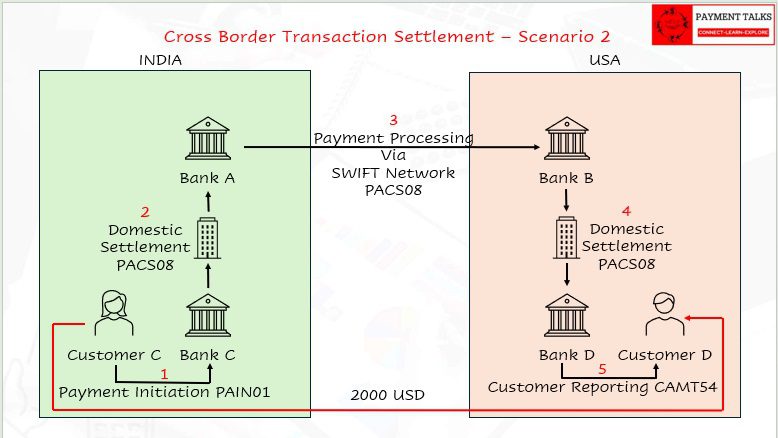
[VISUAL 2: Scenario 2 accounting diagram: Bank C settles INR 1,60,000 to Bank A via local clearing; Bank A converts to USD, credits Mirror Nostro PQRS5678; Bank B debits Vostro ABCD1234, pays Bank D via US local clearing; Bank D credits Customer D]
Step 1: Bank C (Payment Initiator)
Bank C debits Customer C and settles INR 1,60,000 to Bank A via domestic clearing:
Entry 1:
Dr: Customer C’s Account: INR 1,60,000
Cr: Bank A (via Local Clearing): INR 1,60,000
| Note: An alternative would be Bank C maintaining a USD account directly with Bank A. This is less common: most smaller banks prefer opening a direct USD correspondent account in the United States rather than routing through a domestic Indian bank. |
Step 2: Bank A (Local Correspondent for Bank C)
Bank A receives INR from Bank C via local clearing, converts to USD, and instructs Bank B to debit ABCD1234 for USD 2,000 and pass funds to Bank D:
Entry 1:
Dr: Bank C (via Local Clearing): INR 1,60,000
Cr: FX Suspense Account: INR 1,60,000
Entry 2:
Dr: FX Suspense Account: USD 2,000
Cr: Mirror Nostro Account (PQRS5678): USD 2,000
Step 3: Bank B (Correspondent Bank of Bank A)
Bank B settles USD 2,000 to Bank D via local clearing in the United States:
Dr: Vostro Account (ABCD1234): USD 2,000
Cr: Bank D (via Local Clearing): USD 2,000
Step 4: Bank D (Creditor Agent)
Bank D receives the funds and credits Customer D:
Dr: Bank B (via Local Clearing): USD 2,000
Cr: Customer D’s Account: USD 2,000
Customer D’s account is credited. The payment chain is complete.
For the full payment lifecycle from initiation to settlement, see Payment Life Cycle: Banking Transaction.
Why Banks Rely on Nostro and Vostro Accounts
Nostro and vostro accounts exist because most banks cannot maintain a physical presence in every currency and jurisdiction they need to serve. Correspondent banking fills that gap. These accounts are the machinery that makes it work.
- International reach without physical branches: a bank in India can process USD, GBP, EUR, and AED payments without opening branches in New York, London, Frankfurt, or Dubai. One nostro per currency corridor handles the settlement.
- Foreign currency liquidity management: banks actively manage nostro balances to meet anticipated payment outflows, avoid overdrafts at correspondents, and minimise the cost of holding idle foreign currency positions.
- Trade finance support: letters of credit, documentary collections, and import/export settlement all depend on nostro accounts in the relevant currency corridors. There is no trade finance without correspondent account infrastructure.
- Transparent record keeping: the nostro-vostro-mirror nostro structure creates a three-layer audit trail: the domestic bank’s mirror nostro, the correspondent’s vostro statement, and the reconciled position. This supports internal controls and regulatory reporting.
For how charge structures interact with the correspondent banking cost model, see Charge Codes in SWIFT Payments: OUR, BEN, and SHA.
What Are the Real Operational Challenges of Managing Nostro Accounts?
The theory is clean. The operations are not.
- Reconciliation complexity: the mirror nostro and the actual nostro at the correspondent never match perfectly in real time. There are always timing differences between when Bank A posts a payment and when that movement appears on Bank B’s SWIFT MT950 statement. Managing open items in the mirror nostro reconciliation is a daily operational task in any bank running an active nostro portfolio. 🚩 For specific reconciliation failure patterns from implementation experience, add details here before publishing.
- Foreign exchange exposure: nostro accounts hold foreign currency. That balance fluctuates in home currency terms as FX rates move. Banks must manage how much liquidity sits in each nostro: too much is an earnings drag, too little creates settlement risk and potential overdraft charges at the correspondent.
- Cost of the correspondent network: every nostro account carries maintenance costs including account fees, transaction fees, and FX spreads. A bank running correspondent accounts in 20 or more currencies is managing significant ongoing operational overhead.
- De-risking by correspondent banks: large correspondents have been terminating relationships with smaller or higher-risk institutions, citing AML and KYC compliance costs. When a bank loses its US dollar correspondent, it loses the ability to process USD payments entirely until it finds a replacement. This has materially disrupted payment access for banks in emerging markets.
- Regulatory compliance: AML, KYC, and sanctions screening apply to every transaction flowing through nostro and vostro accounts. A payment from a sanctioned entity can freeze a nostro account and trigger regulatory action against the correspondent bank, which is exactly why de-risking happens.
How Is Technology Changing Nostro and Vostro Account Management?
Three developments are reshaping how banks manage nostro accounts. They are evolving at very different speeds.
SWIFT gpi and ISO 20022
SWIFT gpi has already changed nostro management in practice. Every gpi payment carries an end-to-end tracking reference (UETR) that lets banks see exactly where a payment sits in the correspondent chain. For nostro reconciliation, this means matching a mirror nostro debit to a specific payment reference in real time rather than working through an unmatched items report after the fact. The ISO 20022 migration adds to this: the richer data fields in pacs.008 and camt.053 make automated reconciliation more reliable and reduce manual intervention.
Blockchain and Digital Currencies
Platforms like Ripple are architecturally designed to replace the nostro-vostro model with real-time cross-border settlement using digital assets. Central Bank Digital Currencies (CBDCs) take this further, with the potential to eliminate the correspondent intermediary layer entirely through direct central bank settlement across borders.
The technology is sound. The obstacle is not architecture: it is regulatory and compliance infrastructure. Cross-border payments run on trust between regulated institutions operating under defined legal frameworks with clear liability chains. Until digital payment rails carry the same regulatory backing, compliance coverage, and legal certainty as the SWIFT correspondent banking network, they cannot replace nostro and vostro accounts at scale. Expect gradual adoption in specific currency corridors where the regulatory groundwork is in place, not a wholesale displacement of correspondent banking. The nostro-vostro model will be in production for a long time yet.
Automation and AI
Banks are deploying rule-based engines and machine learning to automatically match mirror nostro entries against incoming SWIFT statements. This reduces the manual workload in daily reconciliation and speeds up detection of open items. The operational cost of running a large nostro portfolio is coming down. The underlying correspondent banking structure remains intact.
Frequently Asked Questions
Q1: What is the difference between a nostro account and a vostro account?
A1: A nostro account is the account a bank holds with a foreign correspondent bank, in that foreign bank’s currency. A vostro account is the same physical account viewed from the correspondent’s side. Bank A calls it nostro. Bank B calls it vostro. One account, two names, two perspectives.
Q2: What is a mirror nostro account?
A2: A mirror nostro account is an internal ledger a bank maintains in its own systems to track and reconcile the transactions and balance of its nostro account at the correspondent bank. It is not an actual bank account and carries no funds. Its sole purpose is reconciliation and position monitoring.
Q3: What is a loro account in banking?
A3: A loro account is the name a third bank uses to describe another bank’s nostro or vostro relationship. If Bank C routes a payment through Bank A’s USD account with Bank B, Bank C calls that the loro account: their account with them.
Q4: Is a nostro account an asset or a liability?
A4: A nostro account is an asset on the owning bank’s books, representing funds deposited with a foreign correspondent. A vostro account is a liability on the domestic bank’s books because the funds belong to the foreign bank.
Q5: How does nostro account reconciliation work?
A5: The domestic bank compares its mirror nostro balance against the actual account statement from the correspondent bank, delivered via SWIFT MT950 or CAMT.053. Entries appearing in one but not the other are flagged as open items and investigated. Timing differences across banking-day cut-offs are the most common source of reconciliation breaks.
Q6: What SWIFT messages are used to manage nostro accounts?
A6: MT900 is a debit advice sent by the correspondent bank when the nostro account is debited. MT910 is a credit advice when the account is credited. MT950 and CAMT.053 are account statements used for periodic reconciliation of the mirror nostro.
Q7: Will blockchain or CBDCs replace nostro and vostro accounts?
A7: The technology is capable. Platforms like Ripple and CBDC frameworks are designed to replace the nostro-vostro model with real-time settlement. The obstacle is not architecture: it is regulatory and compliance infrastructure. Until digital rails carry the same legal and compliance frameworks as the SWIFT correspondent banking network, they cannot replace nostro accounts at scale.
Q8: Why do banks maintain multiple nostro accounts across different currencies?
A8: Each nostro account handles one currency in one jurisdiction. A bank processing USD, GBP, EUR, AED, and SGD payments needs a separate nostro for each currency with a correspondent in the relevant country. There is no single account that spans all currencies.
▶ Watch the Full Walkthrough on YouTube
Prefer video? The complete walkthrough of nostro, vostro, mirror nostro, and loro accounts is on the PaymentTalks YouTube channel.