
Introduction — Why This Matters
When a corporate treasurer sends a payment instruction to their bank, they are not just saying “move this money from A to B.” They are also telling the bank how to move it — urgently or normally, through which clearing rail, for what business purpose, under which payment scheme.
In ISO 20022, all of that context lives in one place: the Payment Type Information block, technically known as PmtTpInf.
Here is the part most training material skips. A lot of banks still run their core payment engines on MT-era routing logic. That logic was never built to read PmtTpInf. So even when a corporate populates every field correctly, the bank on the receiving end may not have the plumbing to act on it. And because every field in this block is optional, plenty of banks simply leave it empty rather than build the capability to use it.
If you work in payments technology, testing, operations, or architecture, understanding PmtTpInf is not optional — even if the fields technically are. It directly influences how banks process instructions, which clearing channels get selected, and how payment engines derive routing decisions. Get it wrong and the payment gets delayed, rejected, or shoved down the wrong rail.
This article covers PmtTpInf end to end — where it sits in PAIN.001 (Customer Credit Transfer Initiation) and PACS.008 (Financial Institution Credit Transfer), what each sub-field means, how it flows from corporate initiation to interbank execution, and how it maps back to the older SWIFT MT world. It builds directly on the fundamentals of ISO 20022 — worth a read first if the message structure itself is still new to you.
What Is Payment Type Information?
Payment Type Information (PmtTpInf) is a structured block within ISO 20022 messages that carries qualitative attributes about a payment. It does not describe who is paying whom or how much — that is handled elsewhere. Instead, it describes the nature and characteristics of the payment itself.
Think of it as the payment’s instruction label. It is the control panel of payment processing. It answers questions like:
- Is this urgent or normal priority?
- Should this go through a specific payment scheme, like SEPA?
- What local instrument applies?
- What is the high-level business purpose of this payment?
- Which clearing channel should process this? (interbank level only)
These attributes are critical for downstream processing — both within the initiating bank’s payment engine and across the correspondent banking chain.
Where Does PmtTpInf Live in the Message?
In PAIN.001 — Two Levels
PAIN.001 (Customer Credit Transfer Initiation) has a two-level structure, including batch: Payment Information (PmtInf) and Credit Transfer Transaction Information (CdtTrfTxInf). If the PmtInf / CdtTrfTxInf split itself is not fully settled for you yet, PAIN.001 Structure Explained walks through it in detail before you go further here.
PmtTpInf can appear at both levels, and this is intentional.
- PmtInf level: it acts as a default — it applies to all transactions grouped under that payment information block, i.e. all batch payments.
- CdtTrfTxInf level: it acts as a transaction-level override — it applies only to that specific transaction.
The rule is straightforward: if PmtTpInf is present at both levels, the transaction-level (CdtTrfTxInf) value takes precedence for that transaction.
This design lets a corporate group many transactions in one PAIN.001 batch with a common set of payment type attributes, while still being able to flag individual transactions that need different treatment. The same two-level logic governs how identifiers behave across the batch — see Payment Identifiers in ISO 20022 for the identifier-side version of this same pattern.
In PACS.008 — One Level
PACS.008 (Financial Institution Credit Transfer) is an interbank message. It carries one credit transfer transaction per message instance in the CBPR+ / cross-border context. PmtTpInf here sits at the CdtTrfTxInf level — transaction level only, since there is no batch concept in PACS.008.
Importantly, PACS.008 introduces one additional sub-field — Clearing Channel (ClrChanl) — which is not present in PAIN.001. More on this below.
The PmtTpInf Sub-Fields: A Complete Breakdown
PmtTpInf is a composite block made up of several distinct sub-fields. Each one carries a specific piece of instruction. Let us walk through each one.
Note: all the fields below, and the PmtTpInf section itself, are optional in both PAIN.001 and PACS.008. That single word — optional — causes more production pain than almost anything else in this block. Plenty of banks do not populate it, and plenty of payment orchestration products do not validate it either way. Keep that in mind as you read each field below — the definition is the easy part.
1. Instruction Priority — InstrPrty
What it is: indicates the urgency or priority of the payment from the initiating party’s perspective.
Allowed values:
| Value | Meaning |
| HIGH | Urgent — process as quickly as possible |
| NORM | Normal priority — standard processing timelines apply |
Why it matters: this field gives the receiving bank (Debtor Agent in the PAIN.001 case) a signal about how to prioritise the instruction in its processing queue. A HIGH priority instruction may be flagged for same-day processing or preferential queuing in the payment engine. NORM follows standard batch or cut-off processing.
Important nuance: InstrPrty is guidance to the bank — it does not guarantee a specific settlement time on its own. The actual settlement timeline is determined in combination with the Service Level field and the agreed cut-off times between the corporate and its bank.
MT equivalent: there is no single direct MT equivalent. In MT101, urgency was sometimes communicated via Field 23E instruction codes (e.g., URGP for urgent payment), as defined in SWIFT’s own MT message specifications. Though the same field is present in MT103, the code URGP is not supported there.
2. Service Level — SvcLvl
What it is: identifies the service level or agreement under which the payment should be processed. It tells the bank which payment scheme or processing rule applies.
Format: either a standard External ISO Code (“ExternalServiceLevel1Code,” maintained in the ISO 20022 external code registry) or a bilaterally agreed Proprietary Code.
A few commonly used codes, for reference only (ISO External Code List):
| Code | Meaning |
| SEPA | Payment must be processed under SEPA (Single Euro Payments Area) scheme rules |
| SDVA | Same Day Value — payment must be credited on the same business day |
| NURG | Non-Urgent — no special timing requirement |
| INST | Payment must be processed instantly |
Why it matters: Service Level is one of the most critical routing signals in a payment engine. If a payment carries SEPA as the service level, the engine knows it must comply with SEPA scheme rules — format, data requirements, cut-off times. If it carries SDVA, the bank knows it must prioritise same-day crediting to the creditor.
MT equivalent: no single direct MT equivalent. Partially maps to Field 23E in MT103 — SDVA (same-day value), for example, was carried as a Field 23E instruction code in MT103.
3. Local Instrument — LclInstrm
What it is: identifies the specific local payment instrument or product type used for the transaction. It is more granular than Service Level — if Service Level defines the scheme, Local Instrument defines the specific instrument or product within that scheme.
Format: either a standard External ISO Code (“ExternalLocalInstrument1Code”) or a bilaterally agreed Proprietary Code.
Examples:
| Code | Meaning |
| TRF | Credit Transfer |
| DDT | Direct Debit |
| INSTTC01 | Instant Credit Transfer, Time Critical |
| CORE | SEPA Direct Debit Core |
| B2B | SEPA Direct Debit Business-to-Business |
Why it matters: in domestic clearing environments, Local Instrument distinguishes between different payment rails — a standard credit transfer versus an instant payment versus a cheque-based instrument. Payment engines use this field to decide which processing pipeline the payment enters.
An important point: Service Level and Local Instrument work together. You might have Service Level = SEPA and Local Instrument = TRF or DDT. Or you might use Local Instrument alone, without a Service Level, when the instrument code is self-describing enough, like CORE. Using both together is common in SEPA payments.
MT equivalent: no direct MT equivalent. Some proprietary Field 23E codes served a similar purpose in bilateral SWIFT arrangements, but Local Instrument is a concept largely native to ISO 20022 scheme-based payments.
4. Category Purpose — CtgyPurp
What it is: identifies the high-level business category or purpose of the payment — what the payment is for at a macro level, not the detailed remittance information (which goes elsewhere), but a standardised category code.
Format: either a standard External ISO Code (“ExternalCategoryPurpose1Code”) or a bilaterally agreed Proprietary Code.
Commonly used codes:
| Code | Meaning |
| SALA | Salary payment |
| SUPP | Supplier payment |
| TREA | Treasury payment |
| GOVT | Government payment |
| PENS | Pension payment |
| TAXS | Tax payment |
| CASH | Cash management transfer |
| DIVI | Dividend payment |
Why it matters: Category Purpose serves two audiences — the bank and the regulatory/compliance layer. Banks use it to apply specific processing rules (salary payments, for example, may need to keep processing even during system disruptions). Regulators and compliance systems use it for transaction monitoring, reporting, and sanctions screening prioritisation.
It is also commonly used by corporate ERP systems to automatically populate and classify outgoing payments.
MT equivalent: no direct MT equivalent. Remittance information is usually used instead.
5. Clearing Channel — ClrChanl (PACS.008 Only)
What it is: specifies which clearing channel or settlement system should be used to settle the payment. This field exists only in PACS.008 — it is not present in PAIN.001.
Why the difference? in PAIN.001, the corporate instructs its bank — but the choice of clearing channel is the bank’s responsibility, not the corporate’s. Once the bank converts the PAIN.001 into a PACS.008 for interbank execution, it populates ClrChanl to tell the next party in the chain which settlement rail applies.
Allowed values:
| Value | Meaning |
| RTGS | Real-Time Gross Settlement — e.g., TARGET2 in Europe, CHAPS in the UK, Fedwire in the US |
| RTNS | Real Time Net Settlement — e.g., STEP2 (SEPA) or other ACH systems |
| MPNS | Mixed Payment Net Settlement |
| BOOK | Book Transfer — internal transfer within the same bank, no external clearing needed |
Why it matters: this is one of the most operationally significant fields in PACS.008. Clearing Channel tells the receiving correspondent bank and the Creditor Agent exactly which rail this payment is riding on — which drives liquidity management, settlement timing expectations, and reconciliation.
An RTGS payment settles individually and in real time. An RTNS payment is netted with others and settled at defined intervals. Getting this wrong in a payment engine can leave a payment sitting in the wrong queue — or get it rejected outright.
How Does PmtTpInf Flow from PAIN.001 to PACS.008?
When a corporate sends a PAIN.001 to its bank (the Debtor Agent), the bank processes the instruction and generates one or more PACS.008 messages for interbank settlement. For the full cast of agents involved in that hop, see all agents and parties in an ISO payment message. Here is how PmtTpInf fields flow:
| PAIN.001 Field | PACS.008 Field | Notes |
| InstrPrty | InstrPrty | Carried forward as-is |
| SvcLvl | SvcLvl | Carried forward |
| LclInstrm | LclInstrm | Carried forward |
| CtgyPurp | CtgyPurp | Carried forward |
| (not present) | ClrChanl | Added by the Debtor Agent based on routing logic |
The Debtor Agent’s payment engine is responsible for determining the correct ClrChanl value. It derives this from a combination of the SvcLvl, the currency, the correspondent banking arrangement, the payment amount, and local clearing rules.
Where This Actually Breaks in Production
Here is what the mapping table above does not show you: most of the pain is not in understanding what Payment Type Information means. It is in how payment orchestration products implement the hop from PAIN.001 to PACS.008.
A lot of payment products do a straight, mechanical mapping from PAIN.001 into PACS.008 without anyone on the build actually understanding what each field means. InstrPrty gets copied across. SvcLvl gets copied across. Nobody checks whether the combination still makes sense once ClrChanl gets added on the other side.
Because PmtTpInf and every field inside it are optional, and because these fields are still relatively new to be actively used in production, many payment orchestration products simply never had a validation function written for them. Nothing stops a payment engine from generating a PACS.008 with SvcLvl = SEPA and a ClrChanl that has nothing to do with SEPA. It will pass schema validation — structurally the message is fine. It is still operationally wrong.
That gap shows up in production, not in testing. If you own this orchestration layer, put a mandatory field-combination check in place before ClrChanl gets populated. It is cheaper than the investigation that follows a mis-cleared payment.
A Practical Example: PmtTpInf From Corporate to Interbank
Scenario: ABC Manufacturing Ltd, based in Germany, instructs Deutsche Bank (Debtor Agent) to pay €150,000 to Siemens AG (Creditor), held at Commerzbank (Creditor Agent). This is a supplier settlement. ABC wants same-day value, and the payment must be processed with high priority. The payment is a SEPA Credit Transfer.
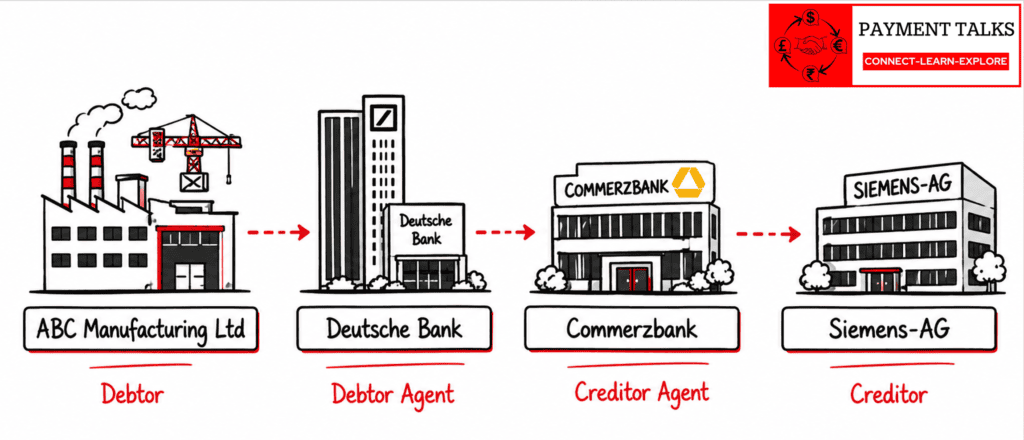
[VISUAL 1: Payment Type Information in ISO 20022 example: PAIN.001 to PACS.008 flow from ABC Manufacturing to Commerzbank]
Step 1 — PAIN.001 (ABC Manufacturing → Deutsche Bank)
ABC Manufacturing sends its payment instruction to Deutsche Bank. At this stage, ABC populates all four fields it controls: Instruction Priority, Service Level, Local Instrument, and Category Purpose. There is no Clearing Channel here — that is not ABC’s decision to make.
XML Snippet:
<PmtTpInf>
  <InstrPrty>HIGH</InstrPrty>
  <SvcLvl><Cd>SEPA</Cd></SvcLvl>
  <LclInstrm><Cd>INSTTC01</Cd></LclInstrm>
  <CtgyPurp><Cd>SUPP</Cd></CtgyPurp>
</PmtTpInf>
Reading it out loud: “This is a HIGH priority instruction. Process it under SEPA scheme rules. The instrument is Time Critical Instant Credit Transfer (INSTTC01). The business purpose is a supplier payment (SUPP).”
ABC has told Deutsche Bank everything it needs to know about the nature of this payment. Deutsche Bank now takes over.
Step 2 — PACS.008 (Deutsche Bank → Commerzbank)
Deutsche Bank validates the PAIN.001, applies its routing logic, and generates a PACS.008 to send to Commerzbank through the interbank network. It carries all four fields forward — and adds the fifth: Clearing Channel.
Deutsche Bank’s payment engine evaluates the Service Level (SEPA), the instrument (INSTTC01), the amount (€150,000), and the currency (EUR). It determines that for a SEPA, high-value EUR Time Critical payment within the Eurozone, TARGET2 (an RTGS system) is the correct clearing rail. It populates ClrChanl accordingly.
XML Snippet:
<PmtTpInf>
  <InstrPrty>HIGH</InstrPrty>
  <SvcLvl><Cd>SEPA</Cd></SvcLvl>
  <LclInstrm><Cd>INSTTC01</Cd></LclInstrm>
  <ClrChanl>RTGS</ClrChanl>
  <CtgyPurp><Cd>SUPP</Cd></CtgyPurp>
</PmtTpInf>
Reading it out loud: “This is a HIGH priority interbank credit transfer. It is governed by SEPA rules. The instrument is a Time Critical Instant Payment. It must settle via Real-Time Gross Settlement (RTGS). The business category is supplier payment.”
Commerzbank receives this PACS.008, sees RTGS as the clearing channel, expects real-time gross settlement through TARGET2, and credits Siemens AG’s account immediately.
The Flow — At a Glance
| Field | PAIN.001 (ABC → Deutsche Bank) | PACS.008 (Deutsche Bank → Commerzbank) | Who Sets It |
| InstrPrty | HIGH | HIGH | ABC Manufacturing |
| SvcLvl | SEPA | SEPA | ABC Manufacturing |
| LclInstrm | INSTTC01 | INSTTC01 | ABC Manufacturing |
| ClrChanl | (not present) | RTGS | Deutsche Bank (payment engine) |
| CtgyPurp | SUPP | SUPP | ABC Manufacturing |
Service Level vs Local Instrument vs Clearing Channel: What Is the Real Difference?
This is one of the most common points of confusion in ISO 20022. The three fields sound similar — they all relate to how a payment is processed — but they operate at completely different layers. Confusing them leads to poor field mapping, incorrect routing, and failed scheme compliance.
Here is the cleanest way to think about it:
- Service Level = the agreement or scheme that governs the payment.
- Local Instrument = the specific payment product or instrument within that scheme.
- Clearing Channel = the technical rail on which settlement actually happens.
Here is how I put it on a whiteboard when someone’s eyes start to glaze over. Think of a payment like a parcel moving through a courier network.
Service Level is the contract you signed with the courier — DHL Express versus a standard postal service. It sets the rules: delivery window, tracking requirements, who is liable if it goes missing.
Local Instrument is the specific product you picked under that contract — next-day, same-day, economy. Same courier, same contract, different tier.
Clearing Channel is the actual vehicle that carries the parcel — the truck, the plane, the van. Two parcels can have the identical contract and the identical service tier and still travel on completely different vehicles, depending on destination and capacity that day.
The corporate picks the contract and the tier. The bank picks the vehicle. That is the whole model — and it is exactly why ClrChanl only shows up in PACS.008. The corporate was never in the vehicle-selection business to begin with.
Let us break each layer down properly — then look at how they interact.
Service Level — The Agreement Layer
Service Level (SvcLvl) defines the processing agreement or scheme under which the payment must be handled. It is a commitment between the initiating party and the bank — or between two banks — about the rules that apply.
Service Level is about the promise and the rulebook. It does not tell the bank which pipe to use. It tells the bank what the payment must achieve and under what rules.
Local Instrument — The Product Layer
Local Instrument (LclInstrm) drills one level deeper. Within a given scheme or market, there are often multiple distinct payment products. Local Instrument identifies exactly which product or instrument applies.
Local Instrument is also heavily used in domestic clearing contexts, where there is no overarching international scheme code, but the payment still needs to be tagged with the correct domestic product type for the local clearing infrastructure.
Clearing Channel — The Settlement Rail Layer
Clearing Channel (ClrChanl) is an entirely different concept. It does not describe the scheme. It does not describe the product. It describes the physical, or logical, infrastructure through which the payment will actually be settled between financial institutions.
Two payments can have the same Service Level and the same Local Instrument, and still settle through completely different clearing channels, depending on their value, currency, or bilateral arrangement.
ClrChanl answers the question: “Which pipe does the money actually flow through?”
And critically, this field only exists in PACS.008, not in PAIN.001. The corporate does not choose the clearing rail. The bank does.
The Three Layers — Side by Side
| Dimension | Service Level | Local Instrument | Clearing Channel |
| What it defines | The scheme or processing agreement | The specific payment product or instrument | The settlement infrastructure / rail |
| Who cares about it | Compliance, scheme rules, SLA | Product classification, clearing system eligibility | Liquidity management, settlement teams |
| Who sets it | The Debtor (corporate) or Debtor Agent | The Debtor (corporate) or Debtor Agent | The Debtor Agent (bank) — in PACS.008 only |
| Present in PAIN.001? | Yes | Yes | No |
| Present in PACS.008? | Yes | Yes | Yes |
| Analogy | “Which rulebook applies?” | “Which product are we using?” | “Which pipe does money flow through?” |
Three Practical Scenarios to Make It Click
Scenario A — A Low-Value SEPA Salary Payment
A German payroll company sends 500 salary payments to employees across Europe. Each is €2,500.
- SvcLvl = SEPA → must comply with SEPA scheme rules.
- LclInstrm = TRF → the specific product is SEPA Credit Transfer, not direct debit, not instant.
- CtgyPurp = SALA → these are salary payments.
- ClrChanl = RTNS (in PACS.008) → at €2,500 each, these go through STEP2, a deferred net settlement ACH system. No need for RTGS. They are batched, netted, and settled at defined cut-off windows.
Scenario B — A High-Value Treasury Payment (Same Day Required)
A UK corporate treasury sends £5 million to a counterparty bank as part of a same-day FX settlement.
- SvcLvl = SDVA → same-day value is mandatory.
- LclInstrm → may be absent or proprietary; this is not a SEPA payment.
- CtgyPurp = TREA → treasury payment.
- ClrChanl = RTGS (in PACS.008) → at £5 million, CHAPS (the UK RTGS system) is the only appropriate rail. This payment settles gross and in real time. No netting. No batching.
Scenario C — An Internal Book Transfer
A corporate with accounts at the same bank, say HSBC UK, moves funds between two of its own accounts, both held at HSBC.
- SvcLvl → may be proprietary or absent; it is an internal movement.
- LclInstrm → may be proprietary or absent; it is an internal movement.
- ClrChanl = BOOK (in PACS.008) → no external clearing needed. HSBC simply moves the balance between two internal accounts. No TARGET2. No CHAPS. No network fees.
Note: since this is a BOOK payment, no PACS.008 is generated to be sent out at HSBC.
The Relationship Between the Three
They are not alternatives to each other. They are complementary layers, each describing a different dimension of the same payment. A complete picture looks like this:
“This payment must comply with SEPA rules (Service Level), it is a SEPA Credit Transfer (Local Instrument), and it will settle through STEP2 net settlement (Clearing Channel).”
Or:
“This is a same-day value payment (Service Level), it is a bespoke bilateral instrument (Local Instrument, proprietary), and it must go through TARGET2 RTGS (Clearing Channel).”
Service Level and Local Instrument travel with the payment from corporate to bank and onwards. Clearing Channel is added by the bank when it sends the interbank PACS.008, because the bank owns the clearing rail decision.
The One-Line Summary for Each
- Service Level = “What rules govern this payment?”
- Local Instrument = “Which specific payment product is this?”
- Clearing Channel = “Which infrastructure settles this payment?”
Three different questions. Three different answers. One PmtTpInf block that carries them all.
Common Misconceptions About Payment Type Information
“Category Purpose and Purpose are the same thing.”
They are not. CtgyPurp (Category Purpose) is a high-level business category: salary, supplier, treasury. Purp (Purpose) in CdtTrfTxInf is a more specific transaction-level code. Both can coexist in the same message, serving different audiences.
“Service Level and Local Instrument are always used together.”
Not always. You can have one without the other. Service Level is the scheme-level signal. Local Instrument is the instrument-level signal. Many domestic payments use only Local Instrument. Many SEPA payments use both. Use what is relevant for the payment context.
“ClrChanl in PACS.008 is populated by the corporate.”
No. The corporate initiates in PAIN.001, which has no ClrChanl. The Debtor Agent’s payment engine determines the appropriate clearing channel and populates it in the outgoing PACS.008. The corporate has indirect influence via Service Level and Instruction Priority, but the clearing channel decision always sits with the Debtor Agent bank.
“InstrPrty = HIGH guarantees same-day settlement.”
It does not. Instruction Priority is a processing signal, not a settlement guarantee. Same-day settlement requires the combination of HIGH priority, SDVA service level, compliance with cut-off times, and the appropriate clearing channel. Miss any of these and the same-day commitment may not be met.
“If the schema validates, the field combination is correct.”
Not necessarily. Schema validation checks structure, not business logic. A message can be perfectly valid XML with a SvcLvl and ClrChanl that do not actually belong together, because most orchestration products do not run that check. That gap is exactly where mis-cleared payments come from.
Key Takeaways
- Payment Type Information (PmtTpInf) is the instruction label on a payment. It describes how and why to process it, not who is paying whom or how much.
- In PAIN.001, it appears at both the PmtInf level (default for all transactions) and the CdtTrfTxInf level (transaction-level override). Transaction level wins if both are present.
- In PACS.008, it appears at the CdtTrfTxInf level only, and includes the additional ClrChanl field, which the Debtor Agent’s payment engine populates.
- The five sub-fields are: Instruction Priority, Service Level, Local Instrument, Category Purpose, and Clearing Channel (PACS.008 only).
- Service Level is the scheme-level signal (e.g., SEPA, SDVA). Local Instrument is the instrument-level signal (e.g., TRF). They complement each other.
- ClrChanl is one of the most operationally critical fields in PACS.008. It tells the interbank chain which clearing rail, RTGS, RTNS, BOOK, or MPNS, to use for settlement.
- The entire PmtTpInf block, except ClrChanl, flows from PAIN.001 through to PACS.008 as the payment moves from corporate initiation to interbank execution.
- Because every field is optional and still relatively new in active use, missing validation logic around this block is one of the more common sources of production incidents in PAIN.001-to-PACS.008 flows. Optional in the schema does not mean optional to get right.
FAQ: Payment Type Information in ISO 20022
Q1: What is Payment Type Information (PmtTpInf) in ISO 20022?
A1: PmtTpInf is a structured block in ISO 20022 messages that describes the nature of a payment: its urgency, scheme, product, business purpose, and, in PACS.008, its settlement rail. It does not carry the who or the how much; those live elsewhere in the message.
Q2: Is PmtTpInf mandatory in PAIN.001 and PACS.008?
A2: No. The entire block, and every sub-field inside it, is optional in both messages. That is exactly why so many banks leave it blank, and why payment orchestration products often skip validating it.
Q3: What is the difference between Service Level and Local Instrument?
A3: Service Level defines the scheme or agreement governing the payment, like SEPA. Local Instrument defines the specific product within that scheme, like a SEPA Credit Transfer (TRF). Many payments use both; some use only one.
Q4: Who sets the Clearing Channel field, the corporate or the bank?
A4: The bank. Clearing Channel only exists in PACS.008, and it is the Debtor Agent’s payment engine that populates it, based on service level, currency, amount, and clearing rules, after the corporate’s PAIN.001 has already been submitted.
Q5: Does InstrPrty = HIGH guarantee same-day settlement?
A5: No. Instruction Priority is a processing signal, not a settlement guarantee. Same-day settlement needs HIGH priority combined with the right service level, such as SDVA, correct cut-off timing, and the right clearing channel.
Q6: What is the MT equivalent of PmtTpInf?
A6: There is no clean one-to-one mapping. Some of the intent, like urgency or same-day value, was carried in MT101/MT103 Field 23E instruction codes, but ISO 20022’s structured sub-fields go further than anything the MT format supported.
Q7: Why do payment engines sometimes mishandle PmtTpInf fields?
A7: Two common causes: many banks still run MT-era routing logic that was never designed to read PmtTpInf, and many orchestration products map PAIN.001 fields straight into PACS.008 without validating whether the resulting combination actually makes sense.
Q8: What happens if PmtTpInf fields are left blank?
A8: The payment still processes, but the bank loses the corporate’s signal on urgency, scheme, and purpose. That usually means the engine falls back to default routing, which can mean slower processing or the wrong clearing rail for what the corporate actually needed.
Watch the Full Walkthrough
▶ Watch the Full Walkthrough on YouTube
Prefer video? The full walkthrough is on the PaymentTalks YouTube channel.