
The Question Every Payments Professional Is Asking Right Now
A colleague stops me in the corridor. “The central bank wants a readiness assessment for a retail CBDC pilot. Can you lead it?” I have had this exact conversation for real, not as a thought exercise. At Saudi Awwal Bank I represented the bank across two separate SWIFT digital asset initiatives while also sitting inside a SAMA sponsored mBridge pilot. The question that follows is always the same, whether it comes from a colleague, a client, or a central bank relationship manager: is a CBDC just a government stablecoin? What is actually different?
You are not alone in asking it. The confusion between Central Bank Digital Currencies (CBDCs) and stablecoins is one of the most common conceptual blurs in payments right now. Both are digital. Both are pegged to fiat currency. Both live on some form of ledger. On the surface they look similar.
Underneath, they are fundamentally different: in who issues them, who bears the risk, how they settle, and what role they play in the monetary system. Getting this distinction wrong has real consequences. It affects how you design payment architectures, how you advise clients, how you assess regulatory obligations, and how you communicate with central banks, commercial banks, and corporate treasurers.
This article gives you the complete picture. By the end, you will understand what CBDCs are, how they work at a technical and operational level, and exactly where they converge with and diverge from stablecoins, backed by real world examples, live projects, and a comparison you can use immediately.
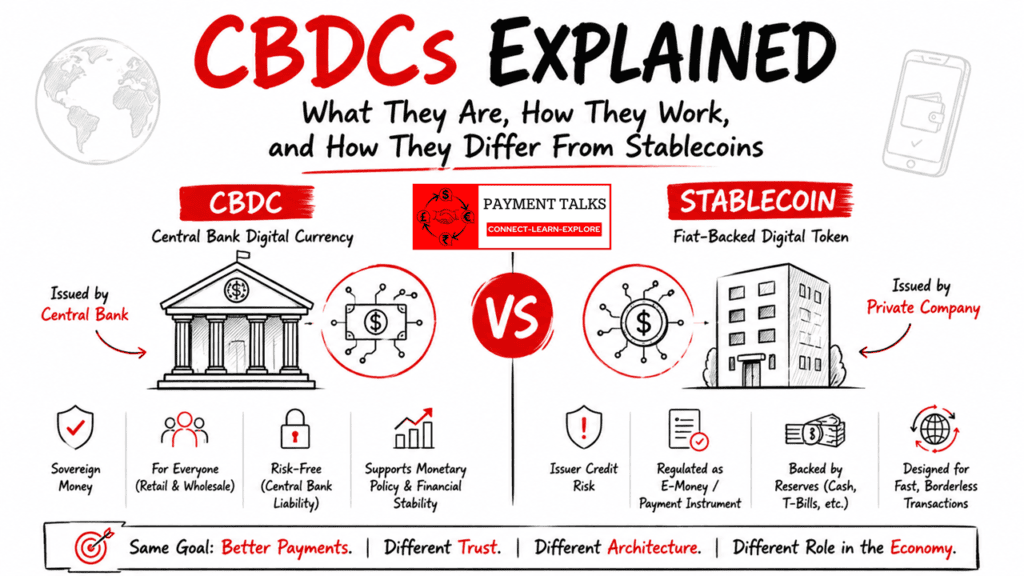
[VISUAL 1: CBDC vs stablecoin at a glance: central bank issuance versus private issuance, side by side infographic]
What Is a CBDC, Exactly?
A Central Bank Digital Currency (CBDC) is a digital form of a country’s sovereign currency, issued and backed directly by the country’s central bank.
Every word in that definition earns its place.
Digital form. It is not physical cash. It is a digital representation of money, but unlike the digital money already sitting in your bank account, it carries specific properties that make it structurally different.
Sovereign currency. It carries the same legal tender status as banknotes and coins. If a country issues a retail CBDC, a shop legally required to accept cash is legally required to accept the CBDC too, because it is the same money in a different form.
Issued and backed directly by the central bank. This is the defining characteristic. A CBDC is a direct liability of the central bank, not a commercial bank, not a private issuer, not an algorithm. The same institution that issues banknotes issues the CBDC.
The simplest analogy I use on a whiteboard: a CBDC is a digital banknote. Just as a physical £20 note is a direct claim on the Bank of England, a digital £20 CBDC is a direct claim on the Bank of England. The trust anchor is the sovereign state itself, the same entity that controls monetary policy, manages the money supply, and acts as lender of last resort.
Why Are Central Banks Building CBDCs?
Central banks do not move quickly. When over 130 central banks, representing more than 98% of global GDP, are actively researching or developing CBDCs, something significant is driving it. Five motivations explain most of it.
Motivation 1: The Declining Use of Cash
Physical cash is in structural decline in most developed economies. In Sweden, cash now accounts for less than 10% of transactions. In the UK, contactless payments overtook cash payments for the first time in 2022. In China, digital wallets handle the vast majority of consumer transactions.
If cash disappears entirely, citizens lose direct access to central bank money. Every digital payment would be intermediated by a commercial bank, subject to that bank’s solvency, policies, and fees. A retail CBDC preserves the public’s access to a risk free, government backed form of money in a cashless world.
Motivation 2: Financial Inclusion
Globally, approximately 1.4 billion adults remain unbanked. Many live in jurisdictions where mobile phones are ubiquitous but banking infrastructure is thin. A CBDC accessible via a smartphone app, or even an offline card, can give these individuals access to safe, government backed money without requiring a bank account.
This is a central motivation for CBDCs in Sub-Saharan Africa, Southeast Asia, and parts of Latin America. Nigeria’s eNaira was explicitly designed with financial inclusion as a primary objective.
Motivation 3: Payment System Efficiency and Competition
Commercial banks and private payment networks have historically controlled payments infrastructure. A CBDC can introduce competition, reduce fees, improve interoperability, and enable innovation, all while the central bank retains oversight of systemic risk.
For cross-border payments specifically, bilateral or multilateral CBDC arrangements like mBridge can eliminate correspondent banking chains, cutting cost and settlement time dramatically. I worked a live mBridge pilot directly, and I walk through what that actually involves later in this article.
Motivation 4: Monetary Policy Transmission
CBDCs open new possibilities for monetary policy. A central bank could, in theory, apply programmable interest rates directly to CBDC holdings, stimulating spending with negative rates on idle balances or encouraging saving with positive rates. It could implement targeted fiscal stimulus, distributing digital money directly to citizens’ CBDC wallets without the friction of banking infrastructure.
These capabilities are theoretically possible. Whether they should be implemented raises significant economic and privacy debates. But they are part of why central banks are interested.
Motivation 5: Countering Private Digital Currencies and Foreign CBDCs
Meta’s Libra project (2019), a global stablecoin backed by a basket of fiat currencies, alarmed central banks worldwide. The prospect of a private company issuing a global digital currency that could compete with sovereign money accelerated CBDC development significantly. Similarly, China’s digital yuan (e-CNY) has created strategic urgency in the US, EU, and UK to develop competing state backed digital currency infrastructure.
Retail vs Wholesale CBDC: What’s the Difference?
This is the most important structural distinction in the CBDC landscape. Retail and wholesale CBDCs serve completely different purposes, involve different participants, and have different architectural implications.
Retail CBDC
A retail CBDC is a digital currency available directly to the general public, individuals and businesses. It is the digital equivalent of banknotes in your wallet.
Who holds it: Every citizen, every business. The end consumer.
How it works: A citizen opens a CBDC wallet, via the central bank’s app or through a licensed commercial bank acting as a distribution intermediary. They can receive wages in CBDC, pay at shops, transfer to other citizens, and hold CBDC as a savings instrument.
Who it replaces or supplements: Physical cash. Potentially also commercial bank deposits, though most central banks are designing holding limits to prevent this. More on that later.
Live examples:
- Digital Yuan / e-CNY (China): The most advanced retail CBDC deployment globally. Live in over 26 cities. Used for retail payments, government subsidies, and event payments (2022 Beijing Winter Olympics). Processed over ¥1.8 trillion (roughly $250 billion) in transactions as of 2023.
- eNaira (Nigeria): Africa’s first CBDC. Launched October 2021. Designed for financial inclusion, targeting the unbanked population.
- DCash (Eastern Caribbean Currency Union): A retail CBDC serving eight island nations. One of the first multi-country retail CBDCs.
- Sand Dollar (Bahamas): The world’s first nationally deployed retail CBDC. Live since October 2020.
Wholesale CBDC
A wholesale CBDC is a digital currency available only to financial institutions: commercial banks, central banks, clearing houses, and other regulated entities. It is not accessible to the general public.
Who holds it: Banks and financial institutions only.
How it works: Commercial banks hold reserve accounts at the central bank. Currently these accounts are digital, but they run on centralised, proprietary central bank ledger systems. A wholesale CBDC moves this infrastructure to a programmable, distributed ledger, enabling atomic settlement, smart contract automation, and interoperability with tokenised asset markets.
Who it replaces: Existing wholesale settlement systems, Fedwire (US), CHAPS (UK), TARGET2 (EU), and RTGS systems globally.
Live examples and pilots:
- mBridge (Central Bank of UAE, PBoC, HKMA, Bank of Thailand, and SAMA): Multi-CBDC platform for cross-border wholesale settlement. Reached MVP stage in mid-2024. As of late 2025 it had processed 4,047 transactions worth $55.49 billion, up from just $22 million in its 2022 pilot. The BIS stepped away from a governance role in October 2024, handing day-to-day running to the five participating central banks, with Saudi Arabia (SAMA) joining that same year. e-CNY accounts for roughly 95% of settled volume. I was part of the SAB team on this pilot, more on that below.
- Project Agorá (BIS and seven central banks): Wholesale tokenisation pilot involving more than 40 private institutions including JPMorgan, Citi, HSBC, and SWIFT. Testing phase results are expected in the first half of 2026.
- Project Jura (BIS, Banque de France, Swiss National Bank): Tested cross-border settlement of tokenised financial assets using wholesale CBDCs.
- Project Rosalind (BIS, Bank of England): Explored API architectures for a retail CBDC.
- Digital Euro (ECB): Final regulatory framework published July 2026, with an EU Parliament vote expected by September 2026. A pilot is targeted for 2027, with potential issuance in 2028 to 2029 pending legislation.
- Digital Dollar (US Federal Reserve): FedNow is an instant payment rail, not a CBDC, and should not be confused with one. As of July 2026, a Federal Reserve CBDC is barred by statute through December 31, 2030, under the 21st Century ROAD to Housing Act, which builds on a January 2025 executive order that had already halted federal work on a digital dollar.
How Does a CBDC Actually Work? The Technical Architecture
CBDCs do not all work the same way. Central banks have significant design flexibility. Here are the key architectural decisions every payments professional needs to understand.
Design Decision 1: Centralised vs Distributed Ledger
A CBDC can run on a centralised ledger, a database managed directly by the central bank, or on a distributed ledger, a shared ledger maintained by multiple nodes, potentially using blockchain technology.
Centralised ledger: The central bank runs the database. It records all CBDC balances and transactions. Commercial banks and wallets interact with it via APIs. This is architecturally similar to how existing RTGS systems work, just modernised and made accessible to a broader set of participants. The Bank of England’s digital pound design leans toward this model.
Distributed ledger (DLT/blockchain): A permissioned blockchain shared between the central bank and selected participants, commercial banks and technology providers. The central bank retains authority over the ledger but shares validation with trusted nodes. China’s e-CNY uses a two-tier architecture with some distributed elements. The mBridge platform uses a permissioned blockchain purpose built for multi-CBDC settlement.
Most retail CBDCs are trending toward centralised or hybrid architectures, prioritising scalability, transaction speed, and central bank control over the pure decentralisation philosophy of public blockchains.
Most wholesale CBDC projects are exploring permissioned DLT architectures, because the benefits of programmability, atomic settlement, and interoperability are more readily achievable on DLT, and the participant set is small and fully regulated.
Design Decision 2: Account-Based vs Token-Based
Account-based CBDC: The balance is held in an account linked to an identity. Spending is authenticated by proving you are the account holder, like a bank account with a PIN or biometrics. Transaction records reference the payer and payee directly.
Token-based CBDC: The balance is held in a cryptographic token. Possession of the token’s private key proves ownership. Transactions work by transferring the token. This is more analogous to physical cash, and enables greater privacy.
Most retail CBDC designs are account based at the institutional level but may offer token based functionality for offline or privacy preserving use cases. The ECB’s digital euro design includes a privacy tier where small payments below a threshold are not individually traceable.
Design Decision 3: Direct vs Indirect (Two-Tier) Issuance
Direct model: The central bank issues CBDC directly to citizens. Citizens hold accounts at the central bank. Very few central banks are pursuing this. It would represent a massive operational undertaking and would disintermediate commercial banks entirely.
Indirect (two-tier) model: The central bank issues CBDC to commercial banks. Commercial banks distribute CBDC to their customers and handle the customer facing infrastructure. The central bank remains the issuer and the liability sits on its balance sheet, but the distribution and servicing is handled by the commercial banking layer. This is the model most central banks are pursuing, including the digital pound (UK), digital euro (EU), and e-CNY (China).
This two-tier model is critical for payments architects. It means commercial banks play a central role in CBDC distribution and need to build CBDC compatible infrastructure: wallets, APIs, onboarding flows, and compliance controls.
Design Decision 4: Programmability
A CBDC on a programmable ledger can have smart contract logic embedded, rules that govern how the currency can be used.
Examples of programmability in CBDC design:
- Earmarking: government stimulus money that can only be spent on food, rent, or utilities, used for pandemic relief in China
- Expiry: CBDC balances that expire after a set period, forcing spending and stimulating economic activity
- Conditional release: payment that only settles when a delivery condition is confirmed, useful for trade finance and supply chain payments
- Interest accrual: positive or negative interest rates applied automatically to CBDC holdings
Programmability is powerful, and controversial. Civil liberties advocates raise significant concerns about governments having the technical ability to control how citizens spend their money. Most Western central banks are moving cautiously, emphasising privacy and limiting programmability to specific use cases.
CBDCs in Action: Two Real-World Scenarios
Scenario 1: Retail CBDC, Consumer Payment
Location: China. Citizen: Zhang Wei, a retail worker in Shanghai.
Zhang Wei receives her monthly salary of ¥8,000 in e-CNY, transferred directly to her digital yuan wallet by her employer. She uses the PBOC issued app to pay for groceries at a nearby supermarket. The merchant’s point of sale terminal accepts e-CNY via QR code. The transaction settles instantly. No bank intermediary is involved. The settlement is final on the central bank’s ledger.
She also transfers ¥2,000 to her mother in rural Shandong. The transfer is instant, free, and works even though her mother has no bank account, just a feature phone with the e-CNY app.
What this demonstrates:
- Peer to peer transfer without a commercial bank
- Financial inclusion for the unbanked
- Real time, 24/7 settlement at zero cost
- Direct claim on the People’s Bank of China, not on a commercial bank
Scenario 2: Wholesale CBDC, Cross-Border Interbank Settlement
Participants: Emirates NBD (UAE) and Siam Commercial Bank (Thailand). Platform: mBridge.
Emirates NBD needs to send $10 million to Siam Commercial Bank in settlement of a trade finance transaction. Traditionally: a SWIFT message, a correspondent bank in USD, one to two day settlement, and fees.
On mBridge:
- Emirates NBD submits the payment instruction to the mBridge platform
- The CBUAE (Central Bank of UAE) issues tokenised dirham (AED CBDC) onto the mBridge ledger equivalent to $10M
- An atomic swap executes on the mBridge DLT: AED CBDC is exchanged for Thai Baht CBDC simultaneously
- Siam Commercial Bank’s account on the mBridge ledger is credited with THB CBDC
- The Bank of Thailand’s systems register the settlement
- The entire transaction is final in seconds
No correspondent bank. No SWIFT message. No one to two day wait. Settlement certainty from the moment the atomic swap executes.
What this demonstrates:
- Wholesale CBDC eliminating the correspondent chain
- Atomic settlement removing Herstatt risk, counterparty default before settlement
- Real time cross-border settlement at institutional scale
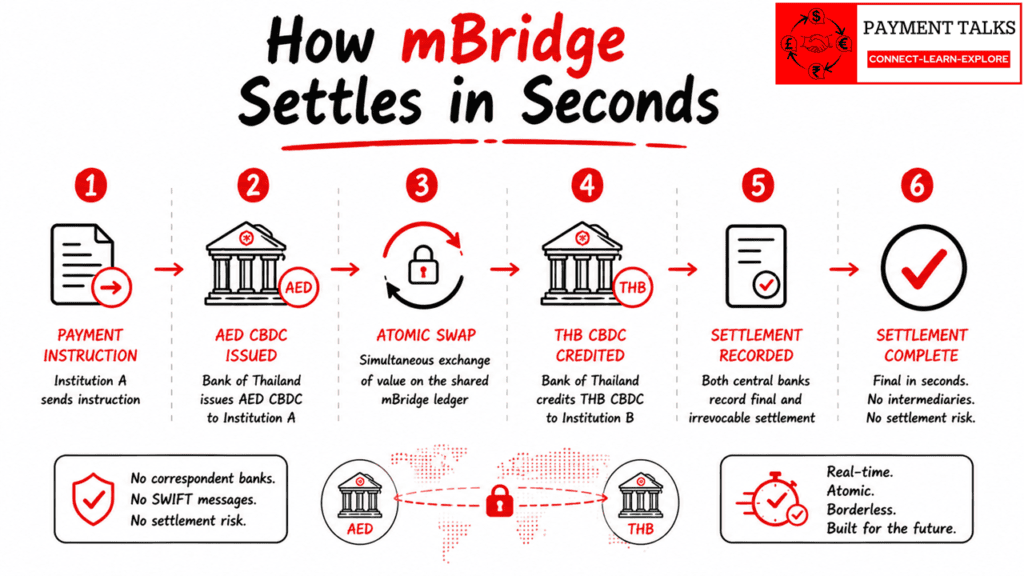
[NEW VISUAL: mBridge atomic swap flow, 6 step diagram showing AED CBDC issuance, atomic swap, and THB CBDC credit]
CBDC vs Stablecoin: The Complete Comparison
This is where many professionals get confused. The table below maps every meaningful dimension of difference.
| Dimension | CBDC | Stablecoin (Fiat-Backed, e.g. USDC) |
| Issuer | Central bank (sovereign institution) | Private company (e.g. Circle, Tether Ltd) |
| Liability of | Central bank, the state | Private issuer, a commercial entity |
| Backing | Full faith and credit of the sovereign state | Reserves (cash, T-Bills) held by private issuer |
| Legal tender status | Yes, legally mandated for acceptance | No, acceptance is contractual |
| Regulatory status | Sovereign money, above regulation | Regulated as e-money / payment instrument (MiCA, GENIUS Act) |
| Insolvency risk | Effectively zero (a state cannot default on its own currency) | Issuer insolvency risk exists (mitigated by reserve quality) |
| Who can hold it | Retail CBDC: general public. Wholesale CBDC: financial institutions | Anyone with a qualifying wallet and KYC approval |
| Peg mechanism | Is the sovereign currency, no peg mechanism needed | External mechanism: reserves + mint/burn cycle |
| De-peg risk | None (it is the reference currency itself) | Yes, reserve failure, bank run, issuer insolvency |
| Programmability | Possible (central bank decides) | Yes, smart contract logic (e.g. blacklisting) |
| Privacy | Determined by central bank design (major policy debate) | Pseudonymous on public chains; custodial platforms know user identity |
| Interest bearing | Possible by design (most current designs non-interest bearing) | No inherent interest, yield only through DeFi lending |
| AML/KYC | Mandatory, embedded in CBDC architecture | Mandatory for regulated issuers and VASPs |
| Cross-border use | Limited, bilateral/multilateral arrangements required (mBridge: $55.49B across 4,047 transactions as of late 2025) | Immediate, transferable to any wallet globally |
| Monetary policy tool | Yes, directly controlled by central bank | No, supply determined by commercial demand |
| Current availability | 3 jurisdictions fully launched (Bahamas, Jamaica, Nigeria); 41+ pilots underway; 146 countries exploring | Globally available in all jurisdictions permitting crypto |
| Settlement finality | On the central bank ledger, ultimate finality | Blockchain finality (varies by chain: seconds to minutes) |
| Interoperability | Limited, each CBDC is jurisdiction specific | High, USDC operates on 10+ blockchains globally |
Trust Architecture: The Deepest Difference Between a CBDC and a Stablecoin
The table above shows the surface differences. But the deepest difference between a CBDC and a stablecoin is the trust architecture: who you are ultimately trusting, and what happens when that trust is challenged.
Who Backs the Money?
When you hold USDC, you are trusting:
- Circle (the issuer) to hold genuine, fully reserved USD and T-Bills
- The banks holding those reserves to remain solvent
- The smart contract to execute correctly
- Regulators to enforce Circle’s compliance obligations
Every one of these trust dependencies is with a private actor. The US government does not guarantee USDC. If Circle failed, USDC holders would be creditors of a bankrupt company. For the full mechanics of how a stablecoin like USDC is actually minted, reserved, and redeemed, see How Stablecoins Are Created and Destroyed.
When you hold a retail CBDC, for example a digital pound, you are trusting:
- The Bank of England, an institution that cannot go insolvent in its own currency, because it issues the currency itself
- No banks, no private issuers, no smart contracts for the core liability
The risk profile is categorically different. A CBDC is as safe as sovereign money, because it is sovereign money. A stablecoin is as safe as its private issuer and its reserves, which is substantially safe for USDC but not the same thing.
The March 2023 Illustration
When Silicon Valley Bank failed in March 2023, USDC briefly de-pegged to $0.87 because Circle held reserves there. In the same moment, central bank reserves held in the Federal Reserve were entirely unaffected. No CBDC would have de-pegged, because a CBDC’s value is not contingent on any commercial bank’s solvency.
This is not a criticism of USDC. It recovered fully and Circle’s reserve design has since been strengthened. It is an illustration of a structural difference in the trust architecture.
Where Do CBDCs and Stablecoins Actually Overlap?
The relationship between CBDCs and stablecoins is not purely adversarial. In several important scenarios, they complement each other.
Intersection 1: CBDC as the Settlement Asset for Stablecoin Systems
In a mature digital money ecosystem, stablecoins could continue to operate as the programmable, consumer facing layer, while wholesale CBDCs provide the interbank settlement infrastructure underneath. A stablecoin transfer between two major exchanges could settle net positions using wholesale CBDC at the end of the day, combining the flexibility of stablecoins with the finality of central bank money. For a deeper look at how architects are designing these layered systems, see How to Architect a Stablecoin Payment System.
This is analogous to how commercial bank money, which most consumers use, settles on central bank reserves, which underpin the system. The layered model is well established in traditional finance.
Intersection 2: Regulated Stablecoins as CBDC Complements
Most central banks are not trying to replace all private digital money. The ECB’s digital euro is designed to coexist with bank deposits, payment applications, and stablecoins. The Bank of England has been explicit that the digital pound is not intended to replace commercial bank money, it is intended to complement it.
In this coexistence model, regulated stablecoins (USDC, EURC) serve the private sector innovation layer, programmable, globally portable, DeFi compatible. Retail CBDCs serve the public layer, accessible to all citizens, no credit risk, legal tender. Both serve their domains. For where this coexistence model runs into regulatory friction, see Stablecoin Risks and Regulation.
Intersection 3: Stablecoins as CBDC On-Ramps
In jurisdictions where a retail CBDC does not yet exist, regulated stablecoins effectively perform a similar function for users already in the digital asset ecosystem. As CBDCs launch, regulated stablecoin issuers may position themselves as licensed distribution infrastructure, wallets and interfaces through which citizens access their CBDC.
Circle has explicitly signalled this direction, positioning USDC as CBDC compatible infrastructure rather than a competitor.
What Do CBDCs Mean for Payments Professionals?
If you work in payments architecture, product, or operations, CBDCs will touch your work within the next five to ten years. Here is where the practical impact falls.
Impact on Commercial Banks
Commercial banks face a genuine structural challenge from retail CBDCs. If citizens can hold CBDC directly with the central bank, they may reduce their commercial bank deposits, particularly in times of financial stress, when a flight to the safety of CBDC could be very rapid.
This is why most central bank CBDC designs include holding limits, caps on how much CBDC an individual can hold. The Bank of England has proposed a limit of £10,000 to £20,000 for the digital pound. The ECB has proposed €3,000 for the digital euro. These limits are explicitly designed to prevent disintermediation of commercial banks.
For banks, the CBDC creates both risk, deposit outflow, and opportunity, distribution infrastructure revenue and programmable product development on CBDC rails.
Impact on Payment Engines
This is the piece I work with directly. Payment engines processing ISO 20022 messages need to evolve to handle CBDC payment instructions. The payment data, debtor, creditor, amount, purpose, remains consistent with ISO 20022 structure. But the settlement layer changes. For the full breakdown of who sits in that message and what each party does, see All Agents and Parties in an ISO Payment Message.
Instead of settling through a commercial bank’s nostro or vostro accounts on RTGS, a wholesale CBDC settlement instruction triggers a tokenised transfer on the CBDC platform. Payment engines must integrate with CBDC APIs, whether that is a central bank API layer, as Project Rosalind explored, or a DLT interface.
The ISO 20022 message standard is well suited to CBDC contexts. Its rich data structure carries everything needed to describe a CBDC payment instruction. SWIFT is actively exploring how its messaging infrastructure connects to CBDC and tokenised settlement platforms; see Stablecoins & ISO 20022 for how the same question plays out on the stablecoin side.
Impact on Correspondent Banking
Wholesale CBDCs are an existential challenge to the correspondent banking model for specific corridors. If mBridge, or its successors, scales to cover major trade corridors, banks in those corridors lose the fee income from correspondent services, but gain faster, cheaper settlement for their own cross-border needs.
The net effect for a bank depends heavily on which side of the correspondent relationship it sits. Smaller banks that depend on correspondents for international access benefit from CBDC enabled direct access. Major correspondent banks face revenue compression in the corridors where CBDC arrangements emerge. If you need the underlying account mechanics first, see Nostro, Mirror Nostro, Vostro, and Loro Accounts.
Impact on Corporate Treasurers
Retail and commercial CBDCs open new treasury management possibilities. If a corporate can hold CBDC directly, with no credit risk on the balance, instant settlement, and programmable disbursement, the appeal for cash management purposes is significant.
For multinationals operating in jurisdictions with live CBDCs, treasury architects need to assess:
- Can the corporate hold CBDC?
- Are holding limits an issue for large corporate balances?
- How does the CBDC integrate with the ERP and treasury management system?
- What happens to CBDC liquidity in a financial crisis, does it behave like cash or like a bank deposit?
Common Misconceptions About CBDCs
“A CBDC is just the government’s version of a stablecoin.”
Not quite. A stablecoin is a private instrument that mimics sovereign currency. A CBDC is sovereign currency in a new form. The difference is not semantic. It is the difference between a photocopy of a banknote and the banknote itself.
“CBDCs will replace cash completely.”
Most central bank designs explicitly preserve cash as an alternative. The digital pound project documentation states that the Bank of England has no plans to abolish cash. CBDCs are designed to supplement, not replace, physical currency. The decision to use CBDC or cash remains with the individual.
“CBDCs are just cryptocurrency with government backing.”
Most retail CBDC designs do not use public blockchain technology. They run on centralised or permissioned ledgers controlled by the central bank. They are not “crypto” in the way Bitcoin or Ethereum is. There is no mining, no public anonymity, no open participation in block validation.
“Stablecoins will become obsolete when CBDCs launch.”
Unlikely in the near term. Stablecoins offer global portability, DeFi compatibility, and private sector programmability that most CBDC designs deliberately do not replicate. They serve different use cases in a complementary ecosystem. The more likely outcome is regulatory clarity that positions regulated stablecoins as licensed private complements to public CBDCs. For the head to head on where stablecoins beat traditional rails today, see Stablecoins vs Traditional Payment Rails.
“Holding a CBDC is risk free.”
The monetary value is risk free, the central bank cannot default on its own currency. But there are other risks: technology risks (wallet hacks, platform outages), programmability risks (government imposed spending restrictions), and privacy risks (transaction surveillance). Risk free in terms of credit does not mean risk free in all dimensions.
“Nothing is happening in digital money until CBDCs actually launch.”
Not even close. Tokenised deposits and shared ledger infrastructure are live today, years ahead of most CBDC timelines. SWIFT’s Shared Ledger went live for initial use in July 2026 with 17 banks piloting real transactions, and the SWIFT payments Scheme already has banks live on it. I worked both initiatives directly at SAB. These are commercial bank money, not central bank money, so they are not CBDCs, but they solve real cross-border settlement problems right now while CBDCs are still mostly pilots. Do not wait for a CBDC to show up before you modernise your settlement infrastructure.
The Global CBDC Landscape: Where Things Stand in 2026
| Jurisdiction | CBDC Project | Type | Status |
| China | e-CNY (Digital Yuan) | Retail | Live, 26+ cities, largest retail deployment globally |
| Bahamas | Sand Dollar | Retail | Live since 2020 |
| Nigeria | eNaira | Retail | Live since 2021, low adoption challenges |
| Eastern Caribbean | DCash | Retail | Live across 8 island nations |
| Jamaica | JAM-DEX | Retail | Live since 2022 |
| European Union | Digital Euro | Retail + Wholesale | Final regulatory framework published July 2026; EU Parliament vote expected Sept 2026; pilot targeted 2027 |
| United Kingdom | Digital Pound (“Britcoin”) | Retail + Wholesale | Design phase, legislation pending |
| United States | Digital Dollar | Wholesale research | Banned by statute through Dec 31, 2030 (ROAD to Housing Act, July 2026) |
| India | e-Rupee | Retail + Wholesale | Pilot since 2022, scaling |
| UAE | Digital Dirham | Retail + Wholesale | Pilot (mBridge for wholesale) |
| Saudi Arabia | eSAR / Project Aber | Wholesale | mBridge participant; SAB among the commercial banks in the pilot track |
| BIS / Multiple | mBridge | Wholesale (Multi-CBDC) | $55.49B across 4,047 transactions as of late 2025; governance now with 5 central banks |
| BIS / Multiple | Project Agorá | Wholesale tokenisation | Testing phase, findings expected H1 2026, 7 central banks |
A note on scope: SWIFT’s Shared Ledger is not CBDC. It moves tokenised commercial bank deposits, not central bank money. It is worth tracking alongside this table because it is the infrastructure most payments professionals will touch years before any CBDC goes live in their market.
Key Takeaways
- A CBDC is a digital form of sovereign currency issued directly by the central bank. It carries the same legal tender status as banknotes. Its liability rests on the sovereign state, not a private company.
- Retail CBDCs target citizens and businesses. Wholesale CBDCs target financial institutions. The two are architecturally and operationally distinct, even when issued by the same central bank.
- The deepest difference from stablecoins is the trust architecture: CBDC equals sovereign credit, risk free in monetary terms. Stablecoin equals private issuer credit, backed by reserves. Both can be safe. They are not the same.
- CBDC design involves five major architectural decisions: centralised vs distributed ledger, account based vs token based, direct vs two-tier issuance, degree of programmability, and privacy model. Each decision has significant implications for payments architects.
- CBDCs and stablecoins are not purely competitive. The most likely near term outcome is a layered ecosystem: retail CBDCs for public access, wholesale CBDCs for interbank settlement, and regulated stablecoins for private sector programmability and global portability.
- Tokenised deposits and SWIFT’s Shared Ledger are live today and are not CBDCs. Do not wait for a CBDC pilot invitation before building your bank’s digital settlement muscle.
- As a payments professional, CBDCs will directly affect payment engine design, correspondent banking, corporate treasury management, and commercial bank deposit models, within your working lifetime, possibly within your current role.
Frequently Asked Questions
Q: What is the main difference between a CBDC and a stablecoin?
A: A CBDC is a direct liability of a central bank and carries legal tender status. A stablecoin is issued by a private company and is backed by reserves, not by the state. The trust anchor is the difference: sovereign credit versus private issuer credit.
Q: Is a CBDC a cryptocurrency?
A: Not in the way Bitcoin or Ethereum are. Most CBDC designs run on centralised or permissioned ledgers controlled by the central bank. There is no mining, no public anonymity, and no open validator set.
Q: Why did the United States ban a central bank digital dollar?
A: In July 2026, the 21st Century ROAD to Housing Act wrote a statutory ban on a Federal Reserve CBDC into law through December 31, 2030, building on a January 2025 executive order. Supporters cited financial privacy and surveillance concerns and a preference for private stablecoin infrastructure instead.
Q: What is mBridge and who uses it?
A: mBridge is a multi-CBDC wholesale settlement platform run by the central banks of China, Hong Kong, Thailand, the UAE, and Saudi Arabia. It has processed over $55 billion across more than 4,000 transactions, settling cross-border interbank payments without correspondent banks or SWIFT messages.
Q: Can a CBDC cause commercial banks to lose deposits?
A: Yes, in theory, particularly during periods of financial stress when depositors might rush to the safety of central bank money. Most central banks address this with CBDC holding limits, for example the Bank of England’s proposed £10,000 to £20,000 cap and the ECB’s proposed €3,000 cap.
Q: Will stablecoins become obsolete once CBDCs launch?
A: Unlikely in the near term. Stablecoins offer global portability, DeFi compatibility, and private sector programmability that most CBDC designs deliberately avoid. The more likely outcome is a layered ecosystem where both coexist.
Q: What is the difference between a CBDC and a tokenised deposit?
A: A CBDC is central bank money. A tokenised deposit, like the ones moving across SWIFT’s Shared Ledger, is still commercial bank money, just represented on a shared ledger instead of a traditional core banking system. Tokenised deposits are live in production today; most CBDCs are still in pilot.
What to Read Next
If you are new to stablecoins and want the foundational context for the comparisons in this article, start with What Is a Stablecoin? A Payments Professional’s Complete Introduction and work through the Stablecoins Masterclass series: mechanics in How Stablecoins Are Created and Destroyed, rails in Stablecoins vs Traditional Payment Rails, risk and regulation in Stablecoin Risks and Regulation, and solution architecture patterns in How to Architect a Stablecoin Payment System.
For the mBridge mechanics referenced throughout this article, see mBridge Explained. For how stablecoins fit inside ISO 20022 payment flows, see Stablecoins & ISO 20022.
For deeper technical reading on CBDCs, the BIS publishes research papers and project reports at bis.org. The BIS Annual Economic Report chapters on CBDCs remain among the most rigorous publicly available analyses.
The conversation between sovereign money and private digital money is one of the defining questions of this decade in finance. Understanding both sides, deeply, precisely, and practically, is the foundation of that conversation.