
Correspondent banking is nothing but a partnership with another bank to do the business you cannot do directly. Your bank teams up with a bank that already has the presence, the licence, and the infrastructure in a market where you do not. That partner does the heavy lifting on your behalf. Two banks. One partnership. One serves where the other cannot.
It is most common in cross-border payments, where a bank needs to reach a foreign jurisdiction it has no presence in. But correspondent banking also exists domestically in limited cases, where a smaller bank uses a larger bank’s clearing infrastructure to access payment systems it cannot join directly.
If you work in payments, this is the plumbing. Every cross-border payment you process runs on top of it. Understanding it means understanding how money actually moves across borders.
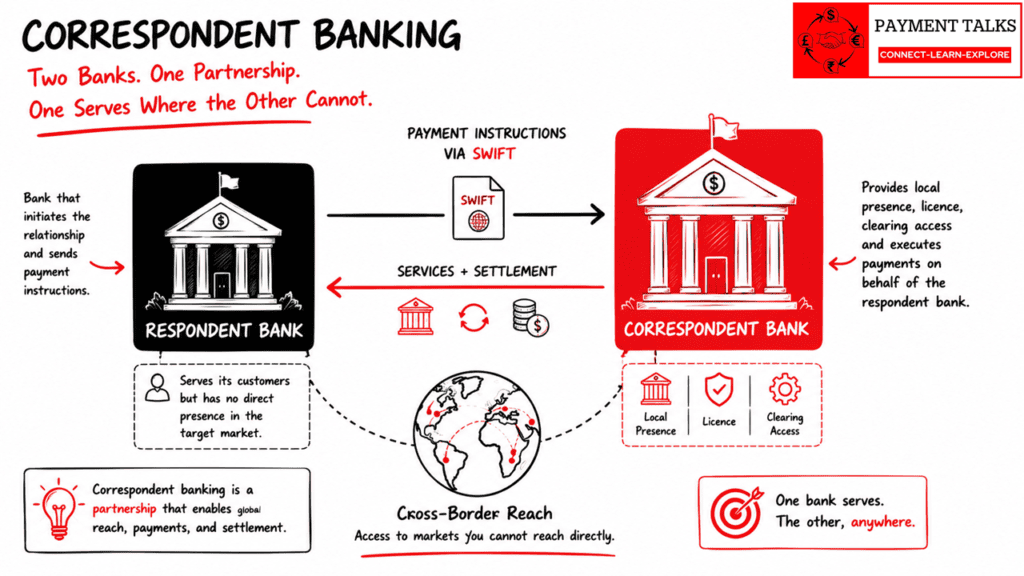
[VISUAL 1 — Correspondent banking overview — how banks partner to reach foreign markets]
What Is Correspondent Banking?
Correspondent banking is a service relationship between two financial institutions, typically in different countries. One bank — the correspondent — provides services on behalf of the other bank, the respondent. The respondent bank uses the correspondent’s local presence, licensing, and clearing access to reach markets it cannot serve directly.
The respondent bank opens an account with the correspondent in the correspondent’s local currency. From the respondent’s perspective, that account is the Nostro account — “our account with you.” From the correspondent’s perspective, the same account is the Vostro account — “your account with us.” This account pair is the financial foundation the entire relationship sits on.
For a full breakdown of how Nostro, Vostro, Mirror Nostro, and Loro accounts work together in practice, see Nostro, Mirror Nostro, Vostro and Loro Accounts: A Comprehensive Guide.
There are three participants in any correspondent banking setup:
- Correspondent Bank: provides clearing, payment processing, foreign exchange, and settlement in the target jurisdiction
- Respondent Bank: the bank that initiates the relationship, sends payment instructions, and holds the Nostro account
- Local Correspondent Bank: a correspondent that operates within a specific domestic market, bridging for respondent banks that have no direct relationship with a foreign correspondent
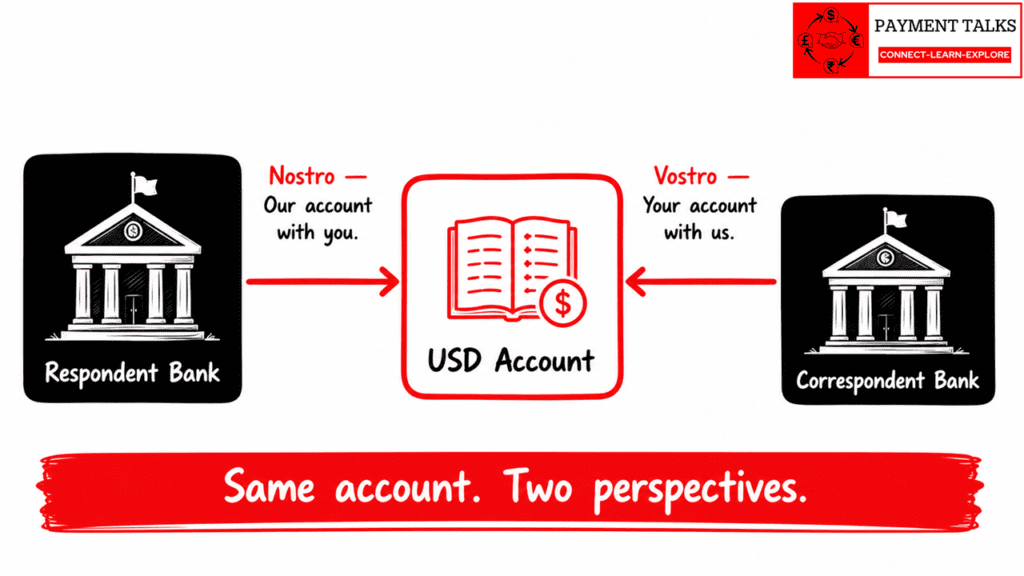
[VISUAL 2 — Correspondent bank and respondent bank relationship — Nostro and Vostro account setup]
How Does Correspondent Banking Work?
The mechanics come down to accounts and instructions. Here is the sequence from first contact to final settlement:
- Establish the relationship. The respondent bank opens a Nostro account with the correspondent. This account is held in the correspondent’s local currency and pre-funded in advance. The correspondent may open a reciprocal account with the respondent, but this is optional and not always the case.
- Receive a payment instruction. A customer of the respondent bank initiates a cross-border payment. The respondent bank debits the customer’s account and prepares a payment instruction for the correspondent.
- Send via SWIFT. The respondent bank sends the instruction to the correspondent via SWIFT. In legacy messaging, this is an MT103 for customer credit transfers. In ISO 20022 — the CBPR+ rail — this is a PACS.008 message. The instruction carries the beneficiary details, amount, currency, and routing information.
- Correspondent executes. The correspondent debits the respondent’s Nostro account and credits the beneficiary’s account — either directly, or via local clearing to the beneficiary’s bank.
- Clear and settle. Both banks update their records. The Nostro account balance decreases on the respondent’s books. The Vostro balance decreases on the correspondent’s books. Both sides reconcile.
I implemented this flow end-to-end when building a payment engine on the CBPR+ rail. Every step above maps directly to a message event in the ISO 20022 message chain. The Nostro account debit in step 4 drives the accounting entry in your payment engine — and getting that mapping right is where most implementation errors occur.
For how this fits into the broader payment journey, see Payment Life Cycle — Banking Transaction.
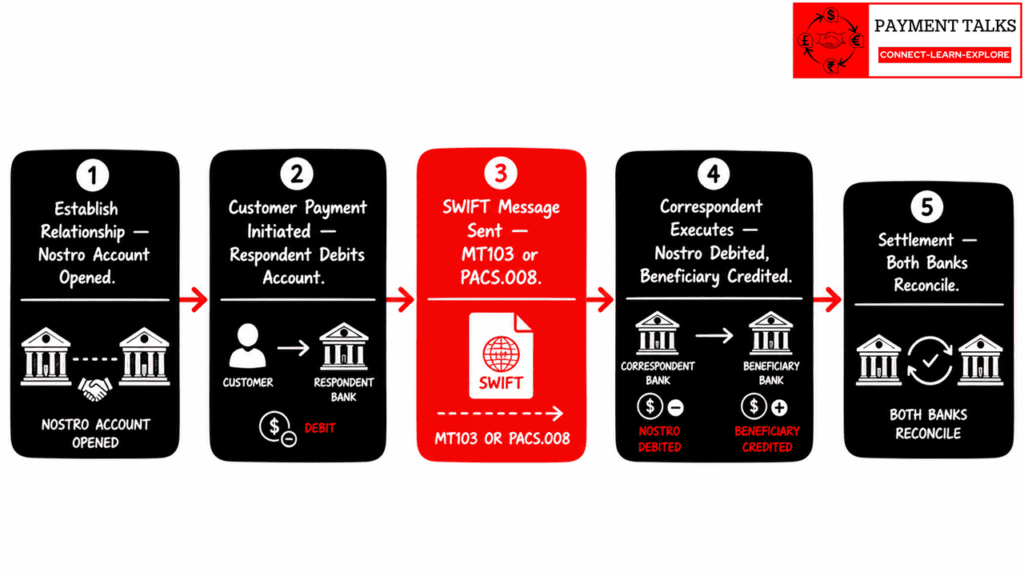
[VISUAL 3 — How correspondent banking works step by step — SWIFT message flow and Nostro account settlement]
Real-World Scenarios: Seeing Correspondent Banking in Action
Scenario 1: Direct Correspondent Relationship
- Customer A holds an account with Bank A in India and wants to send money to Recipient B, who banks with Bank B in the USA.
- Bank A has no presence in the USA. It has a pre-established correspondent relationship with Bank B.
- Bank A debits Customer A’s account and sends a SWIFT message to Bank B with the payment instruction.
- Bank B receives the instruction, debits Bank A’s Nostro account, and credits Recipient B’s account.
Simple two-bank chain. Bank A is the respondent. Bank B is the correspondent.
Scenario 2: Local Correspondent in the Chain
- Customer C holds an account with Bank C in India and wants to send money to Recipient D, who banks with Bank D in the USA.
- Bank C has no correspondent relationship in the USA and no direct SWIFT connectivity to any US bank.
- Bank C approaches Bank A in India, which already has a correspondent relationship with Bank B in the USA. Bank A now acts as the Local Correspondent of Bank C.
- Bank C can settle with Bank A in two ways: by holding a USD account with Bank A, or by settling in INR via local Indian clearing and letting Bank A handle the FX leg and onward payment.
- Bank A sends the payment instruction to Bank B in the USA via SWIFT.
- Bank B credits Bank D via local US clearing.
- Bank D credits Customer D’s account.
Three-bank chain. Bank C is the respondent. Bank A is the local correspondent of Bank C. Bank B is the foreign correspondent of Bank A. Every hop shifts the payer identity in the next instruction. Your payment engine needs to track that correctly across the chain — or your messages will fail.
For how all agents and parties are represented in an ISO payment message across multi-hop chains, see Detailed Explanation of All Agents Involved in an ISO Payment Message.
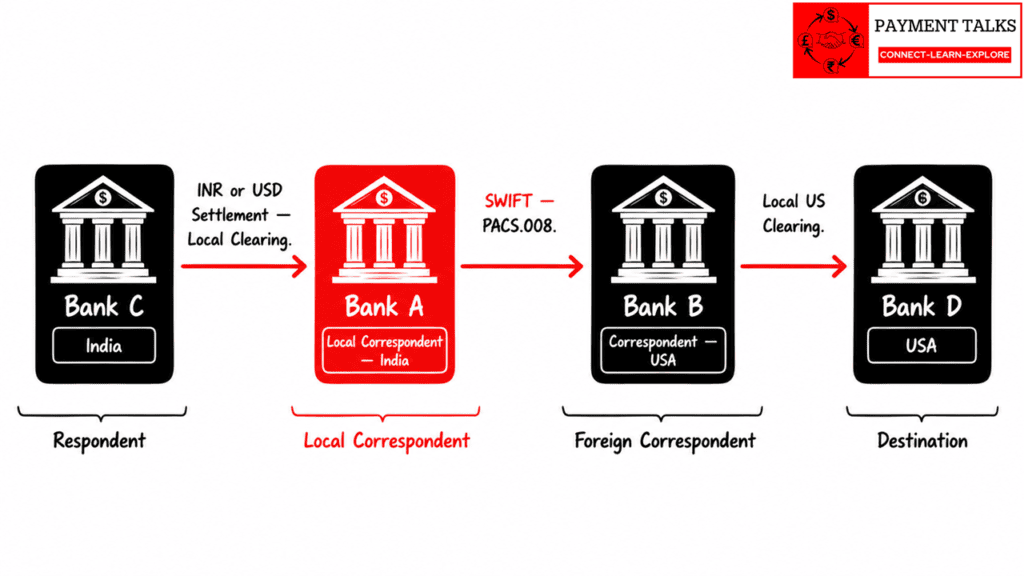
[VISUAL 4 — Multi-hop correspondent banking chain — local correspondent bank routing example India to USA]
Correspondent Bank vs Intermediary Bank: Where Most People Get It Wrong
This is the single most common point of confusion among payments professionals — including architects who have been in the industry for years. The terms get used interchangeably. They are not the same.
A correspondent bank is a relationship. The respondent bank holds a Nostro account at the correspondent. There is a signed agreement, pre-funded liquidity, and a long-term service arrangement. The correspondent knows the respondent before any payment is sent. This is a standing, bilateral arrangement that exists regardless of any specific transaction.
An intermediary bank is a role in a transaction. It is a bank that sits between the originating bank and the final destination bank in a specific payment chain. It may or may not have a direct account relationship with the originator. Its function is transactional: receive the instruction, process it, pass it onward.
In most cross-border payments, the correspondent bank plays the intermediary role for that transaction. But the concepts are distinct. One is a permanent relationship. The other is a position in a payment chain. Mixing them up leads to incorrect party mapping in ISO 20022 messages — specifically the Intermediary Agent and Creditor Agent fields in a PACS.008.
I have written a dedicated article that breaks down this distinction with full examples: Correspondent Bank vs Intermediary Bank — Full Breakdown.
What Services Does a Correspondent Bank Provide?
A correspondent relationship gives the respondent bank access to capabilities it does not have on its own:
Cross-border payments. Processing international transfers for the respondent’s customers in currencies and markets the respondent bank cannot reach directly. This is the primary service the entire model is built around.
Foreign exchange. Converting currencies as part of payment execution. The correspondent handles the FX leg in its local market at rates agreed in the correspondent agreement.
Trade finance. Supporting import and export activities through letters of credit, bank guarantees, and other instruments, backed by the correspondent’s local market standing and regulatory relationships.
Clearing and settlement. Participating in domestic clearing systems on behalf of the respondent. This is the core infrastructure value — access to local clearing networks that the respondent cannot join directly.
Liquidity support. Providing overdraft facilities on the Nostro account when the respondent needs intraday or short-term funding in a foreign currency.
One area closely tied to correspondent services is how fees are allocated across the payment chain. Whether the sender, receiver, or both absorb the correspondent’s charges is governed by SWIFT charge codes — OUR, SHA, and BEN. For a full breakdown, see Charge Codes in SWIFT: OUR, BEN and SHA Explained.
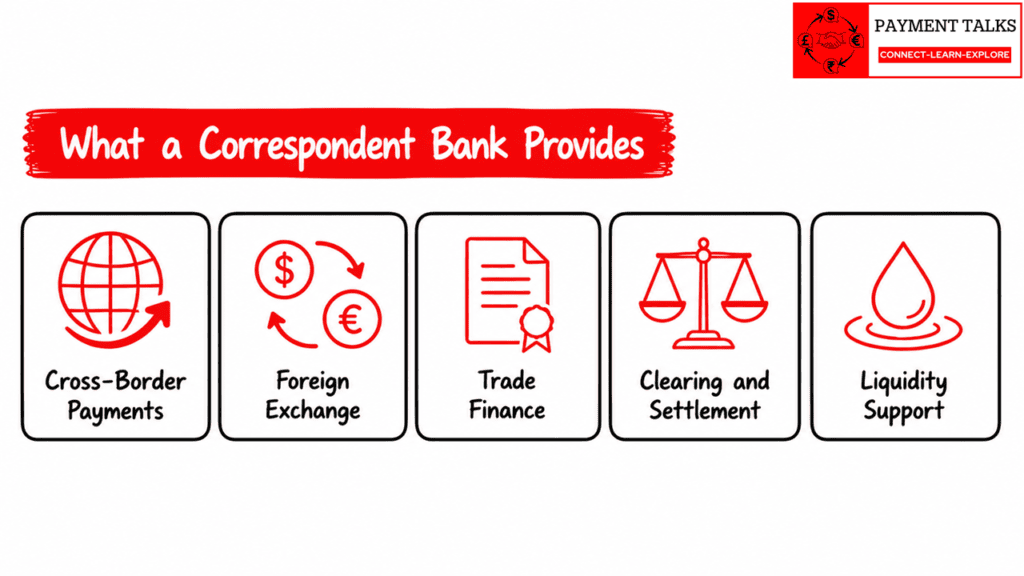
[VISUAL 5 — Services provided by a correspondent bank — cross-border payments FX trade finance clearing]
Why Banks Use Correspondent Banking
Global reach without global infrastructure. A small bank in any country can serve a customer who needs to send money internationally, without building branches or acquiring licences in every destination market.
Operational efficiency. The correspondent already has the regulatory approvals, clearing memberships, FX infrastructure, and compliance programs in the destination market. The respondent bank uses all of that from day one.
Cost efficiency. Maintaining a Nostro account relationship is significantly cheaper than acquiring a banking licence and building operations in a foreign market. For small and mid-tier banks, correspondent banking is the only economically viable path to cross-border services.
Local market knowledge. The correspondent bank understands clearing cycles, local regulations, settlement timelines, and market conventions in its own jurisdiction. That knowledge transfers directly to the respondent through the relationship.
Foundation for trade finance. Cross-border trade depends on banks in both countries trusting each other and having the infrastructure to back letters of credit and guarantees. Correspondent banking provides that trusted bridge between jurisdictions.
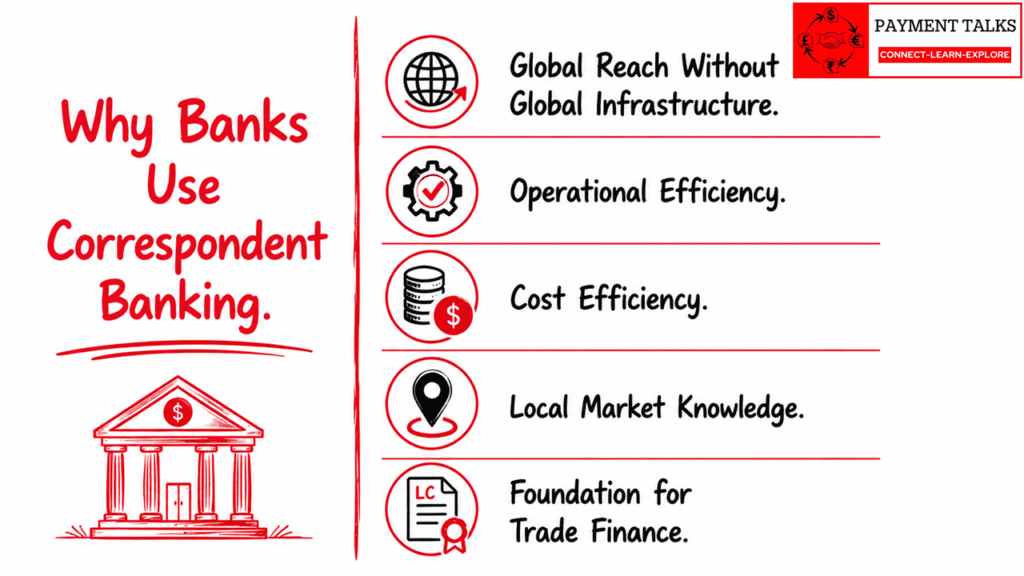
[VISUAL 6 — EBenefits of correspondent banking for respondent banks — global reach cost efficiency local expertise]
What Makes Correspondent Banking Hard in Practice?
The model is powerful, but it carries significant operational and regulatory weight.
Nostro account costs. Maintaining funded Nostro accounts across multiple currencies ties up liquidity in foreign accounts. Those accounts carry maintenance fees, transaction charges, and FX conversion costs. For banks active in many corridors, this is a material balance sheet constraint.
AML and compliance overhead. Correspondent banks are required to perform due diligence not just on the respondent bank but on the respondent’s customers. Anti-money laundering, Know Your Customer, and counter-terrorist financing requirements apply across the entire chain. Every additional hop adds compliance surface area.
De-risking. In response to regulatory pressure, some global correspondent banks have terminated relationships in jurisdictions they consider high-risk — not because of specific misconduct, but because the compliance cost exceeds the commercial return. When a small bank in a developing market loses its correspondent, it can lose all access to international payments. This is a live and ongoing problem in the industry.
Operational complexity. Multi-hop correspondent chains introduce delay risks, reconciliation complexity, and error surface. Every additional bank in the chain is a point where a payment can stall, arrive incorrectly attributed, or trigger a compliance hold.
Fraud exposure. Correspondent networks handle high-value flows across multiple jurisdictions, making them a target for financial crime. Robust transaction monitoring and sanctions screening are not optional — they are baseline requirements for any bank operating in a correspondent network.
How SWIFT Powers Correspondent Banking
SWIFT is the messaging backbone of correspondent banking. It does not hold money or move funds. It carries the instructions between banks — securely, in a standard format, across every participant in the network.
Message standardisation. SWIFT defines the format for payment instructions. MT103 handles customer credit transfers. MT202 handles bank-to-bank transfers. In ISO 20022, these map to PACS.008 and PACS.009 respectively. A standard format means a bank in Tokyo can send a payment instruction to a correspondent in Brazil and both sides process it identically, without bilateral format negotiation.
Secure communication. SWIFT messages are encrypted and authenticated. Each bank on the network has a verified identity via its BIC code. The integrity of every instruction is protected end-to-end.
Multi-party coordination. In a multi-hop correspondent chain, SWIFT carries the instruction across every link. Bank A to Bank B to Bank C — each leg is a separate SWIFT message, formatted correctly for that specific transfer.
SWIFT GPI. Global Payments Innovation added end-to-end payment tracking to correspondent banking. Before GPI, a payment could disappear into the correspondent chain with no visibility for the sending bank or its customer. With GPI, every leg carries a unique end-to-end transaction reference and status updates are shared in near-real-time. GPI tracking is now mandatory for SWIFT member banks on cross-border payments.
Compliance support. SWIFT provides message types for sanctions screening confirmations, AML notifications, and KYC data exchange — supporting the compliance obligations that sit on every bank in a correspondent chain.
Standard Settlement Instructions. SSIs are pre-agreed routing and account details that correspondent banks share with each other. Rather than re-confirming account details on every payment, banks use SSIs stored in SWIFT directories to route instructions automatically and reduce manual errors.
For a deeper look at how ISO 20022 underpins these flows — including PACS and PAIN message structures — see Fundamentals of ISO 20022 and Building Blocks of ISO 20022.
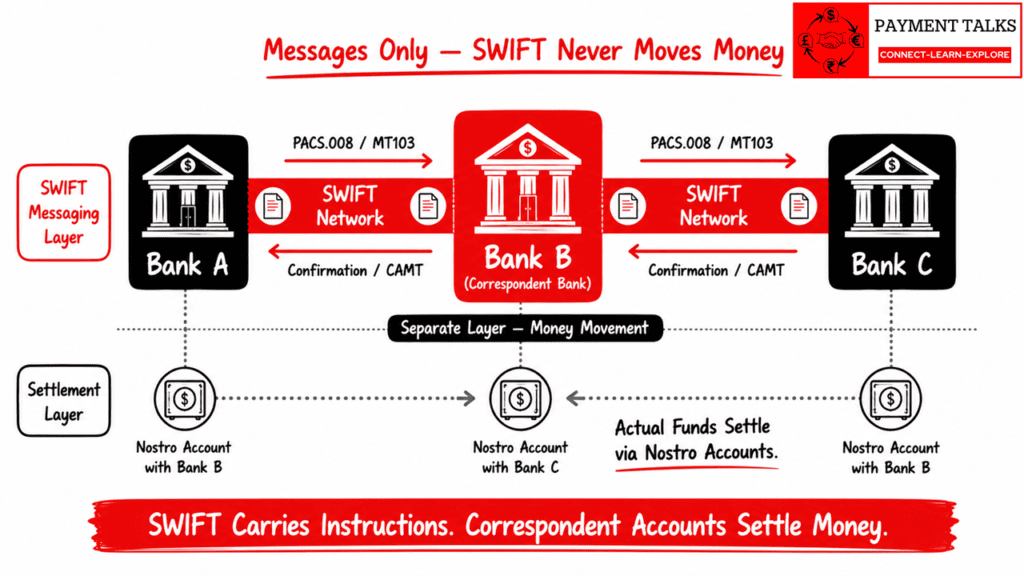
[VISUAL 7 — SWIFT role in correspondent banking — PACS.008 and MT103 message flow between correspondent banks]
How Is Correspondent Banking Changing?
The model is under pressure from multiple directions. Practitioners need to know what is actually happening now, not just what might happen.
ISO 20022 and CBPR+. SWIFT’s Cross-Border Payments and Reporting Plus programme is migrating all cross-border interbank payments from legacy MT to ISO 20022. PACS.008 and PACS.009 are replacing MT103 and MT202. The richer data structure — full legal entity names, structured postal addresses, purpose codes, LEIs — improves straight-through processing rates and makes sanctions screening significantly more effective. I built on this rail. The data quality difference versus legacy MT is substantial. This migration is happening now, not in the future.
SWIFT GPI adoption. End-to-end payment tracking is now mandatory for SWIFT member banks on cross-border payments. The baseline transparency standard across the entire correspondent network has shifted permanently. Real-time payment status visibility is no longer a differentiator — it is the floor.
FinTech alternatives. Blockchain-based settlement platforms are positioning as alternatives to the traditional correspondent chain for specific corridors and payment types. The commercial pitch is lower cost and faster settlement through direct bilateral settlement without intermediaries. For smaller-value flows in well-covered corridors, this is real competition. For large institutional flows and complex multi-currency transactions, correspondent banking remains the dominant model.
Central bank digital currencies are a longer-term structural pressure. CBDC architecture experiments like mBridge are exploring whether banks could settle cross-border payments directly between central bank-issued digital currencies — bypassing Nostro accounts entirely. This is not mainstream yet, but architects should be watching it closely. See mBridge Explained and CBDCs Explained for detailed context.
Consolidation. The number of active correspondent banking relationships globally has been declining for a decade. Compliance costs and de-risking mean large banks are maintaining fewer relationships. The concentration risk is real: if a small number of global banks dominate correspondent flows, any disruption to those banks has outsized consequences for the global payment infrastructure that runs on top of them.
Frequently Asked Questions About Correspondent Banking
Q: What is correspondent banking in simple terms?
A: Correspondent banking is a partnership where one bank provides services in a market on behalf of another bank that has no direct presence there. The bank with no local presence — the respondent — uses the other bank’s infrastructure, licence, and clearing access to serve its customers in that market.
Q: What is the difference between a correspondent bank and an intermediary bank?
A: A correspondent bank is a relationship: the respondent holds a Nostro account at the correspondent, backed by a signed agreement. An intermediary bank is a role in a specific payment transaction — it sits between the originating and destination banks. The correspondent often plays the intermediary role in a payment, but the concepts are not interchangeable. See Correspondent Bank vs Intermediary Bank for a full breakdown.
Q: What is a Nostro account in correspondent banking?
A: A Nostro account is the account that the respondent bank holds at the correspondent bank, denominated in the correspondent’s local currency. “Nostro” means “our account with you.” The same account is called a Vostro account from the correspondent’s perspective — “your account with us.” It is pre-funded and used to settle cross-border payments.
Q: How does SWIFT enable correspondent banking?
A: SWIFT provides the standardised messaging infrastructure that correspondent banks use to exchange payment instructions. It does not move funds — it carries the instruction that tells the correspondent what to do. Legacy MT103 and MT202 messages and ISO 20022 PACS.008 and PACS.009 messages all travel over the SWIFT network. SWIFT GPI now adds end-to-end payment tracking across the entire correspondent chain.
Q: What is CBPR+ and how does it relate to correspondent banking?
A: CBPR+ stands for Cross-Border Payments and Reporting Plus. It is SWIFT’s mandatory migration programme moving all cross-border interbank payments from legacy MT messages to ISO 20022. For correspondent banking, PACS.008 replaces MT103 for customer credit transfers and PACS.009 replaces MT202 for bank-to-bank flows. The migration improves data quality, STP rates, and compliance screening across the correspondent chain.
Q: What is de-risking in correspondent banking?
A: De-risking is when a global correspondent bank terminates its relationship with a respondent bank in a high-risk jurisdiction because the compliance cost of maintaining that relationship exceeds its commercial value. The impact on the respondent bank can be severe — it may lose all ability to process international payments if it cannot find a replacement correspondent.
Q: Can correspondent banking exist within the same country?
A: Yes, but it is limited. Domestic correspondent banking typically occurs when a smaller bank uses a larger bank’s clearing infrastructure to access payment systems it cannot join directly. It is far less common than cross-border correspondent banking.
Q: What are OUR, SHA, and BEN charge codes in correspondent banking?
A: These SWIFT charge codes determine who pays the correspondent bank’s fees. OUR means the sender pays all charges. BEN means the beneficiary absorbs all charges, including deductions from the payment amount. SHA means charges are shared — the sender pays the originating bank’s fees and the beneficiary pays the correspondent’s fees. For a full explanation, see Charge Codes in SWIFT: OUR, BEN and SHA Explained.
Watch the Full Explainer Video
The video below covers correspondent banking the way I would walk through it on a whiteboard — step by step, with the scenarios drawn out and the account flows explained in sequence. If you want the visual version of everything in this article, start there.
YouTube: Understanding Correspondent Banking — Full Explainer
For related foundational reading, see What Is a Payment? Evolution and Key Elements, Domestic Payment Processing Methods, and Nostro, Mirror Nostro, Vostro and Loro Accounts.