RAVI

Understanding MT Field Formats | SWIFT MT Message Basics Explained

SWIFT MT messages are often described as “legacy”, yet they continue to power a large part of the global payments ecosystem. At the core of every MT message lies a strict field format language that governs how data must be represented, parsed, validated, and interpreted. Understanding MT field formats is not about memorising syntax. It […]

Understanding MT Field Formats | SWIFT MT Message Basics Explained Read More »

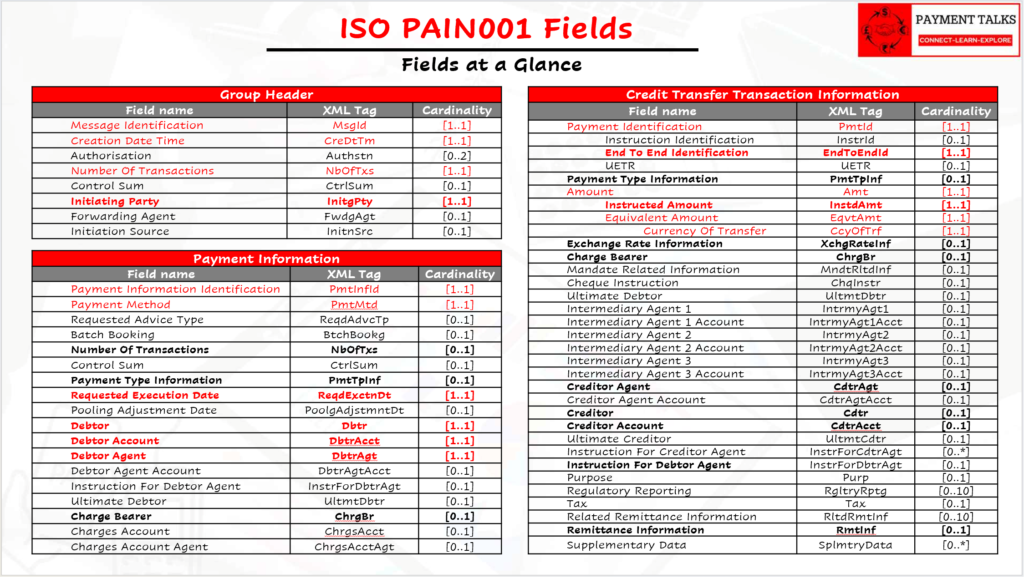
PAIN.001 Structure Explained — Architecture, Bulk Logic, and Comparison with MT101

Introduction After understanding who can initiate a PAIN.001 and why, the next natural question is: How is a PAIN.001 message actually built? Because in payment systems, structure is everything. Banks don’t process “intent”.They process hierarchy, grouping, and repetition. This article focuses on the big picture structure of PAIN.001: We will not go field-by-field here.That deep

PAIN.001 Structure Explained — Architecture, Bulk Logic, and Comparison with MT101 Read More »

What Is PAIN.001? | ISO 20022 Payment Initiation Flows Explained with Real Examples

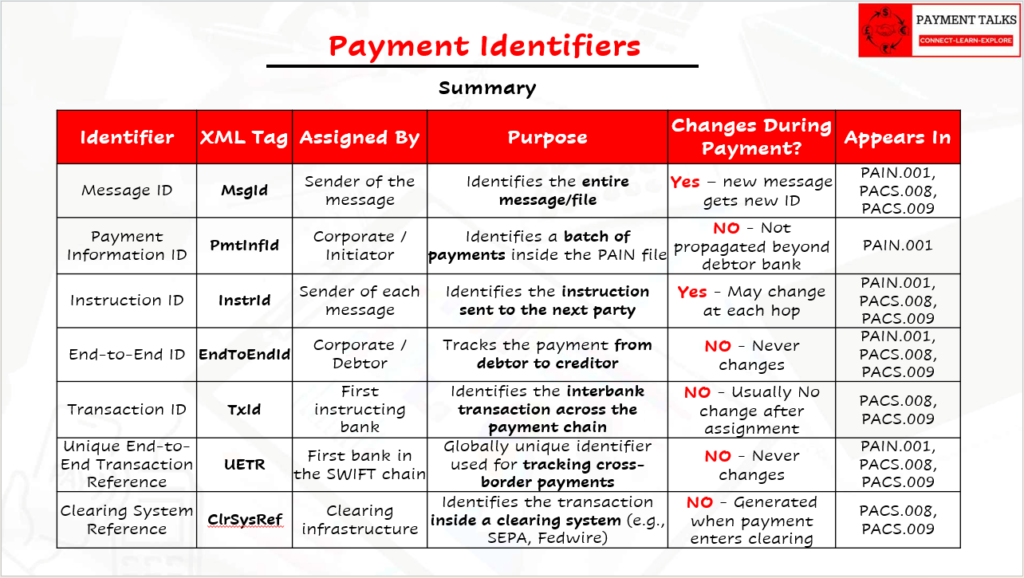
What Is PAIN.001? PAIN.001 (Customer Credit Transfer Initiation) is an ISO 20022 message used by a customer (typically a corporate or institution) to instruct its bank to make one or more credit transfers. In simple words: Why PAIN.001 Exists (Business Rationale) The Core Business Problem Corporates need to: Before PAIN.001: The ISO 20022 Solution PAIN.001

What Is PAIN.001? | ISO 20022 Payment Initiation Flows Explained with Real Examples Read More »

Unstructured, Structured, and Hybrid Postal Addresses in ISO 20022

Introduction Postal address data has long been one of the weakest links in cross-border payments. While names and accounts are often well-defined, addresses historically traveled as free text, limiting automation, weakening sanctions screening, and increasing repair rates. ISO 20022 introduced rich, structured postal address elements to solve this problem. However, real-world data realities slowed adoption.

Unstructured, Structured, and Hybrid Postal Addresses in ISO 20022 Read More »

ISO 20022 Business Application Header (BAH) – A Complete, Structured, and Practical Guide

The Business Application Header (BAH) is a foundational concept in ISO 20022 messaging.It plays a crucial role in routing, identifying, securing, and contextualizing business messages—no matter which network transports them. What is the Business Application Header (BAH)? In short: BAH = “header metadata” for ISO 20022 messages; ISO business payload = “the actual business data”.

ISO 20022 Business Application Header (BAH) – A Complete, Structured, and Practical Guide Read More »

Understanding the Building Blocks of ISO 20022

Introduction: ISO 20022 has rapidly become the global language of financial messaging, reshaping how banks, payment systems, and financial institutions share information. But before diving into message structures and complex flows, it’s essential to understand the foundation—the core concepts that make ISO 20022 powerful, flexible, and globally consistent. These concepts form the backbone of every

Understanding the Building Blocks of ISO 20022 Read More »

Fundamentals of ISO20022

What is ISO? ISO stands for International Organization for Standardization.ISO is a global organization that creates standards—basically, agreed-upon rules—so that things work the same way everywhere in the world. It is an independent, non-governmental global standards body headquartered in Geneva, Switzerland, with 170+ member countries. What does ISO actually do? ISO creates standards that bring:

Fundamentals of ISO20022 Read More »

Double-Entry Accounting in Payments: The Foundation of Financial Integrity in Banking

Introduction In the world of banking and financial services, every payment—no matter how simple—triggers a series of accounting movements behind the scenes (one that’s often overlooked outside of payment operations and finance teams). When a customer sends money, receives funds, or a transaction fails, these actions are not just operational events—they are financial transactions that

Double-Entry Accounting in Payments: The Foundation of Financial Integrity in Banking Read More »

Payment Life Cycle – Banking Transaction

Introduction Payments are the lifeblood of the banking system. Every time money moves—from a customer paying a bill, a company running payroll, or a bank settling cross-border trades—there is a carefully orchestrated series of steps that ensure funds are transferred accurately, securely, and in compliance with regulations. Behind the scenes, a single payment journey involves

Payment Life Cycle – Banking Transaction Read More »