
Correspondent banking settlement runs on four values, INDA, INGA, CLRG and COVE, that tell a bank where and how the funds behind a payment message will actually move.
Most people learn these settlement method codes as one-liners. INDA means Instructed. INGA means Instructing. CLRG means Clearing. COVE means separately.
Those one-liners are true at the fundamental level. But what they mean in reality is what no one teaches. That is what this article does for correspondent banking settlement, using one single payment that touches all four codes.
If you have ever opened a payment and wondered why the same payment says INDA in one message, CLRG in the next and INGA in the last, this is for you. Once you see correspondent banking settlement on one payment, you will not mix the settlement method codes up again.
What should you read before learning correspondent banking settlement?
This article builds on three ideas. If any of them feels shaky, read the original first.
- Understanding Correspondent Banking for respondent banks, correspondent banks and the Local Correspondent idea.
- Nostro, Mirror Nostro, Vostro and Loro Accounts for the account vocabulary and the mirror entries used in every T-account below.
- Payment Routing Explained for how the payment chain is built before any settlement method is chosen.
Routing builds the chain first. This article explains what each hop of that chain says about correspondent banking settlement, and why.
A note on scope. Everything here describes correspondent banking settlement on traditional rails: banks, SWIFT messaging, nostro and vostro accounts and domestic clearing systems. Crypto, stablecoins and fintech platform models settle differently, and the standard settlement method codes do not cover them.
I also keep three things out on purpose. Charges and fees are out of scope, so the full USD 10,000 passes through every hop. Edge cases are out of scope, so we stay on the most common cross border pattern. And the field-level detail of the Serial and Cover methods gets its own article. Here we stay at payment flow level.
What problem do settlement method codes solve?
A payment message carries an instruction, not money. The pacs.008 that travels between two banks tells the receiver who to pay, how much and when. It cannot move a single dollar.
The funds move somewhere else, on someone’s books. The settlement method code tells the receiving bank where and how those funds will be moved and received.
That is the split between clearing and settlement, and every correspondent banking settlement depends on it. Clearing is the exchange of instructions. Settlement is the movement of funds. If that split is new to you, start with From Payment Instruction to Finality: Understanding Clearing and Settlement.
Keep this picture in your head for the rest of the article. In a serial payment, the pacs.008 travels hop by hop. In correspondent banking settlement, the funds move differently, in three places: once at the receiving bank, once at the clearing, and once at the sending bank. The code in each message tells you which of those three applies to that hop.
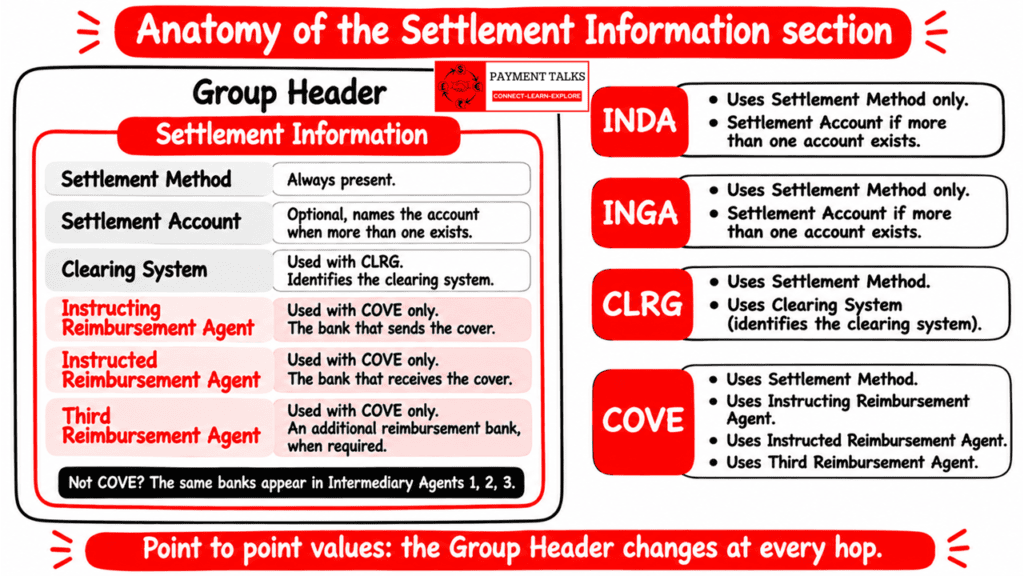
ISO 20022 places this code in the Settlement Information section, inside the Group Header of the message. The element is called Settlement Method, and the ISO 20022 message definitions give it exactly four values: INDA, INGA, COVE and CLRG.
What does the Settlement Information section of a payment message contain?
Settlement Information is the part of the message that describes how the funds behind the instruction will move. Which elements you see depends on the settlement method code.
Matrix 1: the four settlement method codes in one view
| Code | Reads as | Who settles | Where funds move | Timing | Elements used |
| INDA | Instructed | The Instructed Agent, the receiver of this message | Receiving bank’s books. The sender’s account held there is debited | Message first, then funds | Intermediary Agents, if any |
| INGA | Instructing | The Instructing Agent, the sender of this message | Sending bank’s books. The receiver’s account held there is credited | Funds first, then message | Intermediary Agents, if any |
| CLRG | Clearing | The clearing system | Clearing system accounts, in central bank money | Through the clearing | Clearing System identifier. |
| COVE | Separately | Not settled by this message | On a separate pacs.009 COV travelling through the reimbursement agents | Cover runs separately from the message | Reimbursement Agents only. No Intermediary Agents |
Read the second column as shortcuts. The rest of this article shows what these settlement method codes mean in correspondent banking settlement in practice.
Which codes a given scheme or bank accepts in which message is set by its usage guidelines, and the guidelines differ. This article teaches the concept of settlement method codes. Check the guideline you implement against before you build.
Matrix 2: the elements of the ISO Settlement Information section
| Element | What it tells the receiver | When it applies |
| Settlement Method | Which of the four codes applies to this hop. | Always present |
| Settlement Account | The exact account to debit or credit. If Bank A holds three USD accounts with its correspondent, this element names the one to use. It adds clarity when more than one account exists in the payment currency. | Optional, information only. Not relevant for CLRG, confirm against your usage guideline |
| Clearing System | The clearing system, and so the exact rail, through which the funds settle. Domestic clearing can run on Instant, RTGS or DNS, and this identifier says which one. | CLRG |
| Instructing Reimbursement Agent | A bank through which the funds travel when they do not travel with the message. | COVE only |
| Instructed Reimbursement Agent | The next bank through which the funds travel, on the receiving side. | COVE only |
| Third Reimbursement Agent | An additional bank in the funds path when two reimbursement agents are not enough. | COVE only |
The three reimbursement agents are the banks through which the funds travel. I explained these agents in the guide to all agents and parties in an ISO payment message. They only come into the picture when the code is COVE. For INDA, INGA and CLRG they are not used.
If the code is not COVE, the same banks appear in Intermediary Agent 1, 2 and 3 instead. Any intermediary banks like Bank B and Bank C in our example belong there. When the code is COVE, the banks in the funds path are reimbursement agents and the Intermediary Agents are not used.
The identifier you put in the Clearing System element comes from the ISO external code sets. I do not list values here. The concept matters more than the value.
[VISUAL 2: Anatomy of the Settlement Information section inside the Group Header, showing which elements appear for INDA, INGA, CLRG and COVE]
In correspondent banking settlement, the settlement method code decides which companion elements are used: Clearing System for CLRG, reimbursement agents for COVE.
How does one USD payment show correspondent banking settlement with all four settlement method codes?
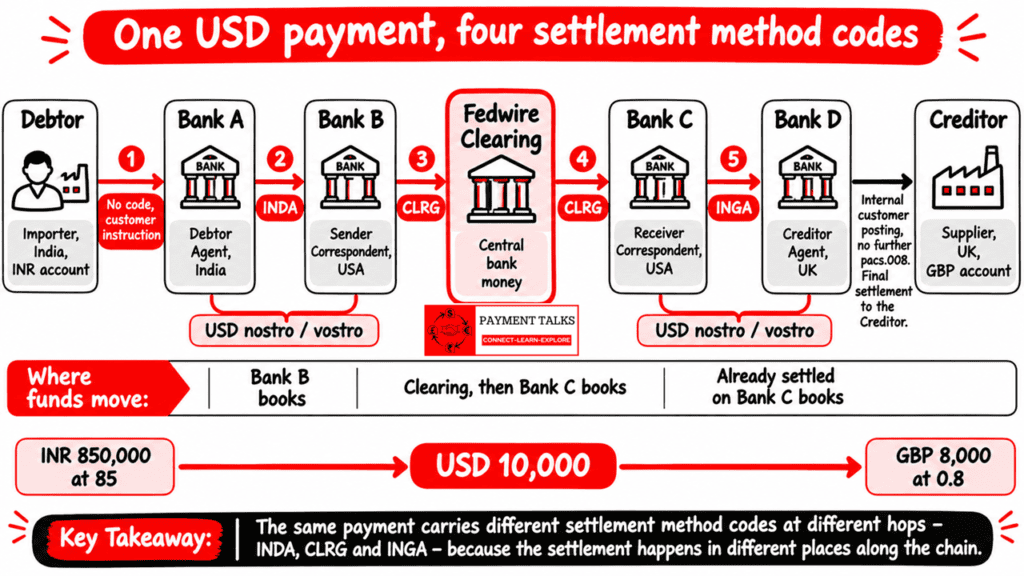
Let me set up one payment and hold it constant. Every explanation of correspondent banking settlement below uses this payment.
An importer in India, the Debtor, holds an INR account with Bank A. A supplier in the UK, the Creditor, holds a GBP account with Bank D. The Debtor instructs the payment in USD. Neither account is in USD, but the payment currency is. That matters, because the payment currency decides everything.
Because the payment is in USD, routing sends it down a correspondent chain. Bank A holds a USD account with Bank B in the USA. Bank D holds a USD account with Bank C in the USA. Banks B and C are both connected to Fedwire. There is no common correspondent.
Remember what a currency correspondent means. It is the bank that holds your account in that currency. Bank B holds Bank A’s USD account. Bank C holds Bank D’s USD account.
| Party | Role in the chain | Detail |
| Debtor | Payer | Importer in India with an INR account at Bank A |
| Bank A | Debtor Agent | India. Converts INR to USD and sends to its USD correspondent |
| Bank B | Sender Correspondent | USA. Services Bank A’s USD account (Bank A’s nostro, Bank B’s vostro) |
| Fedwire | Domestic clearing | USD clearing and settlement between Bank B and Bank C |
| Bank C | Receiver Correspondent | USA. Services Bank D’s USD account (Bank D’s nostro, Bank C’s vostro) |
| Bank D | Creditor Agent | UK. Converts USD to GBP and credits the Creditor |
| Creditor | Payee | Supplier in the UK with a GBP account at Bank D |
So the full chain is: Debtor, Bank A, Bank B, Fedwire, Bank C, Bank D, Creditor. Always keep the Debtor and the Creditor in the picture. Without them there is no payment.
The numbers are simple. The Debtor pays USD 10,000. At 1 USD = 85 INR, that is INR 850,000 debited from the Debtor. At 1 USD = 0.8 GBP, Bank D credits GBP 8,000 to the Creditor.
This chain is the output of routing. Two currency correspondents with no common bank, joined across the USD clearing. Routing decides the path, as we saw in Payment Routing Explained. This article decides what each hop of that path says about funds. I draw the same chain step by step in the PaymentTalks YouTube walkthrough linked at the end.
[VISUAL 1: The full correspondent banking settlement chain with the settlement method code on each hop]
Correspondent banking settlement on one payment: Debtor, Bank A, Bank B, Fedwire, Bank C, Bank D, Creditor.
What happens at each of the five steps of correspondent banking settlement?
The payment moves in five steps: customer to bank, bank to bank, bank to clearing, clearing to bank, and bank to bank. Each step shows the message, the settlement method code, and where the funds really move.
How do you know when funds really moved?
One rule before the T-accounts. A posting in a real account is final. It moves actual funds, and the only way to undo it is a return, which moves funds back.
A posting in a non real account is notional. A mirror nostro is the classic example. It exists for tracking. If something fails, a reverse posting is enough and no funds move.
I label every posting Real or Notional, and I mark [FINAL SETTLEMENT] where interbank funds really move. The entries are high level. FX position entries are left out. For the full accounting detail, see the Double-Entry Accounting in Payments guide.
Step 1: Customer to Bank A, no code
The Debtor instructs Bank A through a bank channel or a pain.001. There is no settlement method code yet, because there is no bank to bank message. This is a customer instruction.
Bank A debits INR 850,000 from the Debtor and converts it to USD 10,000. It credits its mirror nostro for USD 10,000, to track the funds that will leave its USD account at Bank B.
| Account (books of) | Debit | Credit | Posting |
| Debtor INR account (Bank A) | INR 850,000 | Real, customer | |
| Bank A mirror nostro at Bank B (USD) | USD 10,000 | Notional |
This step is provisional. Nothing has moved between banks. The mirror credit is notional, because it anticipates a debit that Bank B has not made yet. Customer funds are taken by Bank A though.
Step 2: Bank A to Bank B, code INDA
Bank A sends the pacs.008 to Bank B with INDA. In plain words, Bank A says: Bank B, you are the Instructed Agent. Settle this payment from my USD account held at your bank, and forward it to Bank D via Bank C.
Why INDA? The payment is in USD, and Bank A’s USD nostro sits with Bank B. The account lives with the receiver, so the receiver settles. That is what the settlement method code is telling Bank B.
The message moves first. Only after it arrives does Bank B post.
| Account (books of) | Debit | Credit | Posting |
| Bank A USD vostro (Bank B books) | USD 10,000 | Real | |
| Bank B clearing settlement A/c (USD) | USD 10,000 | Notional |
[FINAL SETTLEMENT] between Bank A and Bank B, in commercial bank money. Bank B’s vostro debit is the mirror of Bank A’s mirror nostro credit from Step 1. This is the entry Bank A reconciles against.
Step 3: Bank B to the clearing, code CLRG
Bank B sends the pacs.008 to Bank C through Fedwire. The Settlement Method is CLRG and the Clearing System identifier is populated. In plain words, Bank B says: I am instructing this payment to Bank C, but you will receive the funds from the clearing.
Why show the clearing as its own step? Because the pacs.008 goes from Bank B to Bank C, but not directly. It goes through the clearing, and the clearing is the one that exchanges the funds. Most flow diagrams keep the clearing in the background. Here it comes forward, because that is where the funds move.
| Account (books of) | Debit | Credit | Posting |
| Bank B settlement A/c at the central bank (USD) | USD 10,000 | Real | |
| Bank C settlement A/c at the central bank (USD) | USD 10,000 | Real |
[FINAL SETTLEMENT] between Bank B and Bank C, in central bank money. Steps 2 and 3 are the same dollars seen from two ledgers: Bank B’s own books, and the central bank’s.
Step 4: Clearing to Bank C, code CLRG continues
The clearing delivers the pacs.008 to Bank C. The code is still CLRG, because Bank C receives the funds from the clearing.
Now Bank C reads the instruction. It knows the USD must go to Bank D in the UK. It also knows Bank D holds a USD account with it. So Bank C credits Bank D’s account right here, before it sends Bank D anything.
| Account (books of) | Debit | Credit | Posting |
| Bank C clearing settlement A/c (USD) | USD 10,000 | Notional | |
| Bank D USD account (Bank C books) | USD 10,000 | Real |
[FINAL SETTLEMENT] between Bank C and Bank D. This is the settlement for the last hop, and it has already happened.
Step 5: Bank C to Bank D, code INGA
Bank C now sends the pacs.008 to Bank D with INGA. In plain words, Bank C says: I am sending you this payment so you can credit the final beneficiary, and I have already settled at my side as the Instructing Agent.
Look at the timing. The funds settled in Step 4. The message follows in Step 5. With INGA, the message works almost like a notification that settlement is done.
Bank D applies the FX at 1 USD = 0.8 GBP. It debits its mirror nostro for USD 10,000 and credits the Creditor GBP 8,000.
| Account (books of) | Debit | Credit | Posting |
| Bank D mirror nostro at Bank C (USD) | USD 10,000 | Notional | |
| Creditor GBP account (Bank D) | GBP 8,000 | Real, customer |
The Creditor credit is an internal customer posting. It sits outside the scope of the settlement method code, as there is no further pacs.008. This is the final settlement to Customer.
The five steps on one page
| Step | Hop | Code | Message | Funds move on | Settlement Posting |
| 1 | Debtor to Bank A | None | Customer instruction | Bank A books | Provisional |
| 2 | Bank A to Bank B | INDA | pacs.008 | Bank B books (receiving bank) | Real, final |
| 3 | Bank B to Clearing | CLRG | pacs.008 | Clearing, central bank money | Real, final |
| 4 | Clearing to Bank C | CLRG | pacs.008 | Bank C books, from clearing receipt | Real, final |
| 5 | Bank C to Bank D | INGA | pacs.008 | Already done in Step 4 on Bank C books (sending bank) | Customer credit |
Now you can see why the pacs.008 and the funds are different things in correspondent banking settlement. The message moved serially, hop by hop. The funds moved in three places: at the receiving bank in Step 2, at the clearing in Step 3, and at the sending bank in Step 4. The settlement method code is the field that tells each bank which one it is.
Why does INDA versus INGA timing matter in correspondent banking settlement?
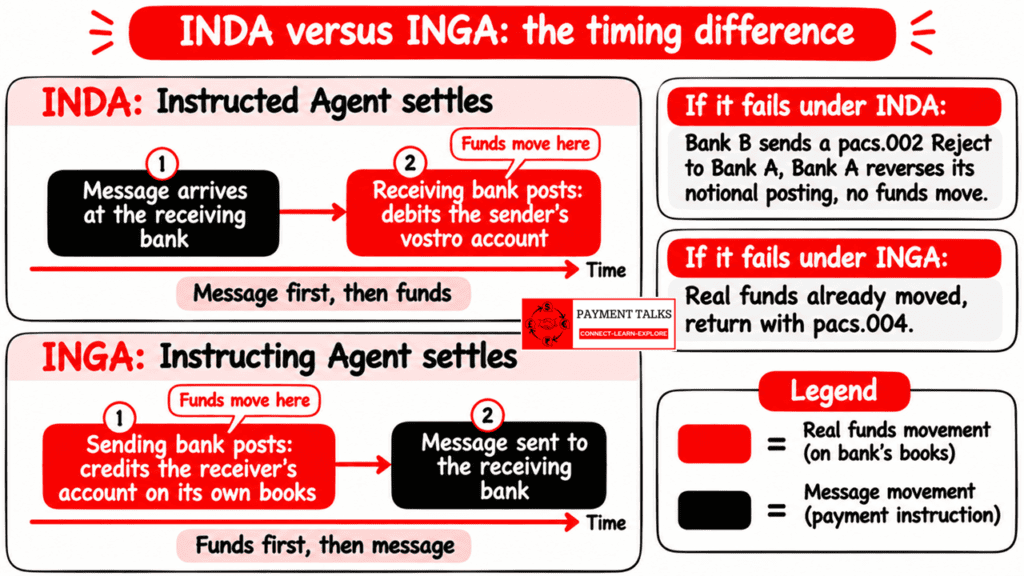
INDA means the receiving bank, the Instructed Agent, settles the funds. So the message moves first, and then the funds move.
INGA means the sending bank, the Instructing Agent, settles the funds. So the funds settle first, and then the message moves.
This one difference drives how failures and returns behave in correspondent banking settlement. It is the reason the pacs.002 status and the pacs.004 return messages work the way they do.
[VISUAL 3: Timeline comparing INDA (message, then funds) with INGA (funds, then message)]
INDA: the instruction arrives and then the receiving bank posts. INGA: the sending bank posts and then the instruction follows.
Take an INDA failure. Say Bank B rejects Bank A’s instruction after a screening hit. Bank B has not debited any real account and sends pacs.002 Reject to inform the same to Bank A. Bank A reverses its notional mirror entry, and no funds move.
Now take an INGA failure. Say Bank D cannot credit the Creditor. Bank C has already credited Bank D’s real account in Step 4. The funds are sitting with Bank D. The only way back is a return, a pacs.004, which moves real funds.
Real accounts need a return. Notional accounts need a reverse posting. Keep that rule in mind and the status and return messages start to make sense for every settlement method code. The full return flow gets its own article.
How is a settlement method code determined?
A settlement method code is determined by the underlying settlement model between the two banks on that hop. The settlement method codes do not follow payment direction. They do not follow who initiated the payment. They do not follow the sender’s preference either.
Why is CLRG the clear one?
The CLRG settlement method applies when both banks are connected to the same clearing system, so the funds move through it. The Clearing System identifier names the exact rail: Instant, RTGS or DNS. The settlement method code is CLRG whichever rail it is.
Fedwire in our example is an RTGS rail. If the two banks were on a DNS or an Instant rail, the code would still be CLRG. How each rail works is a topic of its own.
Why do INDA and INGA vary on the correspondent route?
INDA and INGA are purely about the accounting relationship in the payment currency. They are bilateral between two banks, and they are transaction based. There is no netting concept and no direction logic in the code.
Bank A holds a USD account at Bank B, so Bank A to Bank B is INDA. Bank D holds a USD account at Bank C, so Bank C to Bank D is INGA. Same payment, same currency. The codes differ because the account sits with a different bank on each hop.
The bank that services the account is the bank that settles. Bank B services Bank A’s account and settles as the Instructed Agent. Bank C services Bank D’s account and settles as the Instructing Agent.
What if the account sat at Bank D instead of Bank C?
If Bank C held its USD account at Bank D, the Bank C to Bank D hop would be INDA instead of INGA. Only the account moved. That is all it takes to flip the code.
But this is theoretical. If Bank C held its account at Bank D, why would Bank C be added as Bank D’s USD currency correspondent in the first place? A currency correspondent holds the account of the bank it serves. In the most common cross border pattern, this scenario does not happen, and I will not walk the full flow to complicate the picture.
Why do the codes change at every hop?
Settlement Information sits in the Group Header, and the Group Header changes at every hop. These are point to point values, not end to end values. The same payment shows INDA in the first message, CLRG in the next and INGA in the last. Three messages, three settlement method codes.
Keep two vocabularies apart. Debtor Agent and Creditor Agent are end to end: Bank A and Bank D. Instructing Agent and Instructed Agent are per hop. And the codes are always spoken from the sender’s side of each hop, exactly like the chain terms in the routing article.
What changes when the same payment uses the COVE settlement method?
COVE means the funds are covered separately. I will show it using the same payment.
In the serial method above, correspondent banking settlement moved communication and funds step by step, hop by hop. In the cover method, the same serial movement repeats, but with a different message.
Suppose Bank A wants to talk to Bank D directly, to tell it to pay the Creditor. Banks A and D have no accounting relationship in USD. They may have another currency relationship, or an RMA relationship to exchange messages. But exchanging messages is not exchanging funds. For funds you definitely need an accounting relationship.
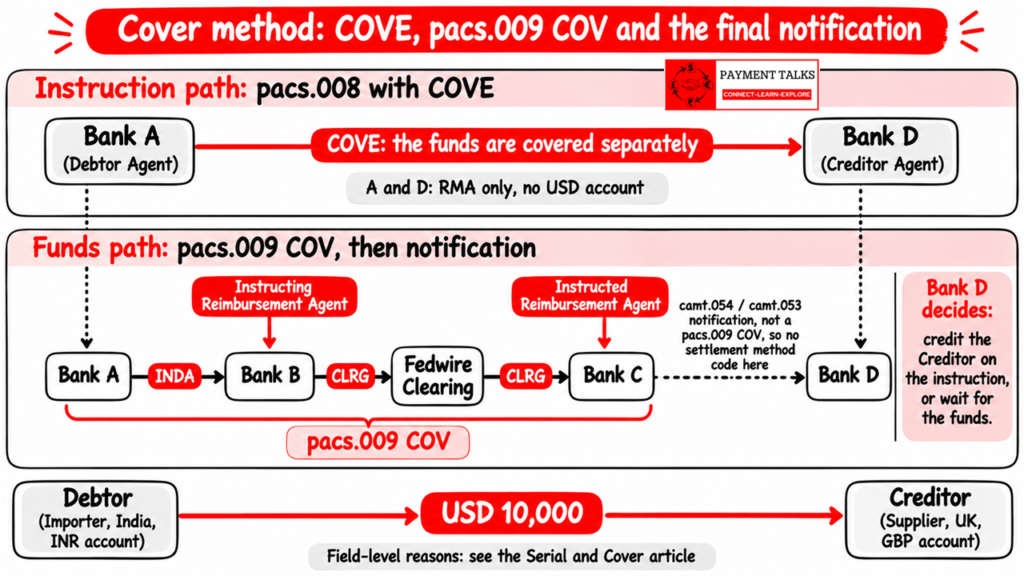
So Bank A sends the pacs.008 directly to Bank D. The message cannot support the funds movement, so it uses the code COVE. Bank A is saying: I am sending you this payment, but the underlying funds are covered separately.
What does separately mean?
Separately means through the reimbursement agents. In our example, Bank B is the Instructing Reimbursement Agent and Bank C is the Instructed Reimbursement Agent. A third reimbursement agent exists when the funds pass through one more bank.
These agents only appear when the code is COVE. If there are intermediaries in a serial payment, they sit in the Intermediary Agents, whatever the settlement method code. In the cover method, the banks in the funds path are the reimbursement agents. We cover these finer points field by field in the Serial and Cover article.
The funds travel in a pacs.009 COV, not a pacs.008. It moves serially from Bank A to Bank D through Bank B and Bank C. Since this is the same serial movement as before, the settlement method codes are the same: INDA from Bank A to Bank B, CLRG across Fedwire, and from Bank C to Bank D, in this current scenario is not a pacs.009 COV message. It is camt.054/053 message. Why? We see this in Serial and Cover Article. The accounting is the same as Steps 2 to 4. Only the message changes.
Two points, kept short. First, the instruction reaches Bank D before the funds do. Whether Bank D credits the Creditor on the instruction or waits for the funds is Bank D’s risk appetite and customer relationship. Second, the pacs.009 COV carries the underlying customer details, so Bank B and Bank C can screen the payment even though they never see the pacs.008.
The last hop of the cover flow, from Bank C to Bank D, works as a notification. The deep dive on how this runs field by field is the next topic.
[VISUAL 4: Cover method: pacs.008 direct from Bank A to Bank D with COVE, and pacs.009 COV travelling A to B to Fedwire to C to D]
COVE sends the instruction directly and the funds separately. The funds leg carries the same INDA, CLRG and INGA codes as the serial flow.
Which other messages carry settlement method codes?
The settlement method code is not a pacs.008 only field. Settlement method codes show up across the pacs family. The Settlement Information section appears in other messages too. This is a callout, not a deep dive. The flows live in The Complete ISO 20022 Payment Lifecycle.
- pacs.009: a bank to bank transfer, used when the paying party is itself a bank.
- pacs.009 COV: the funding leg of the cover method, as you just saw.
- pacs.009 ADV: pre-advises the Creditor Agent of an incoming payment.
- pacs.004: the payment return.
Why does a pacs.004 flip the code?
A pacs.004 is the reverse flow of the payment. Everything reverses, and that is why the settlement method code reverses too. On the correspondent route, INDA becomes INGA and INGA becomes INDA. When the return goes through the clearing, CLRG stays CLRG.
Take Bank D returning the funds to Bank C. Bank D is now the Instructing Agent, and its account sits with Bank C, the Instructed Agent. Bank C debits Bank D’s account, so the code is INDA. On the original payment this same hop was INGA. The account did not change. The roles did.
Likewise, Bank B returning to Bank A: Bank B is the Instructing Agent and credits Bank A’s vostro on its own books, so the code is INGA. The pacs.004 article covers this in depth.
What are the most common mistakes in correspondent banking settlement?
- Reading INDA and INGA as payment direction. They are about where the account is held, not who started the payment.
- Assuming message movement equals funds movement. The pacs.008 moves serially. The funds move at the receiving bank, the clearing and the sending bank.
- Mixing up reimbursement agents and intermediary agents, in both directions. Intermediary banks of a serial payment do not belong in the reimbursement agents. And the reimbursement agents of a COVE payment do not belong in the Intermediary Agents.
- Reading CLRG as one specific rail. CLRG covers Instant, RTGS and DNS. The Clearing System identifier tells you which one.
- Assuming the sender picks the settlement method code by preference. The code follows the accounting relationship in the payment currency, or the shared clearing system.
- Treating a mirror nostro posting as funds movement. It is notional. A reverse posting undoes it. Only real account postings need a return.
How do INDA, INGA, CLRG and COVE compare side by side?
| Aspect | INDA | INGA | CLRG | COVE |
| Reads as | Instructed | Instructing | Clearing | Separately |
| Who settles | Instructed Agent | Instructing Agent | The clearing system | Reimbursement agents, via the cover message |
| Funds move on | Receiving bank’s books | Sending bank’s books | Clearing system accounts | A separate pacs.009 COV chain |
| Basis | Sender’s account held at the receiver | Receiver’s account held at the sender | Both banks on the same clearing system | No accounting relationship between the two end banks |
| Order | Message, then funds | Funds, then message | Through the clearing | Message direct, funds separate |
| Reimbursement agents | Not used | Not used | Not used | Used |
| On a pacs.004 | Becomes INGA | Becomes INDA | Stays CLRG | Not Applicable |
Correspondent banking settlement FAQ
Q: How does settlement work in correspondent banking?
A: In correspondent banking, the payment message moves hop by hop between banks, but the funds settle separately. They settle on the nostro and vostro accounts of the two banks, in a shared clearing system, or through a separate cover payment. The settlement method code on each hop, INDA, INGA, CLRG or COVE, tells the receiving bank which one applies.
Q: What do the settlement method codes INDA, INGA, CLRG and COVE mean?
A: Settlement method codes are the four ISO 20022 values of the Settlement Method element. INDA means the Instructed Agent settles. INGA means the Instructing Agent settles. CLRG means a clearing system settles. COVE means the funds are covered separately by another message. In practice, each one tells the receiving bank where and how the funds will move.
Q: What is the difference between INDA and INGA?
A: Both are about the accounting relationship between two banks in the payment currency. With INDA, the sender’s account is held at the receiving bank, so the receiver settles and the message moves before the funds. With INGA, the receiver’s account is held at the sending bank, so the sender settles and the funds move before the message.
Q: Is INDA or INGA decided by the payment direction?
A: No. A settlement method code is decided by which bank holds the account in the payment currency. There is no netting concept and no direction logic in these settlement method codes. The code is written from the sender’s side of each hop, which is why it flips on a pacs.004 return.
Q: Where is the settlement method code in a pacs.008?
A: The settlement method code is the Settlement Method element inside the Settlement Information section of the Group Header. Because the Group Header changes at every hop, the code is a point to point value and can differ from hop to hop on the same payment.
Q: When is the CLRG settlement method used?
A: CLRG is used when the two banks settle through a shared clearing system. A Clearing System identifier is mentioned because domestic clearing can run on several rails such as Instant, RTGS or DNS, and the identifier says which one. The code stays CLRG whichever rail is used.
Q: When are reimbursement agents used in the Settlement Information section?
A: Only when the code is COVE. They are the banks through which the covering funds travel. For INDA, INGA and CLRG they are not used, and any intermediary banks go in the Intermediary Agents instead.
Q: Why does the same payment carry different settlement method codes at each hop?
A: Each hop is a different pair of banks with a different settlement relationship, so each hop has its own settlement method code. Bank A and Bank B settle on Bank B’s books, Bank B and Bank C settle through the clearing, and Bank C and Bank D settle on Bank C’s books. So the same payment can carry INDA, CLRG and INGA in three consecutive messages. That is normal in correspondent banking settlement.
Q: What happens to the settlement method code on a pacs.004 return?
A: A pacs.004 is the reverse flow of the payment, so everything reverses, including the settlement method code. On the correspondent route INDA becomes INGA and INGA becomes INDA. If the return goes through the clearing, CLRG stays CLRG.
Watch the full walkthrough on YouTube
[VIDEO EMBED PLACEHOLDER: URL:]
Prefer video? Full walkthrough on the PaymentTalks YouTube channel. Link above.
What is the one thing to remember about correspondent banking settlement?
In correspondent banking settlement, the message is communication. The funds move on someone’s books. A settlement method code tells you whose books, or which clearing system, or that the funds travel separately.
Among the settlement method codes, INDA and INGA are purely the accounting relationship in the payment currency. CLRG is the shared clearing system, whatever the rail. COVE means the funds go another way, through the reimbursement agents.
Your next action: take any pacs.008 from your system, read the Settlement Method, and then find the bank that services the account in the payment currency. If the two do not match your reading, you have found the gap this article is about.
Next topic to watch out for: the Serial and Cover methods field by field, and the pacs.004 return flow in depth.