
Payment routing is the one decision that shapes everything else that happens to a payment. Long before a message gets built, before any correspondent gets billed, before a beneficiary sees money land in their account, some bank in the chain has already worked out exactly which path this payment is going to take.
Here is the strange part. Almost nobody questions how that payment routing decision actually gets made. A payment routing engine gets configured once, right at the start of a payment platform’s life, and after that every single payment just flows through it. People take it for granted, because it works, until the day it does not.
Strip away every rule and every exception in this article, and one idea sits underneath all of it: payment routing decides the payment chain. That is the exact sequence of banks a payment instruction passes through, from the Debtor Agent to the Creditor Agent. Every check in payment routing exists to answer one question: who belongs in that chain, and who does not.
By the end of this article, you will know what a bank checks during payment routing, in what order, and how it builds that entire chain from nothing more than three inputs: the beneficiary details, the Creditor Agent details, especially its location, and the payment currency.
A quick note on scope. This article covers traditional rails only. Alternative rails such as crypto, stablecoins and direct API connections are out of scope, and so is dynamic or intelligent routing, which makes the core concept of payment routing even more complex. Those deserve their own pieces. Here, the focus is how the payment chain, the payment path, gets created.
What Is Payment Routing, and How Is It Different From Clearing and Settlement?
Payment routing is the process a bank uses to determine the payment chain, the exact path a payment instruction takes from the Debtor Agent to the Creditor Agent, across whatever intermediary banks are needed to get there. It answers one question only: who needs to be involved to get this payment from sender to receiver.
Why does the chain connect the Debtor Agent and the Creditor Agent, and nobody else? Because the funds from the payer, the Debtor, have to reach the payee, the Creditor. That sounds obvious. But knowing these small nuances makes everything that follows much easier to learn.
Payment routing is a different question from clearing and settlement, and BAs mix these three up constantly. Clearing is the exchange of instructions between banks that participate in the same clearing arrangement. Settlement is the actual movement of funds that makes the payment final.
Do not think of clearing and settlement as purely domestic ideas. They apply just as much inside a correspondent banking chain, the mechanics just change. Settlement between two correspondents typically happens through debits and credits on their own Nostro and Vostro accounts, rather than central bank money. Clearing between them can mean a shared clearing system in the payment currency’s home market, like in domestic payments, or a simple bilateral account entry in the Nostro or Vostro accounts, like in correspondent banking.
The full breakdown of how these concepts fit together sits in From Payment Instruction to Finality: Understanding Clearing and Settlement. For now, keep one rule in mind: payment routing decides the path first, regardless of which flavor of clearing and settlement eventually applies to each leg of that path.
What Does the Customer Actually Tell the Bank?
Here is something most BAs never think about. The customer initiating a payment never specifies a route. They give the bank exactly two things.
- Who the beneficiary is, and which bank the beneficiary holds the account with, the Creditor Agent. They provide these details using bank identifiers such as a BIC or bank codes. From those identifiers, the Debtor Agent bank knows where the Creditor Agent is located.
- The payment currency, the exact funds currency that needs to be sent.
That is it. Everything else in payment routing, whether the payment goes through local clearing or a chain of correspondents, how many banks touch it, which specific banks those are, gets derived by the bank itself.
Where Does the Payment Chain Show Up in the Payment Message?
Once the path is fully worked out, it shows up in the payment message the bank actually sends. Every bank added to the chain becomes an Intermediary Agent field, sitting alongside the Debtor Agent and Creditor Agent fields explained in Detailed Explanation of ALL Agents and Parties Involved in an ISO Payment Message. Whether the message ends up being a pacs.008 for a serial transfer or a pacs.009 COV for the cover method, the message format is just the container.
Payment routing happens first. The message reflects the decision, it does not drive it.
Here is an example. Once payment routing has built the chain, it is the bank’s own decision whether to send the payment as Cover or not. Based on certain parameters and the bank’s policy, a bank can choose Cover for some payments, or it can default every payment to Serial. The pros and cons deserve their own piece. The point to hold on to here is simple: the payment message a bank sends is a reflection of the payment routing decision.
What Is a Book Transfer, and When Does a Payment Never Leave the Bank?
Before any of the payment routing logic in this article even applies, a bank checks one thing first: is the Creditor Agent actually a different bank at all?
If the Creditor Agent’s BIC is the same as the Debtor Agent’s, or it belongs to a different branch within the same banking group in the same financial jurisdiction, and the payment is in the Debtor Agent’s own local currency, the payment never leaves the bank. This is a book transfer. The bank simply debits the sender’s account and credits the beneficiary’s account on its own books. No clearing system, no correspondent, no chain, because there is nothing for payment routing to decide.
Notice that “same bank” includes the financial geography. HSBC UK and HSBC USA are two different banks in two different geographies. HSBC UK in London and HSBC UK in Manchester are the same bank, under the same financial jurisdiction, and a GBP payment between them is in the local currency. Only the second pair qualifies as a book transfer.
This is worth checking first, before the currency and country evaluation covered next, because it changes the entire shape of the decision. A book transfer is not a routing outcome with zero intermediaries the way a Direct correspondent relationship is. It is not payment routing at all. The payment simply never crosses a bank boundary.
Is There an Exception When the Payment Is in a Foreign Currency?
There is one. The Creditor belongs to the same bank as the sender, but the payment currency is a foreign currency.
Banks do not offer this to generic customers, and these accounts carry many restrictions. Depending on regulations, they may not be able to transact at all, or they transact with limits and other restrictions. This usually happens with special customers, such as businesses in GIFT City in India, or non-resident customers.
Such payments are usually settled inside the bank, just like a book transfer. It also depends on the bank.
What Two Factors Decide Every Payment Routing Path?
Once a payment has been confirmed as not a book transfer, every payment routing decision starts with the same two checks, run against the payment itself: what currency is this payment in, and where is the Creditor Agent located.
The bank compares the payment currency against its own local currency, also called the functional currency. It also compares the Creditor Agent’s country or financial jurisdiction, identified through its BIC or local clearing code, against its own.
Those two checks produce three, and only three, possible outcomes.
| Payment Currency | Creditor Agent Location | Route Evaluated |
| Same as Debtor Agent’s local currency | Same country or jurisdiction as Debtor Agent | Local Clearing |
| Same as Debtor Agent’s local currency | Different country | Correspondent |
| Foreign currency (different from Debtor Agent’s local currency) | Same or different country, does not matter | Correspondent, always |
Foreign currency always forces correspondent evaluation, regardless of where the Creditor Agent sits.
Why Does Currency Decide the Payment Route Before Country?
Here is the detail that trips people up. An Indian bank sending USD to another Indian bank still goes through correspondent evaluation, even though both banks are in the same country. Why? Because USD is not that bank’s local currency.
To be more precise, USD is not a currency that can be settled through the central bank of that country, in this case the RBI. Only INR can be settled in India. Any currency other than INR in India always takes the correspondent route.
The same rule applies anywhere in the world. Only the currency supported by the central bank, or the authority of that financial jurisdiction, can be settled via local clearing. Everything else takes the correspondent route. Country alone never decides payment routing. Currency decides it first.
Does Correspondent Payment Routing Always Mean a Cross Border Payment?
No. Correspondent payment routing does not mean cross border. It simply means the payment moves between banks without a central regulatory authority settling it between them.
For example, in India, a USD payment can pass from one bank to another if they hold a USD correspondent relationship with each other, or if they share a common USD correspondent. To be clear, we are talking about payment routing, the message exchange, and that is possible. Settlement of that USD, including funding and defunding of the USD, can only happen in the currency’s home country, the USA.
How Does Local Clearing Routing Work?
Local clearing payment routing applies when the payment currency matches the Debtor Agent’s own local currency, and the Creditor Agent sits in the same country or financial jurisdiction. The bank then checks a Clearing Identification File. Central banks publish this file, under different names depending on the market. It lists every bank connected to that country’s domestic clearing system, whether directly or indirectly through another bank.
If the Creditor Agent shows up in that file, the payment routes via local clearing. Cutoff times apply here. Miss the cutoff, and the value date simply rolls to the next working day.
If the Creditor Agent does not show up in that file, the payment gets rejected outright. There is no correspondent fallback in this branch. We are already in local currency, same country territory, and direct bilateral relationships are genuinely rare for domestic payments. Unless a rare bilateral agreement exists between two banks for some specific reason, this is a straight reject in normal cases.
The payment chain in local clearing payment routing is the simplest one you will ever see: the Debtor Agent and the Creditor Agent exchange the payment through the local clearing scheme, with nobody in the middle.
How Does Correspondent Routing Work When a Direct Relationship Exists?
The moment the payment currency is foreign, or the Creditor Agent sits outside the Debtor Agent’s own country, local clearing gets skipped entirely. The bank moves straight into correspondent evaluation, a broader concept covered in Understanding Correspondent Banking: A Comprehensive Guide. This is where the real complexity of payment routing lives, and correspondent chain payments are exchanged over the SWIFT messaging network.
If you have mostly worked on domestic schemes like SEPA or Fedwire, you may never have met correspondent evaluation in payment routing. It is more complex, and most people ignore it. It is the part that those aiming at solution architect roles need to understand in depth.
The first check inside correspondent evaluation is simple: does the Debtor Agent already hold a direct account relationship with the Creditor Agent, in the payment currency, a mutual Nostro or Vostro?
“In the payment currency” is the part that matters. The same two banks can hold a relationship in one currency and have nothing at all in another currency. The relationship only counts if it exists in the currency this specific payment is moving in.
If it exists, the payment routes direct. This is genuinely rare outside large correspondent banks or high volume bilateral corridors. It is also worth reframing how you think about it. Direct is not a separate category of payment routing. It is simply the shortest possible correspondent chain, a chain with a length of one, where that one bank happens to be the Creditor Agent itself.
One note on terms. From here on, when this article says Correspondent, it means the Currency Correspondent in the payment currency.
What Happens When There Is No Direct Relationship? Two Ways Banks Build the Chain
No direct relationship in the payment currency means an intermediary has to be added, and this is exactly where banks differ in payment routing sophistication.
Some banks take the simplified route. They identify their own correspondent for the payment currency and hand the payment straight to them, trusting that correspondent to figure out the rest of the path to the Creditor Agent. If the payment is in GBP, they find their GBP correspondent and send it there, full stop.
This works. It is also incomplete payment routing. You are outsourcing the routing decision to your currency correspondent instead of making it yourself, and that correspondent is going to charge you for the privilege. It is slower and more expensive than it needs to be, but plenty of banks still run this way, because building the intelligence to do the full job is genuinely hard.
I saw this pattern directly while architecting the payment routing logic for a CBPR plus implementation on Volpay. Domestic payment routing, using the Clearing Identification File, is comparatively straightforward to build. Almost every payment engine gets that part right. Correspondent payment routing for cross border payments is where the real complexity lives, and it is exactly why most implementations lean on the simplified handoff instead of investing in full chain resolution. The banks that do invest in it get faster, cheaper, more predictable cross border payments as a direct result.
The other approach is to build the complete chain yourself. That is where the rest of this article goes, and before we get there, you need a few concepts in place.
What Is an SSI File, and How Does It Drive Payment Routing?
SSI stands for Standing Settlement Instructions, and it is the reference data that makes full chain payment routing possible. An SSI is a pre-agreed record of a party’s currency, product, correspondent and beneficiary bank chain, account details and validity. An SSI file is the stored set of these records.
Banks use it to automate payment routing to the right agents and accounts, without re-sending settlement details every time. That reduces errors, manual repair and fraud risk.
Two sources publish essentially the same kind of information. SWIFT publishes it through its SWIFTRef package, and LexisNexis publishes an equivalent through the Bankers Almanac. You only need one, not both, since they cover the same ground. SWIFT’s own SwiftRef Standing Settlement Instructions Directory describes exactly this kind of structured SSI data, built to validate the correct correspondent, account, and clearing path before a payment is released.
Worth knowing upfront: neither of these is a free public resource. Both SWIFTRef and the Bankers Almanac are paid, commercial subscription services, and that cost matters more than it might seem, as the closing sections of this article get into.
Some banks also maintain their own internal reference data, which works like an SSI file. They build it up over the years from experience, and many cache the resolved chain for high volume corridors instead of running a live SSI lookup on every single payment. That is efficient, but it has one real weakness: relevance. If a correspondent changes anything, the bank usually learns post facto, only after the current payment fails. That risk becomes important later in this article.
What Does an SSI Record Contain, and How Does Payment Routing Pick the Correspondent?
A typical SSI record carries these fields. The exact set varies by source and by bank, so treat this as the concept, not a specification.
| Field | What It Tells the Routing Engine |
| Party | Name, BIC or LEI, and counterparty ID of the bank the record belongs to |
| Currency | The currency the instruction applies to |
| Product scope | Which type of payment or flow the record covers |
| Correspondent or intermediary bank | The bank that handles this currency for the party |
| Beneficiary’s account-holding bank | The bank and account number or IBAN the funds finally reach |
| Clearing codes | Identifiers such as ABA, CHIPS UID or IFSC |
| Effective and expiry dates | When the instruction is valid |
| Approval status | Whether the record is approved for use |
The content in an SSI file comes from the banks themselves. A single bank can list several correspondents for the same currency, split by business domain. One correspondent might handle ordinary commercial payments, and a different one handles FX or trade related flows. Where no domain is specified, the file carries a default correspondent. Where several eligible correspondents exist, the file ranks them by priority, based on which one the bank prefers to receive through.
Here is a simplified, illustrative record, so the concept is easier to picture. The values are placeholders, not real banks.
| Field | Illustrative Value |
| Party | Example Bank A (its BIC and LEI) |
| Currency | GBP |
| Product scope | Commercial payments |
| Correspondent | Example Correspondent Bank, UK |
| Priority | 1, default for this currency |
| Clearing code | The correspondent’s GBP clearing identifier |
| Valid from, valid to | Effective and expiry dates |
| Approval status | Approved |
What Is a Local Correspondent, and How Is It Different From a Correspondent?
Not every bank holds a Nostro or Vostro relationship with a foreign bank in every currency it needs to support. When a bank has no such relationship, it arranges with another bank, one in its own country or jurisdiction, to process that currency on its behalf. That arranging bank is called a Local Correspondent.
The distinction that matters here is connectivity to clearing, not geography for its own sake.
| Term | What It Means |
| Correspondent | Directly connected to that currency’s clearing system. |
| Local Correspondent | Not directly connected to that clearing. Reaches it indirectly through a Correspondent, usually because it sits in the same country as the bank that needs it. |
SSI data captures this distinction explicitly, and payment routing relies on it. Correspondent Bank vs Intermediary Bank: Same Bank, Two Different Lenses goes deeper into how this terminology maps out, and Nostro, Mirror Nostro, Vostro, and Loro Accounts covers how the underlying account relationships work.
This works the same way in reverse. A Creditor Agent can just as easily have its own Local Correspondent on the receiving side.
How Does a Bank Build the Complete Payment Chain?
This is the recursive part, and it is where full payment routing actually earns its keep. The bank works backwards from the Beneficiary Bank, because that is the bank the payment ultimately has to reach.
Step 1: Who Delivers the Payment to the Creditor Agent?
The Debtor Agent takes the Creditor Agent’s BIC, since BIC is the universal identifier that every reference file is built around, and looks it up in the SSI data. That lookup returns the Creditor Agent’s currency correspondent for the payment currency, applying whatever domain, default, and priority logic the SSI entry carries.
That bank is the Receiver Correspondent. It is the bank that will eventually deliver the payment onward to the Creditor Agent, which you will also hear called the receiver bank or the beneficiary bank.
Step 2: Does the Debtor Agent Already Share That Correspondent?
Now comes the check that saves the most cost and time in the entire payment routing process. It is also the most complex part, so take it slowly. Is this Receiver Correspondent also the Debtor Agent’s own correspondent for that currency?
If both banks already share the same correspondent, that one bank does double duty. Payment chain terminology is always spoken from the sender’s side, the same reason terms like INDA and INGA describe payment settlement methods from the sending bank’s perspective. So this shared bank simply gets called the Sender Correspondent.
The Debtor Agent can send funds to this common correspondent, and the common correspondent can send funds to the Creditor Agent. The chain collapses immediately: Debtor Agent, to the Sender Correspondent, to the Creditor Agent. A single intermediary.
This is not a rare edge case. It is one of the most common and most efficient outcomes of the entire algorithm, and it deserves just as much attention as the longer chains.
Step 3: What If the Two Banks Do Not Share a Correspondent?
Then the Debtor Agent has to reach the Receiver Correspondent. This time, the Receiver Correspondent becomes the new bank to be reached, and the Debtor Agent does that by running the exact same evaluation again: check for a direct relationship first, then fall back to a correspondent lookup in the SSI data, recursively, for however many hops it takes.
Since the Receiver Correspondent is, by definition, already connected to the payment currency’s clearing, the Debtor Agent’s own remaining job simplifies to finding its own correspondent in that currency, its Sender Correspondent. The Sender Correspondent and the Receiver Correspondent are both connected to that currency’s local clearing, by definition. So they can exchange funds through it. Once that piece is in place, the chain closes across that currency’s own clearing system.
Now check how the funds actually move:
- The Debtor Agent sends funds to its Sender Correspondent, through the Nostro and Vostro setup.
- The Sender Correspondent sends funds to the Receiver Correspondent, through the currency clearing.
- The Receiver Correspondent sends funds to the Creditor Agent, through its own Nostro and Vostro setup.
This is the chain most commonly drawn on whiteboards.
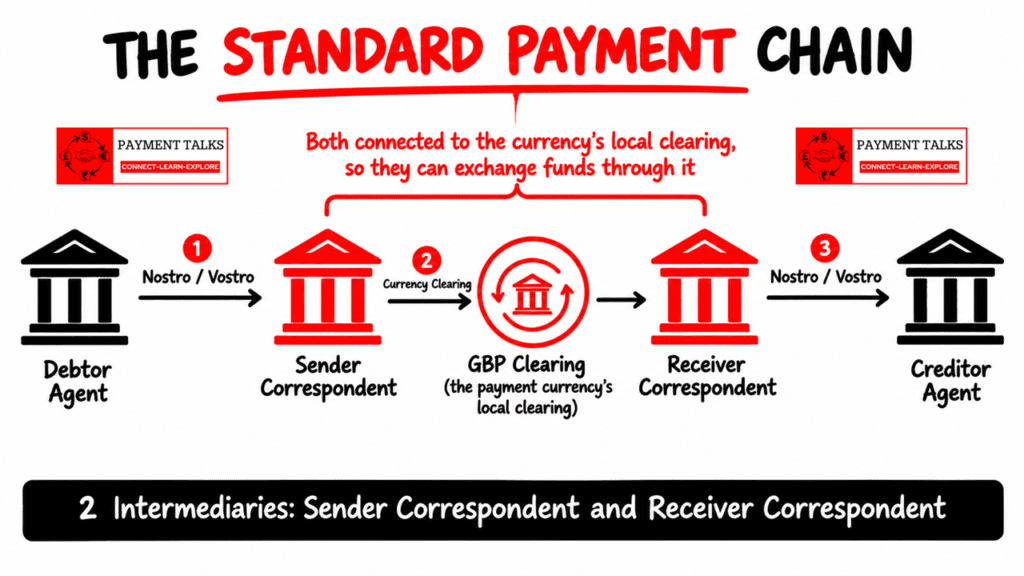
[VISUAL 1: The Standard Payment Chain, Closing Across Currency Clearing]
Caption: Sender Correspondent and Receiver Correspondent both touch the currency’s clearing, which is why the chain closes there.
I walk through this exact recursive resolution on a whiteboard in the video version of this piece. It is genuinely easier to follow when you can watch the chain get built hop by hop instead of reading it in prose.
What Are the Variations of the Payment Chain?
In the practical world, the scenario is rarely this simple and textbook. Payment routing produces several variations of the chain, and you need to recognize all of them.
- A shared correspondent. The Debtor Agent and the Creditor Agent use the same correspondent, as in Step 2. One intermediary.
- A Local Correspondent turns up during resolution. If any step returns a Local Correspondent instead of a Correspondent, that bank is not directly connected to clearing either. Adding it to the chain does not finish the job. Whichever bank is doing the resolving still needs to find that Local Correspondent’s own Correspondent, the bank that actually touches clearing, before the chain can close. Say the Creditor Agent is connected through a Local Correspondent. That Local Correspondent has its own correspondent connected to clearing, and the chain gains one hop on the receiving side. The same Local Correspondent link can also appear on the sender side, which the worked example below shows.
- The Creditor Agent is itself connected to the local clearing of that currency. There is no need for a Receiver Correspondent.
- The Debtor Agent is itself connected to the local clearing of that currency. There is no need for a Sender Correspondent.
To get this clear in your head, think about real examples where each of these scenarios can happen. That exercise teaches more than any definition.
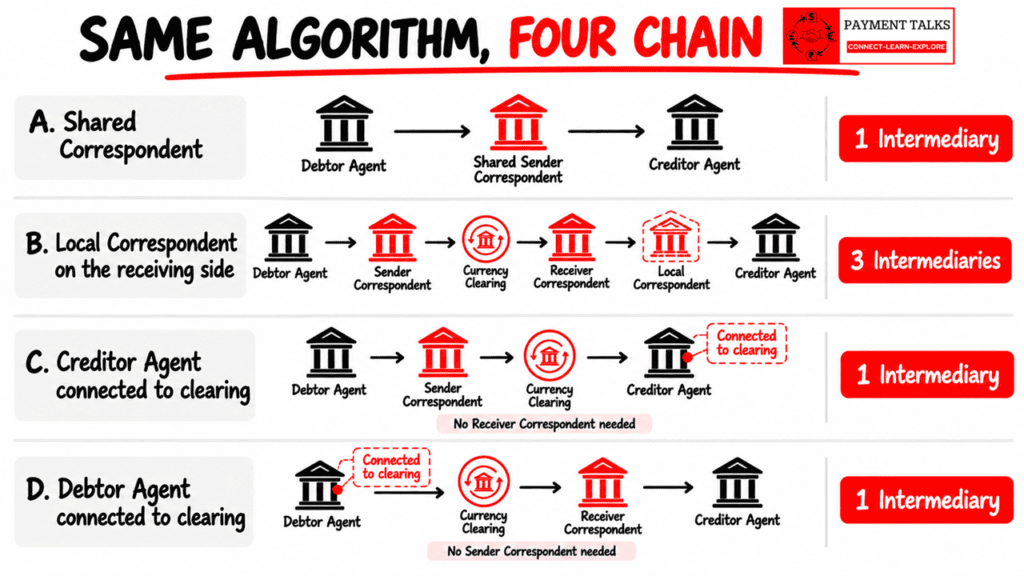
[VISUAL 2: The Four Variations of the Payment Chain]
Caption: Same algorithm, four different chain shapes, depending on who is connected to clearing and who shares a correspondent.
Why Does the Payment Chain Keep Changing Shape? The Minimum Chain Principle
One principle governs the entire payment routing process: keep the chain as short as possible. Every agent added increases cost, adds delay, and adds an entirely separate layer of AML, KYC, and country level compliance checks, since each bank in the chain runs its own screening independently.
A shorter chain is not just cheaper. It is also lower risk. This is the principle that creates the variations you just saw.
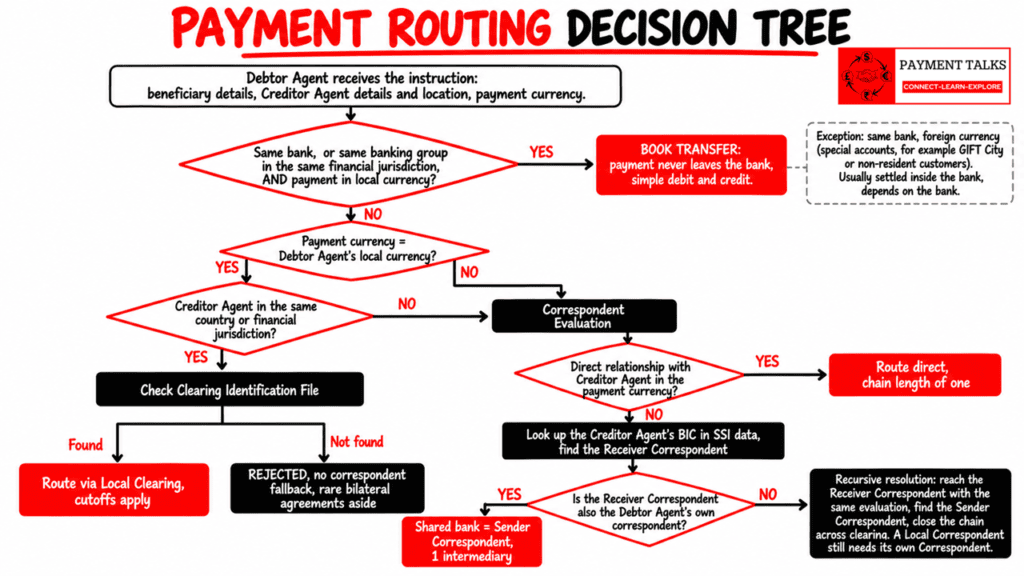
[VISUAL 3: Payment Routing Decision Tree]
Caption: The full payment routing logic on one page, from the book transfer check to the shared Sender Correspondent check.
A Worked Example: Sending GBP From a Small Bank in India
Let us make all of this payment routing logic concrete with one example. Take a small bank in India. A customer wants to send a payment in GBP, but this bank holds no Nostro, Vostro, or correspondent relationship with any GBP bank in the UK.
This small bank has an agreement with a large bank, also based in India, that any GBP payments from its customers will be handled by that large bank. So the large bank is the GBP currency correspondent of the small bank. But the large bank sits in India, and it is not connected to the GBP clearing. That makes it an indirect GBP correspondent, or simply the Local Correspondent of the small bank.
Here is the detail that is easy to miss. The Local Correspondent itself is not directly connected to GBP clearing either, that is exactly what makes it a Local Correspondent rather than a Correspondent. So the big Indian bank has to use its own GBP correspondent, a UK bank connected to GBP clearing, to actually move the payment forward.
Call this the Sender Correspondent, because the payment enters the UK through this bank for the first time. If that is confusing, simply remember it as the GBP correspondent in the UK for the big Indian bank. In the full payment chain it is just another Intermediary bank.
Now suppose the Creditor Agent in the UK uses a completely different GBP correspondent. The SSI lookup for the Creditor Agent returns that separate bank, another UK bank connected to GBP clearing, the Receiver Correspondent. The Sender Correspondent and the Receiver Correspondent reach each other across the UK’s GBP clearing system.
A quick tip on the Receiver Correspondent. It comes into the picture whenever the Creditor Agent is not itself connected to the GBP clearing. That is always the case when GBP goes from India to a bank outside the UK, because that bank needs a GBP correspondent to receive the GBP funds. It can also be the case for a UK bank. When the Creditor Agent is in the UK and connected to GBP clearing itself, as in variation three above, there is no need for a Receiver Correspondent.
The funds movement now looks like this: small Indian bank, to its Local Correspondent in India, to the Local Correspondent’s own GBP Sender Correspondent in the UK, across GBP clearing to the Receiver Correspondent in the UK, to the Creditor Agent. Three intermediaries.
Now change one fact. Suppose the big Indian bank’s own GBP correspondent turns out to be the exact same UK bank the Creditor Agent uses. That single UK bank is now serving both sides at once, and by the sender-side naming convention explained earlier, it simply gets called the Sender Correspondent of the big Indian bank, or the GBP shared correspondent. In the full payment scope it is just an Intermediary bank.
The chain collapses: small Indian bank, to its Local Correspondent, to that shared Sender Correspondent, to the Creditor Agent. Two intermediaries instead of three, purely because the algorithm checked for a shared correspondent before assuming it needed the longer path. Before any new bank gets added to a chain, there is always an effort to keep the chain simple and short.
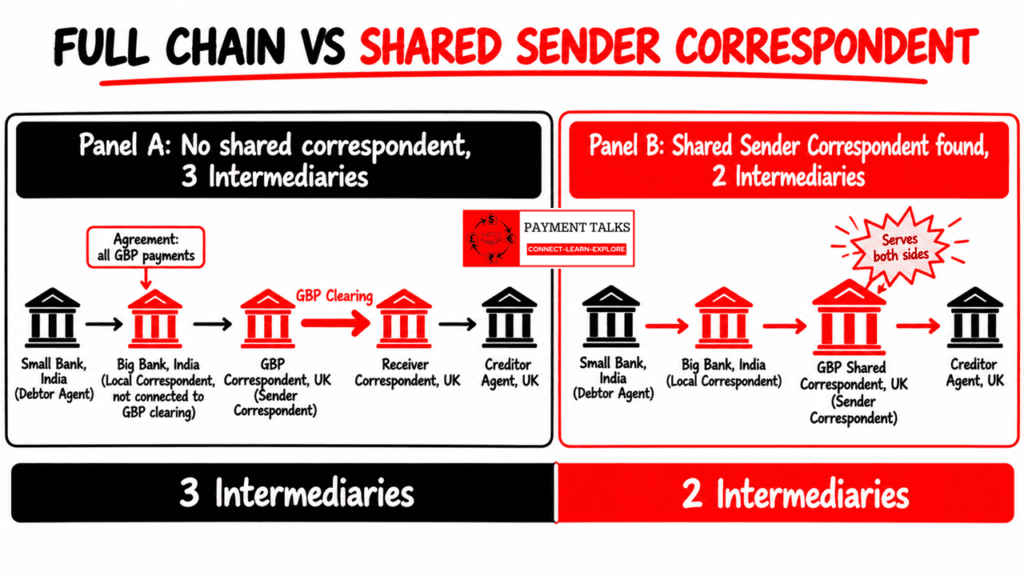
[VISUAL 4: The India GBP Worked Example]
Caption: Same payment, same two end banks. One shared correspondent turns three intermediaries into two.
That is the entire value of building payment routing properly instead of taking the simplified handoff. The same payment, the same two banks at either end, and the chain length still depends entirely on how carefully the resolution gets done in the middle.
Does Every Bank in the Chain Repeat This Same Payment Routing Logic?
Everything explained so far has been framed from the Debtor Agent’s side, because that is the clearest way to teach it, and because that is the first place where chain building happens. But payment routing is not a Debtor Agent exclusive capability. Any bank that receives a payment instruction and has to move it forward runs this same payment routing logic. The way it does so is different, though.
How Does a Receiving Bank Evaluate the Payment Chain?
A receiving bank that processes the payment evaluates the chain by reading the payment message. That message reflects the chain as it was built up to the point where it reaches this bank.
And here, the processing bank is mainly concerned with one thing: the next bank in the chain.
What Happens If the Receiving Bank Cannot Pay the Next Bank?
The question is simple. Can the processing bank transfer funds to the next bank in the chain?
| Can It Pay the Next Bank? | What the Processing Bank Does |
| Yes | Builds no new chain. It simply follows the payment instruction. |
| No, by default | Rejects the payment and tries to return the funds if needed. |
| No, with a bilateral agreement in place | Reconstructs the chain by adding more intermediaries. |
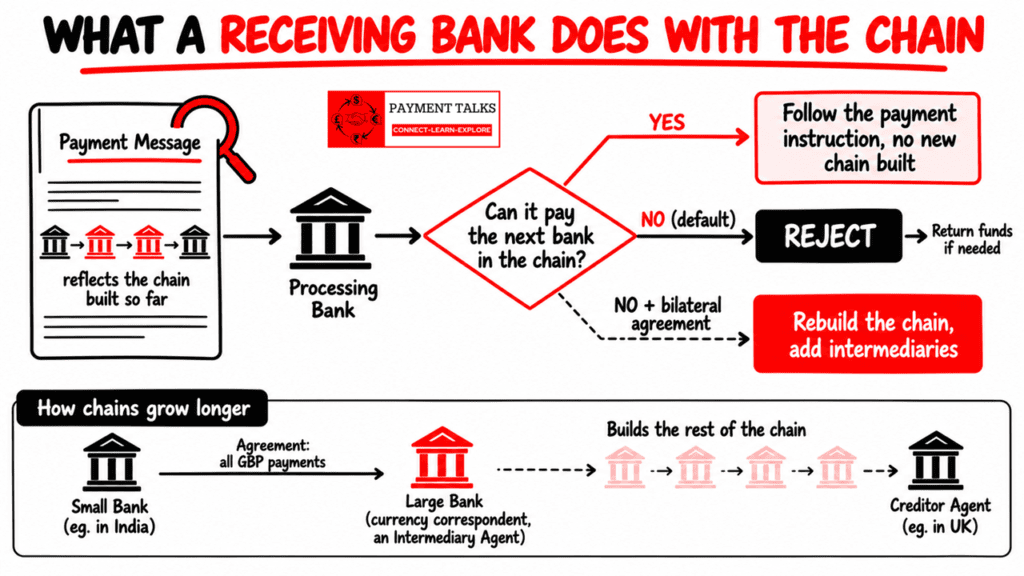
[VISUAL 5: What a Receiving Bank Does With the Chain]
Caption: Follow the instruction, reject by default, or rebuild the chain when a bilateral agreement allows it.
How Do Payment Chains Grow Longer Than Anyone Expects?
Take a small bank handing a payment off to a large bank, its currency correspondent. That large bank is an Intermediary Agent in the chain. The large bank already has an agreement from the small bank that it will handle all of its GBP payments. So in this case, the large bank takes the onus of building the rest of the payment chain to reach the Creditor Agent.
This is exactly how chains grow longer than anyone expects.
How Do Multi-Hop Chains Affect Payment Charges?
Every correspondent in a chain is entitled to deduct its own handling charge, unless the charge bearer instruction, OUR, SHA, or BEN, says otherwise. The full breakdown sits in Understanding Charge Codes in SWIFT Payments: OUR/DEBT, BEN/CRED, and SHA/SHAR.
A three hop chain has three separate opportunities for deduction, which is exactly why beneficiaries sometimes receive less than the amount the sender actually sent.
Do Charges Change Payment Routing?
Here is the important part. Charges can influence the decision when the payment route is selected. But charges do not change the payment routing decision for a payment that is already in flight. They only shape which routes stay preferred going forward.
In practice, that means a bank that notices a particular correspondent chain consistently producing heavy deductions or beneficiary complaints can deprioritize that chain over time, either in the SSI priority ranking or in the bank’s own internal reference data. The payment already moving through the chain does not get re-routed because of it.
What Happens When Payment Routing Goes Wrong?
Now for the part nobody wants to talk about: what happens when all of this careful logic actually breaks. Two very different failure patterns show up here, and it matters which one you are dealing with.
Failure 1: The Clean Reject
The first is a clean reject. The payment is in local currency, the Creditor Agent sits in the same country, and the Clearing Identification File simply does not show a path. No fallback exists, so the payment gets rejected, as covered earlier.
Failure 2: Stale Reference Data
The second is messier, and it comes from stale reference data. The chain looked correct at the start, but an intermediary bank partway through can no longer follow the exact path that was assumed.
Here is how that happens. The SSI, or a bank’s internal reference table, has not been refreshed, and a correspondent relationship has changed somewhere in that chain since the last update. When the payment reaches the intermediary bank with a defined payment chain, that bank is unable to honor the exact path. The chain was built on stale or outdated data.
The usual outcome is a reject, or a return of the payment, unless very specific bilateral agreements exist between the exchanging banks. It is the same fork a receiving bank faces whenever it cannot pay the next bank in the chain.
This is also why chain length and risk are directly connected. More agents in the chain means more independent points where a stale relationship, a compliance hold, or a missing detail can break the flow. It is one more reason the minimum chain principle in payment routing is not just a cost optimization. It is a reliability one too.
And it is exactly why the two SSI sources matter as much as they do. Responsibility for keeping that data current sits with SWIFTRef and the Bankers Almanac, not with the bank consuming it. Both sources publish Daily and Monthly full files, along with separate incremental update files covering whatever has changed since the last refresh. The bank’s job is to actually consume those files on a proper cadence. An SSI subscription that is not being refreshed regularly carries the same risk as the stale internal data banks accumulate over the years: current on the day it was set up, and drifting further from reality every day after that.
Can SWIFT gpi Track the Actual Route a Payment Takes?
SWIFT gpi is a tracking layer, not a routing control layer, and that distinction matters. It gives visibility into whichever chain actually gets executed, using the payment’s UETR, as each gpi member bank along the route reports its own status.
It does not enforce or validate against the chain that was originally intended. When a payment routing chain has been built correctly, from fresh SSI or reference data, the banks in the middle are expected to follow it, and generally do. gpi simply reports that path as it happens.
The real limitation shows up when a bank in the actual chain is not a gpi member. That hop becomes a blind spot in the tracker until the payment resurfaces at the next gpi member bank further along. Combine that with the stale data scenario from the previous section, and you can see why getting the payment routing decision right at the start matters so much more than trying to track down problems after the fact.
Where Do Serial and Cover Fit In?
Once payment routing has fully resolved the chain, banks still choose how to actually move the payment along that chain: the Serial method, pacs.008, or the Cover method, pacs.009 COV. That choice usually comes down to the RMA relationship in place between the correspondents involved, along with the bank’s own parameters and policy. Some banks simply default every payment to Serial.
It is a genuinely deep topic on its own, and it deserves a dedicated piece rather than a rushed paragraph here.
How Does Payment Routing Play Out in a Real Payment Engine?
I saw a version of the stale data problem play out directly while working on payment routing for a CBPR plus rail. A corridor had its Receiver Correspondent resolved once and cached in the bank’s internal reference data, because that corridor ran high volume and a live SSI lookup on every payment was not worth the overhead. Sensible, on its own.
The problem showed up months later. The correspondent at the far end of that chain quietly changed its own downstream relationship, its own Local Correspondent for that currency shifted to a different bank. Nothing on our side changed. Our internal reference data still pointed to the same, now outdated, chain. Payments kept flowing through it, until the corridor started showing an uptick in delays and a few beneficiary complaints about payments taking longer than usual to land.
The fix was not complicated once we found it: rebuild the chain from a fresh SSI lookup rather than trusting the cached path, and put a refresh cadence around any internally cached corridor instead of treating it as permanent. But finding it took longer than it should have, precisely because nobody was looking at the payment routing logic itself. It had been configured once, it had worked for years, and it was the last place anyone thought to check.
That is the pattern across payment routing as a whole topic. Domestic payment routing is simple enough that almost every implementation gets it right. Correspondent payment routing for cross border payments is where the real engineering lives, and it is exactly the part that big banks invest heavily in and smaller banks often do not.
It is not only hard to build well. It is expensive to keep running. The SSI data this entire chain resolution depends on, SWIFTRef or the Bankers Almanac, is not free, as covered earlier. Both are paid, commercial subscriptions, and that cost sits on top of the engineering effort itself. Big banks can absorb it as a cost of doing business at scale. Smaller banks usually cannot justify it on their own, which is exactly why the simplified currency correspondent handoff described earlier in this article remains so common. It is not always a knowledge gap. Sometimes it is simply a budget one.
Common Mistakes New BAs Make With Payment Routing
- Assuming clearing or correspondent payment routing applies before checking whether it is a book transfer. If the Creditor Agent is the same bank, or a different branch of the same banking group in the same jurisdiction, and the currency is local, the payment never leaves the bank at all. No chain gets built, because none is needed.
- Assuming the payment routing engine “just knows” the path from a BIC alone. It does not. It is a live evaluation of currency, country, existing relationships, and reference data, and missing even one of those parameters is usually why a new BA gets confused about why a payment went to clearing instead of a correspondent, or the other way around.
- Treating the simplified currency correspondent handoff as the entire payment routing logic. It is one option among two, and it is the incomplete one. If you only ever learn that shortcut, full chain resolution reads like an entirely different topic instead of the same algorithm done properly.
- Using Correspondent and Local Correspondent interchangeably. The distinction is connectivity to clearing, not just geography, and mixing them up leads to incorrect assumptions about how many hops a chain actually needs.
- Assuming SWIFT correspondent payments carry cutoff times the same way clearing does. They do not. Correspondent messaging moves over SWIFT effectively around the clock. What actually causes delay is the receiving bank’s own business hours and processing calendar, especially on anything that does not go straight through automatically.
Frequently Asked Questions About Payment Routing
Q: What is payment routing in banking?
A: Payment routing is the process a bank uses to determine the path a payment takes from the Debtor Agent to the Creditor Agent, including any intermediary banks needed to get there. It is decided before the payment message is even built, and it is different from clearing, which is the exchange of instructions between banks in the same clearing arrangement, and settlement, which is the movement of funds that makes the payment final.
Q: What is a book transfer in payment routing?
A: A book transfer happens when the Creditor Agent is the same bank as the Debtor Agent, or a different branch of the same banking group in the same financial jurisdiction, and the payment is in the Debtor Agent’s own local currency. The payment never leaves the bank. It is simply a debit to the sender and a credit to the beneficiary on the bank’s own books.
Q: How does a bank decide between local clearing and a correspondent bank in payment routing?
A: It checks two things: whether the payment currency matches its own local currency, and whether the Creditor Agent sits in the same country. Only when both are true does local clearing get evaluated. Any foreign currency, or any Creditor Agent outside the country, goes to correspondent evaluation.
Q: Does correspondent payment routing always mean a cross border payment?
A: No. Correspondent payment routing means the payment moves between banks without a central regulatory authority settling it between them. An Indian bank sending USD to another Indian bank still takes the correspondent route, because only INR can be settled through the central bank in India.
Q: What is an SSI file in payment routing?
A: SSI stands for Standing Settlement Instructions. It is reference data, published through SWIFTRef or the Bankers Almanac, that records which currency correspondent a bank uses, along with account details and validity, so a payment routing engine can resolve the next hop in a payment chain.
Q: What is the difference between a correspondent bank and a local correspondent?
A: A correspondent is directly connected to a given currency’s clearing system. A local correspondent is not directly connected. It reaches that clearing indirectly, through a correspondent, usually because it sits in the same country as the bank that needs it.
Q: Does every bank in a payment chain run payment routing?
A: Yes, in its own way. A receiving bank reads the chain in the payment message and focuses on the next bank. If it can pay that bank, it simply follows the instruction. If it cannot, it rejects the payment by default, or rebuilds the chain by adding intermediaries when a bilateral agreement allows it.
Q: What happens when payment routing fails?
A: There are two patterns. A clean reject happens when a local currency payment to a bank in the same country finds no path in the Clearing Identification File. Stale reference data happens when an intermediary can no longer follow the chain that was built. The usual outcome is a reject or a return of the payment.
Watch the Full Walkthrough on YouTube
Prefer video? Full walkthrough on the PaymentTalks YouTube channel.
The One Thing to Remember About Payment Routing
Payment routing comes down to two questions, asked every single time: what currency is this payment in, and where does the Creditor Agent sit. Sometimes there is no chain to build at all, because the payment never leaves the bank as a book transfer.
The moment it does leave, those two questions decide whether a payment goes through local clearing or correspondent banking. If it is correspondent banking, the Debtor Agent either hands off to its currency correspondent and hopes for the best, or resolves the full chain itself using SSI data, checking every step for a shared correspondent before adding another hop. Every bank that receives the payment afterwards asks one smaller question: can I pay the next bank in the chain.
The next time you look at a payment sitting in a repair queue, or a beneficiary complaint about a shortfall, or a payment routing configuration screen in a payment engine, you will know exactly what question to ask: which of these checks did the payment routing logic actually run, and on what data.